School Travel Survey
Consultation has concluded. The results of the 2025 survey are available to read.
The City of Kingston, in partnership with community agencies and local school boards, are conducting this survey to better understand how students travel to and from school in Kingston. By taking part, you will also enter your school in a chance to win a free bike rack!
Your responses will provide valuable insights into travel patterns and help inform future active school travel initiatives, such as new policies, programs, and infrastructure improvements. This survey is intended to be conducted at regular intervals in the future to determine how travel patterns may be changing over time.
The City of Kingston, in partnership with community agencies and local school boards, are conducting this survey to better understand how students travel to and from school in Kingston. By taking part, you will also enter your school in a chance to win a free bike rack!
Your responses will provide valuable insights into travel patterns and help inform future active school travel initiatives, such as new policies, programs, and infrastructure improvements. This survey is intended to be conducted at regular intervals in the future to determine how travel patterns may be changing over time.
Consultation has concluded. The results of the 2025 survey are available to read.
-
School Travel Survey Results – Fall 2025
Summary
The School Travel Survey was delivered by the City of Kingston in partnership with community agencies and local school boards to better understand how students travel to and from school. The survey was hosted on Survey123 through the City’s Get Involved Kingston platform and remained open from September 22, 2025 to October 13, 2025. Responses were anonymous and were collected to inform future active school travel initiatives, including policies, programs and infrastructure improvements.
A total of 2,224 responses were received across participating schools. While the large sample size provides strong insight, potential response bias means that the results should be interpreted as indicative of community perspectives rather than as a representative sample of all families.
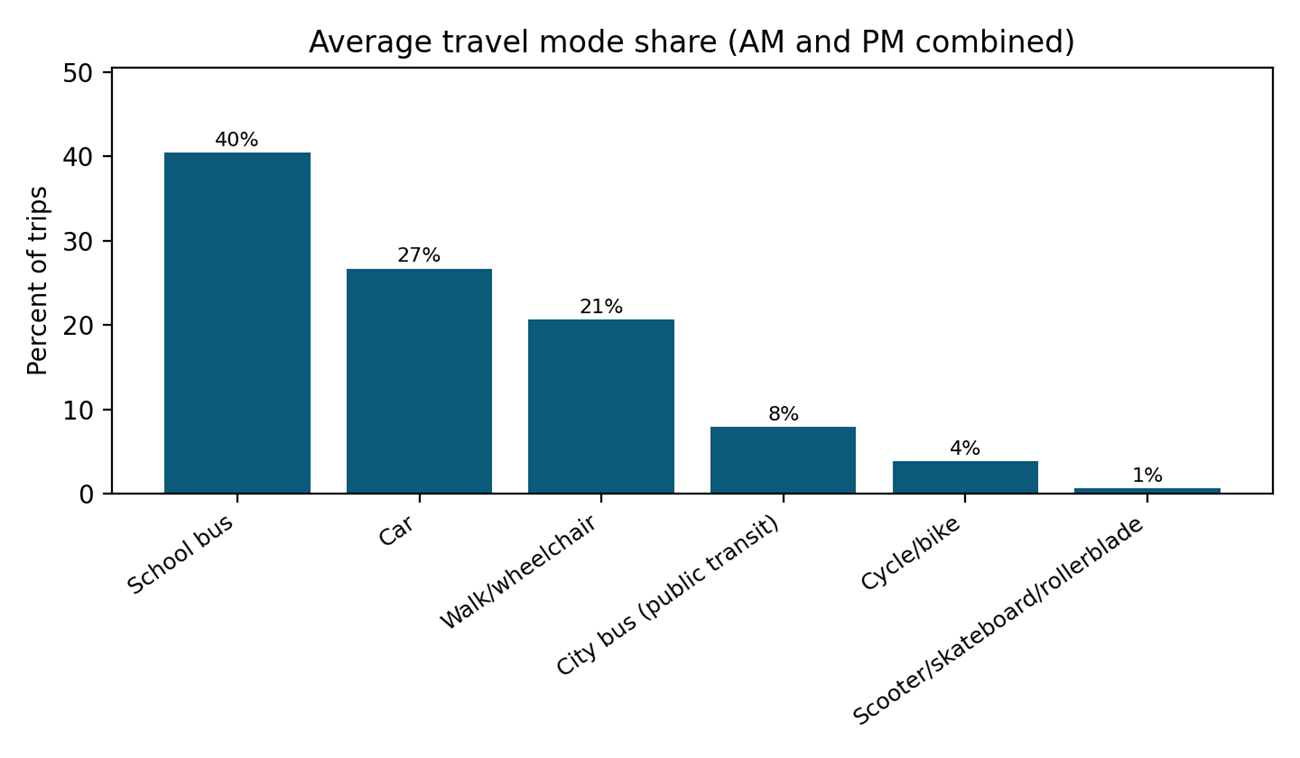
Across morning and afternoon trips, school bus use (40%) was the most common mode, followed by vehicle travel (27%). Walking and wheeling (21%) represented a meaningful share of trips, with transit (8%) and cycling (4%) making up the remainder. Distance remains a key constraint, with most families reporting a walk time greater than 20 minutes. At the same time, a notable group of families who live within walking distance still report driving, most commonly due to time pressures and convenience. Overall, the findings highlight opportunities for targeted infrastructure upgrades, supportive programming, and initiatives that make it easier for families to choose active travel.
These findings will help inform future decisions related to infrastructure, programming, and operations near schools. They also highlight the importance of continued efforts to improve traffic safety in school areas, in collaboration with partners and school communities.
1. Purpose and Survey Approach
The School Travel Survey was implemented to establish a baseline understanding of student travel patterns in Kingston and to identify barriers and opportunities for increasing active school travel. The survey asked families and students about typical travel modes for drop-off and pick-up, approximate walking time to school, and factors that would encourage active travel. The survey was designed for broad participation and was accessible online through the City’s engagement portal. Participants were encouraged to complete one submission per student in each household. The survey is intended to be repeated at regular intervals to measure changes over time and to support evaluation of active school travel initiatives.
2. Participation and Respondent Profile
Of the 2,224 completed responses that were received, parents and guardians submitted the majority of surveys, accounting for 94% of responses. Student responses provided additional perspective, and participation was recorded across all grade levels.
Parent/guardian - 2,099 responses
Student - 117 responses
Other caregiver - 8 responses
3. Key Results
Travel mode patterns show that school bus and car travel remain the dominant modes, with walking and wheeling representing roughly one-fifth of trips. Cycling contributes a smaller share but remains an important mode for targeted improvement, given its dependence on connected routes, end-of-trip facilities and perceived safety.
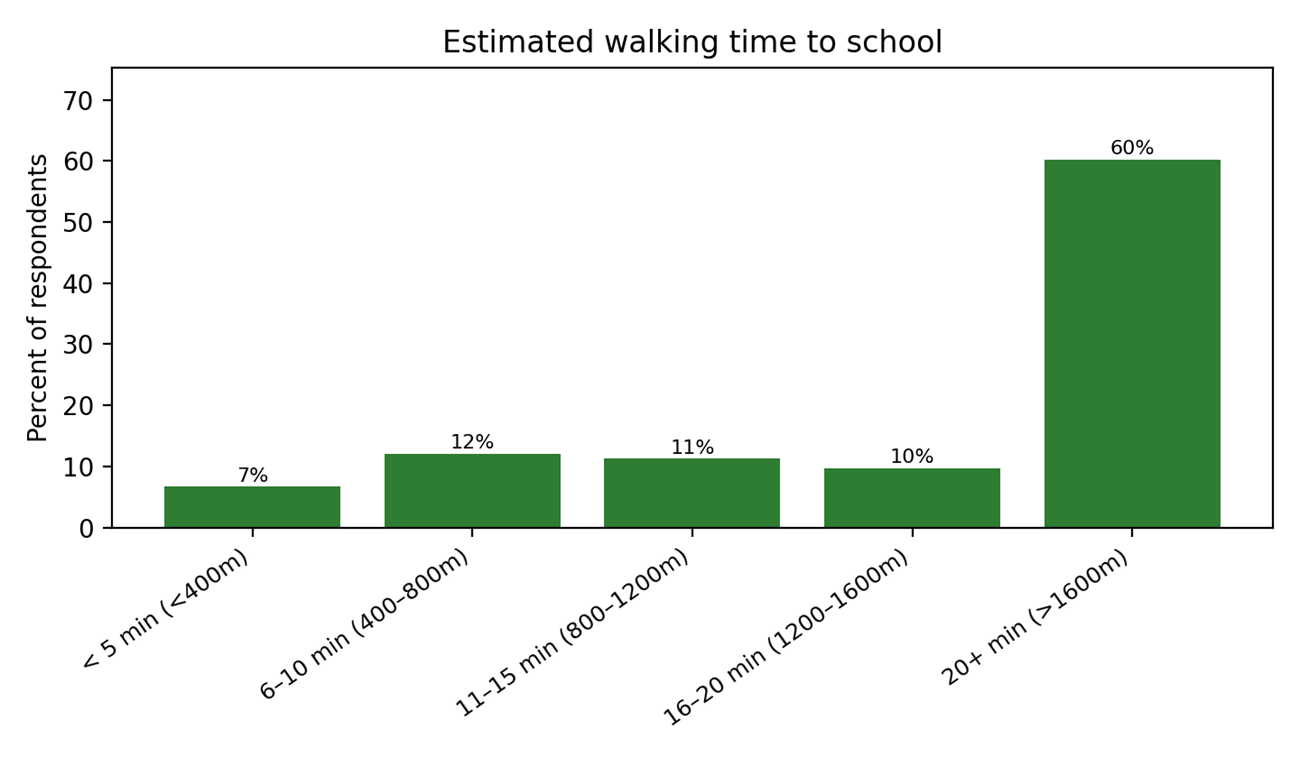
Proximity to school is a key determinant of travel behaviour. Many respondents estimated a walking time greater than 20 minutes, indicating that a significant portion of respondents live beyond a comfortable walking distance. This has implications for where active travel initiatives are most likely to support mode shift, and as well as where complementary strategies such as school bus service and transit integration remain essential.
4. Factors that Encourage More Active Travel
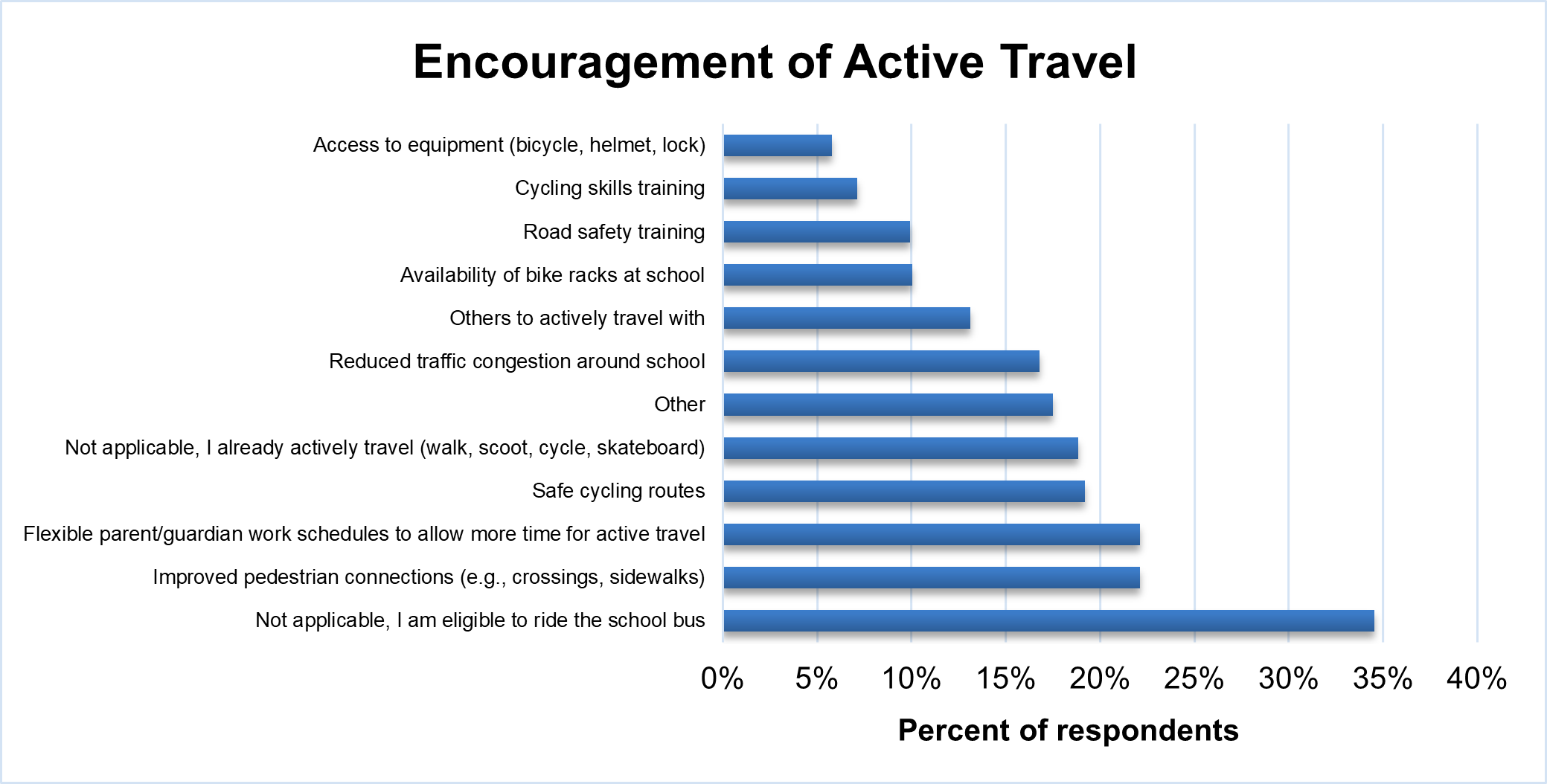
Families identified a range of potential supports that could increase active travel. The most frequently selected opportunities relate to safer and more complete walking connections and safe cycling routes, as well as family schedule flexibility. Responses also highlight the importance of practical enablers such as bike racks, equipment access and road safety training. Because participants could select multiple options, results reflect the breadth of needs rather than a single preferred intervention.
5. Safety and Operations Near Schools
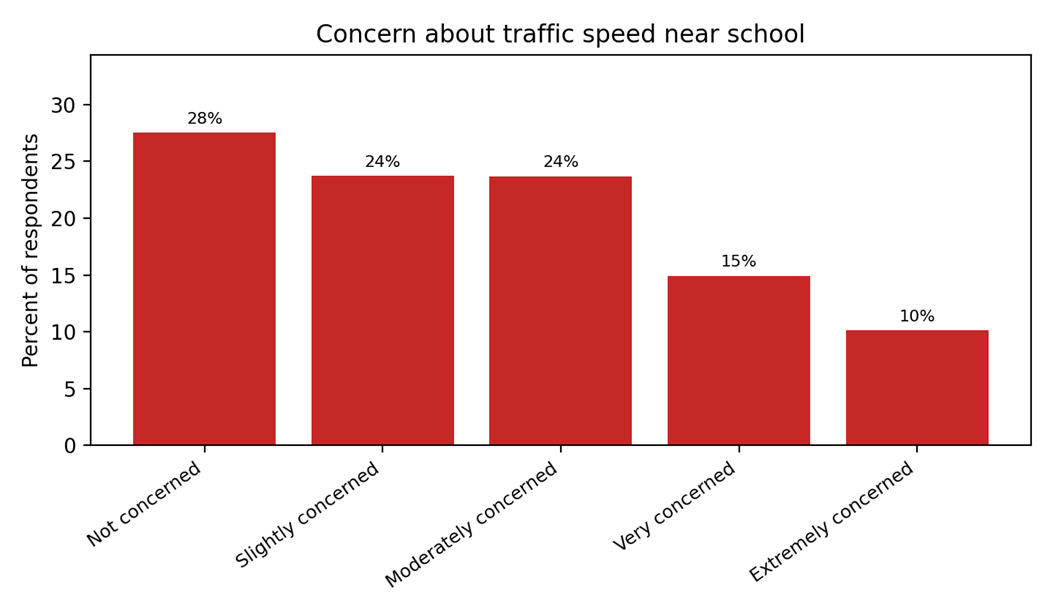
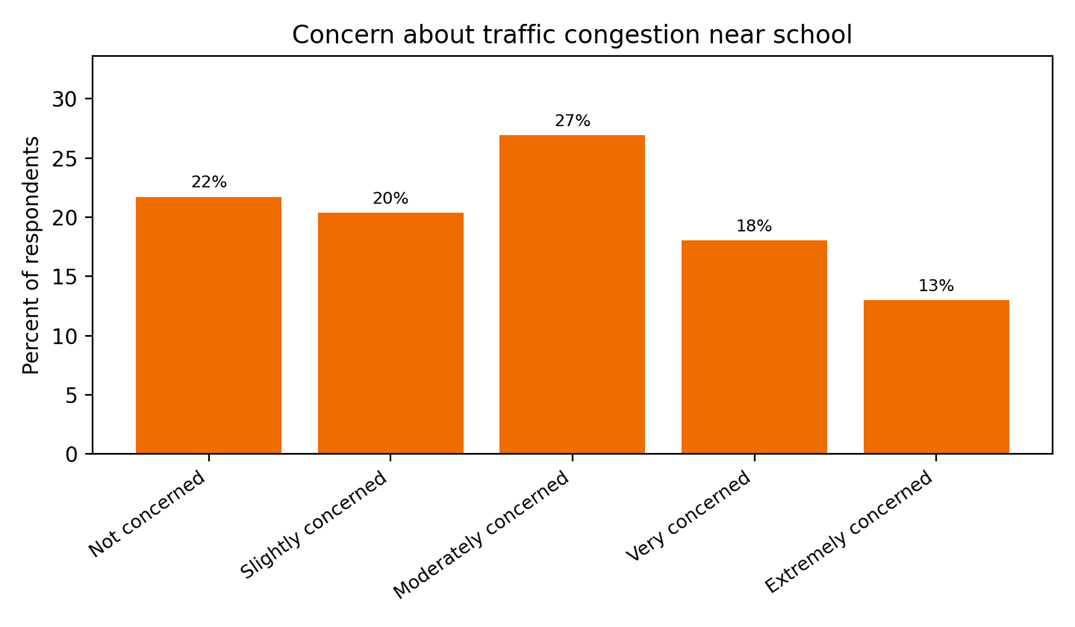
Perceptions of traffic conditions near schools vary by measure. For traffic speed, just over half of respondents (52%) report low levels of concern — not concerned or slightly concerned — while the remaining 49% report moderate to extreme concern. Congestion near schools generates somewhat higher concern overall, with 58% of respondents reporting moderate to extreme concern, compared to 42% who report low or no concern.
Overall, this indicates that while some respondents experience limited levels of concern, a meaningful share is at least moderately concerned about traffic conditions near schools, particularly during pick-up and drop-off times.
These findings will help inform future decisions related to infrastructure, programming, and operations to improve safety and confidence in school areas. They also reinforce the importance of continued collaboration with enforcement partners to address compliance issues in school areas.
Summary
The School Travel Survey was delivered by the City of Kingston in partnership with community agencies and local school boards to better understand how students travel to and from school. The survey was hosted on Survey123 through the City’s Get Involved Kingston platform and remained open from September 22, 2025 to October 13, 2025. Responses were anonymous and were collected to inform future active school travel initiatives, including policies, programs and infrastructure improvements.
A total of 2,224 responses were received across participating schools. While the large sample size provides strong insight, potential response bias means that the results should be interpreted as indicative of community perspectives rather than as a representative sample of all families.
Across morning and afternoon trips, school bus use (40%) was the most common mode, followed by vehicle travel (27%). Walking and wheeling (21%) represented a meaningful share of trips, with transit (8%) and cycling (4%) making up the remainder. Distance remains a key constraint, with most families reporting a walk time greater than 20 minutes. At the same time, a notable group of families who live within walking distance still report driving, most commonly due to time pressures and convenience. Overall, the findings highlight opportunities for targeted infrastructure upgrades, supportive programming, and initiatives that make it easier for families to choose active travel.
These findings will help inform future decisions related to infrastructure, programming, and operations near schools. They also highlight the importance of continued efforts to improve traffic safety in school areas, in collaboration with partners and school communities.
1. Purpose and Survey Approach
The School Travel Survey was implemented to establish a baseline understanding of student travel patterns in Kingston and to identify barriers and opportunities for increasing active school travel. The survey asked families and students about typical travel modes for drop-off and pick-up, approximate walking time to school, and factors that would encourage active travel. The survey was designed for broad participation and was accessible online through the City’s engagement portal. Participants were encouraged to complete one submission per student in each household. The survey is intended to be repeated at regular intervals to measure changes over time and to support evaluation of active school travel initiatives.
2. Participation and Respondent Profile
Of the 2,224 completed responses that were received, parents and guardians submitted the majority of surveys, accounting for 94% of responses. Student responses provided additional perspective, and participation was recorded across all grade levels.
Parent/guardian - 2,099 responses
Student - 117 responses
Other caregiver - 8 responses
3. Key Results
Travel mode patterns show that school bus and car travel remain the dominant modes, with walking and wheeling representing roughly one-fifth of trips. Cycling contributes a smaller share but remains an important mode for targeted improvement, given its dependence on connected routes, end-of-trip facilities and perceived safety.

Proximity to school is a key determinant of travel behaviour. Many respondents estimated a walking time greater than 20 minutes, indicating that a significant portion of respondents live beyond a comfortable walking distance. This has implications for where active travel initiatives are most likely to support mode shift, and as well as where complementary strategies such as school bus service and transit integration remain essential.

4. Factors that Encourage More Active Travel
Families identified a range of potential supports that could increase active travel. The most frequently selected opportunities relate to safer and more complete walking connections and safe cycling routes, as well as family schedule flexibility. Responses also highlight the importance of practical enablers such as bike racks, equipment access and road safety training. Because participants could select multiple options, results reflect the breadth of needs rather than a single preferred intervention.

5. Safety and Operations Near Schools
Perceptions of traffic conditions near schools vary by measure. For traffic speed, just over half of respondents (52%) report low levels of concern — not concerned or slightly concerned — while the remaining 49% report moderate to extreme concern. Congestion near schools generates somewhat higher concern overall, with 58% of respondents reporting moderate to extreme concern, compared to 42% who report low or no concern.
Overall, this indicates that while some respondents experience limited levels of concern, a meaningful share is at least moderately concerned about traffic conditions near schools, particularly during pick-up and drop-off times.
These findings will help inform future decisions related to infrastructure, programming, and operations to improve safety and confidence in school areas. They also reinforce the importance of continued collaboration with enforcement partners to address compliance issues in school areas.


Consultation has concluded. The results of the 2025 survey are available to read.

Who's Listening
Notice of Collection
All information collected from the Annual School Traffic Survey will be compiled and considered by staff to assist with measuring change and effectiveness of active school travel initiatives (policy, programs, and infrastructure) and to help inform future active school travel initiatives, such as new policies, programs, and infrastructure improvements. Information will be collected and used in accordance with the Municipal Freedom of Information and Protection of Privacy Act, and all other relevant privacy legislation. All information collected from this survey may form part of reports that may be available to the public, and may be shared directly with interested agencies, such as: the Kingston Police Force, the Kingston, Frontenac and Lennox & Addington Public Health Unit, Tri-Board Transportaion, and any of the local School Boards and educational institutions. Please direct any questions about the collection, use, and disclosure of your personal information to the Supervisor of School Area Safety, through: contactus@cityofkingston.ca. Learn more about the City’s accountability and transparency responsibilities on our website.
How We're Engaging
We use the IAP2 Spectrum of Public Participation to let you know how feedback on a project will be used. Here's how we are seeking and using your feedback on this project.
Inform: We will keep you informed by providing balanced and objective information to assist you in understanding the problem, alternatives, opportunities and/or solutions.
Consult: We will keep you informed, listen to and acknowledge concerns and aspirations, and provide feedback on how public input influenced the decision.