The City of Kingston is updating its Age-Friendly Plan.
Kingston has been a member of the World Health Organization’s Global Network of Age‑Friendly Cities and Communities since 2012. Since that time various age‑friendly recommendations have been implemented across transportation, housing, recreation, accessibility, and community supports, embedding principles of aging in place, social inclusion, and universal access within municipal planning, services, and partnerships.
Now, we're conducting an environmental scan and needs assessment to identify existing initiatives, gaps and opportunities. Findings will inform a prioritized action plan and articulate the City's role in advancing Age-Friendly principles.
Background
Kingston’s population is aging. As of 2021, residents aged 65 and older account for 21% of the Kingston Census Metropolitan Area (CMA), totaling nearly 37,000 people, with this group growing by 18% between 2016 and 2021.
In 2023, the City's Age-Friendly Working Group revived Kingston's age-friendly efforts and created a key building block for the 2026. This work was further strengthened through the creation of the Older Adults Connecting and Belonging (OACB) initiative led by the Community Foundation for Kingston & Area and with funding from the Sister of providence.
What is an Age-Friendly City?
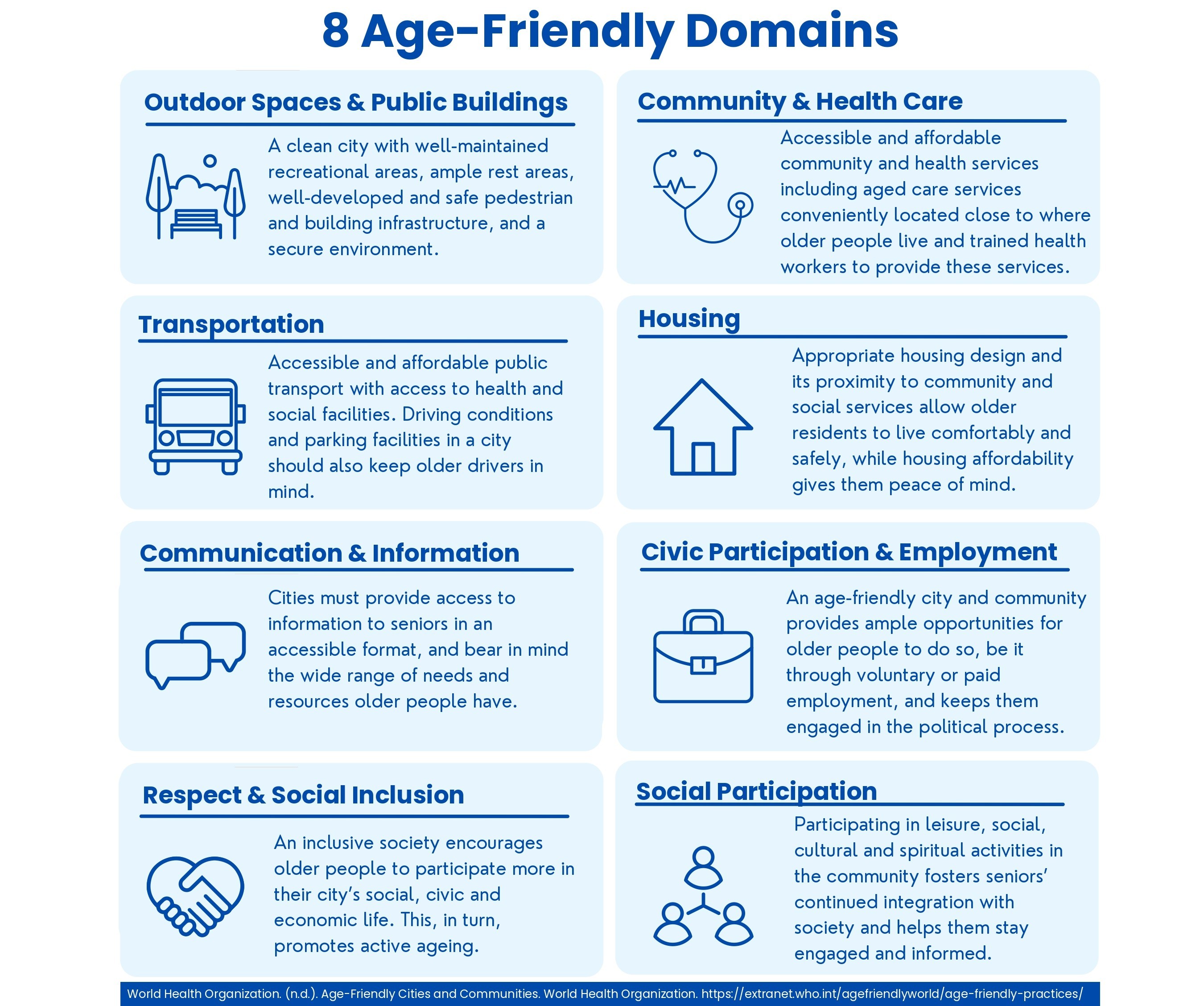
Age-friendly environments are free from physical and social barriers, and supported by policies, systems, services, products and technologies that:
promote, build, and maintain physical and mental health across the life course;
and enable people to continue to do things they value
Get Involved
Staff are currently reviewing feedback from an environmental scan and will review findings with key partners. Opportunities for community participation will be shared on this page later in 2026.
The City of Kingston is updating its Age-Friendly Plan.
Kingston has been a member of the World Health Organization’s Global Network of Age‑Friendly Cities and Communities since 2012. Since that time various age‑friendly recommendations have been implemented across transportation, housing, recreation, accessibility, and community supports, embedding principles of aging in place, social inclusion, and universal access within municipal planning, services, and partnerships.
Now, we're conducting an environmental scan and needs assessment to identify existing initiatives, gaps and opportunities. Findings will inform a prioritized action plan and articulate the City's role in advancing Age-Friendly principles.
Background
Kingston’s population is aging. As of 2021, residents aged 65 and older account for 21% of the Kingston Census Metropolitan Area (CMA), totaling nearly 37,000 people, with this group growing by 18% between 2016 and 2021.
In 2023, the City's Age-Friendly Working Group revived Kingston's age-friendly efforts and created a key building block for the 2026. This work was further strengthened through the creation of the Older Adults Connecting and Belonging (OACB) initiative led by the Community Foundation for Kingston & Area and with funding from the Sister of providence.
What is an Age-Friendly City?
Age-friendly environments are free from physical and social barriers, and supported by policies, systems, services, products and technologies that:
promote, build, and maintain physical and mental health across the life course;
and enable people to continue to do things they value
Get Involved
Staff are currently reviewing feedback from an environmental scan and will review findings with key partners. Opportunities for community participation will be shared on this page later in 2026.
Kingston currently has over 28,000 citizens aged 65+ (approx. 19% of the population today). This number is expected to rise to 25% by 2036, as the baby boom generation ages and retires. With these trends in mind, and with the aim of supporting City Council’s strategic priority of fostering a caring and inclusive community, the Age-Friendly Working Group will be submitting a report with recommendations to Council this September.
This survey will take approximately 5 minutes to complete and all questions are optional. Please note that the City expects to launch an extensive engagement on what it means to be an age-friendly city at a later date. This initial survey is part of an inform stage meant to help us better understand current awareness of age-friendly definitions and initiatives across the city.
Notice of Collection
All information received will be compiled and considered by staff for use under the purposes of this site. Information will be collected and used in accordance with the Municipal Freedom of Information and Protection of Privacy Act and other relevant privacy legislation. All comments made on this site are available to the public and may form part of public records.
Creation of Older Adults Connecting and Belonging (OACB) initiative
Age-Friendly Kingston has finished this stage
Environmental scan on current age-friendly initiatives
Age-Friendly Kingston is currently at this stage
Needs assessment and community engagement
this is an upcoming stage for Age-Friendly Kingston
Develop action plan based on findings
this is an upcoming stage for Age-Friendly Kingston
Present report to City Council
this is an upcoming stage for Age-Friendly Kingston
All information received will be compiled
and considered by staff for use under the purposes of this site. Information
will be collected and used in accordance with the Municipal Freedom of Information and Protection of Privacy Act and other relevant privacy
legislation. All comments made on this site are available to the public
and may form part of public records.
We use the IAP2 Spectrum of Public Participation to let you know how feedback on a project will be used. Here's how we are seeking and using your feedback on this project.
Inform: We will keep you informed by providing balanced and objective information to assist you in understanding the problem, alternatives, opportunities and/or solutions.
Consult: We will keep you informed, listen to and acknowledge concerns and aspirations, and provide feedback on how public input influenced the decision.