What we heard: Biodiversity mapping engagement
This report summarizes the community input received from the biodiversity mapping engagement.
Why we engaged
As one of the goals outlined in Kingston’s 2023-2026 Strategic Plan, the City of Kingston is developing a Biodiversity Action Plan with the support of ICLEI Canada. The plan will be a valuable guide that identifies and prioritizes opportunities to improve community biodiversity, sustainability and resilience.
Community input is vital to understanding where biodiversity is observed and which spaces need extra support; this input will help shape the actions and priorities in the Biodiversity Action Plan to help biodiversity flourish in the region for generations to come.
How we engaged
From June 2 to July 12, 2026, an interactive mapping tool was hosted on Get Involved Kingston. Community members were encouraged to place pins on a map to highlight areas important for biodiversity and locations they felt were vulnerable or in need of enhanced protection or support. Participants could provide comments to explain their choices and interact with other submissions through a "like" feature.
Participants were also invited to answer the question: What does biodiversity in Kingston mean to you?
The mapping exercise was shared with community members in multiple ways, including:
Social media promotion across the City of Kingston’s Facebook, X and Instagram channels
Inclusion in the City’s Inside Kingston YouTube series
Inclusion in the City’s Climate Action newsletter
Inclusion in the Get Involved Kingston newsletter
A physical map for attendees at the 2026 Kingston Climate Summit
Direct contact with interested and affected parties including members of the Biodiversity Action Plan working group
Who we heard from
Online: Get Involved Kingston
- 68 participants engaged with the online map exercise by adding 171 pins and comments, and ‘liking’ other comments
31 participants engaged by answering the question: What does biodiversity in Kingston mean to you?
711 users visited the project page to learn more about the Biodiversity Action Plan
8 participants engaged with the City for the first time on Get Involved Kingston
Emails and comments submitted through the City’s Contact Us options were also received and form part of the feedback.
In person: Kingston Climate Summit
Participants added 24 stickers to a physical map
32 participants engaged by answering the question: What does biodiversity in Kingston mean to you?
What we heard
Below is a summary of feedback received during the online mapping engagement and in-person engagement at the Kingston Climate Summit, grouped by major themes.
A total of 171 pins were placed on the virtual map; participants identified them as either a place of value or at risk:
57 per cent: Areas of value
43 per cent: Areas at risk/in need of support
A total of 24 stickers were placed on the physical map; 1/3 were identified as areas of value, and 2/3 as areas at risk/in need of support.
Waterways
Large clusters of pins were placed in waterways, wetlands and along riparian areas, including Lake Ontario, Collins Creek, Butternut Creek, the St. Lawrence River and the Cataraqui River. Participants mentioned the importance of protecting shoreline and aquatic habitat and aquatic/amphibian species, identifying both areas of value and areas at risk (e.g., due to rising presence of non-native species, increased algae, etc.). Participants emphasized protecting watersheds, such as Butternut Creek, which provide valuable habitat for a number of species.
Increased trees and forests
Participants would like to see more protections for existing natural areas and mature trees. Participants mentioned planting more trees in urban areas would be beneficial to create connected corridors between natural spaces, support biodiversity and provide shade to mitigate the impacts of higher temperatures. Several participants mentioned the benefits of Pocket Forests or Little Forests in supporting biodiversity.
Wildlife diversity
Participants reported seeing many types of wildlife and native plants in natural areas across Kingston. Participants emphasized the need to protect habitat for local wildlife and migratory birds, and for greater actions taken to mitigate invasive species (e.g., phragmites). Many participants expressed particular concern for protecting turtle nesting areas and treed areas that provide habitat for native and migratory birds.
Habitat variety and protection
Participants identified meadows, grasslands, wetlands, woodlands and other natural areas around Kingston that provide homes for many insects, birds and animals. Participants expressed concern for bird, insect and animal habitat loss in some areas.
What does biodiversity mean to you in Kingston?
Participants shared input across many themes, summarized below:
Protecting and restoring local habitat and ecosystems to support keystone species
Increasing education and awareness about invasive species, while supporting the presence of native species and protecting endangered species
Connectivity or corridors of natural spaces to avoid fragmented ecosystems
Local policies that support biodiversity
Having access to spaces in which to enjoy nature
Preserving natural spaces (e.g., wetlands, forests) while promoting density
Living in harmony with the land and other species; having spaces where people, plants and animals can prosper
Considering how human and non-human species use spaces and move around Kingston
Humans are part of the local ecosystem, not separate from it
Protecting lakes, creeks, riparian areas and wetlands
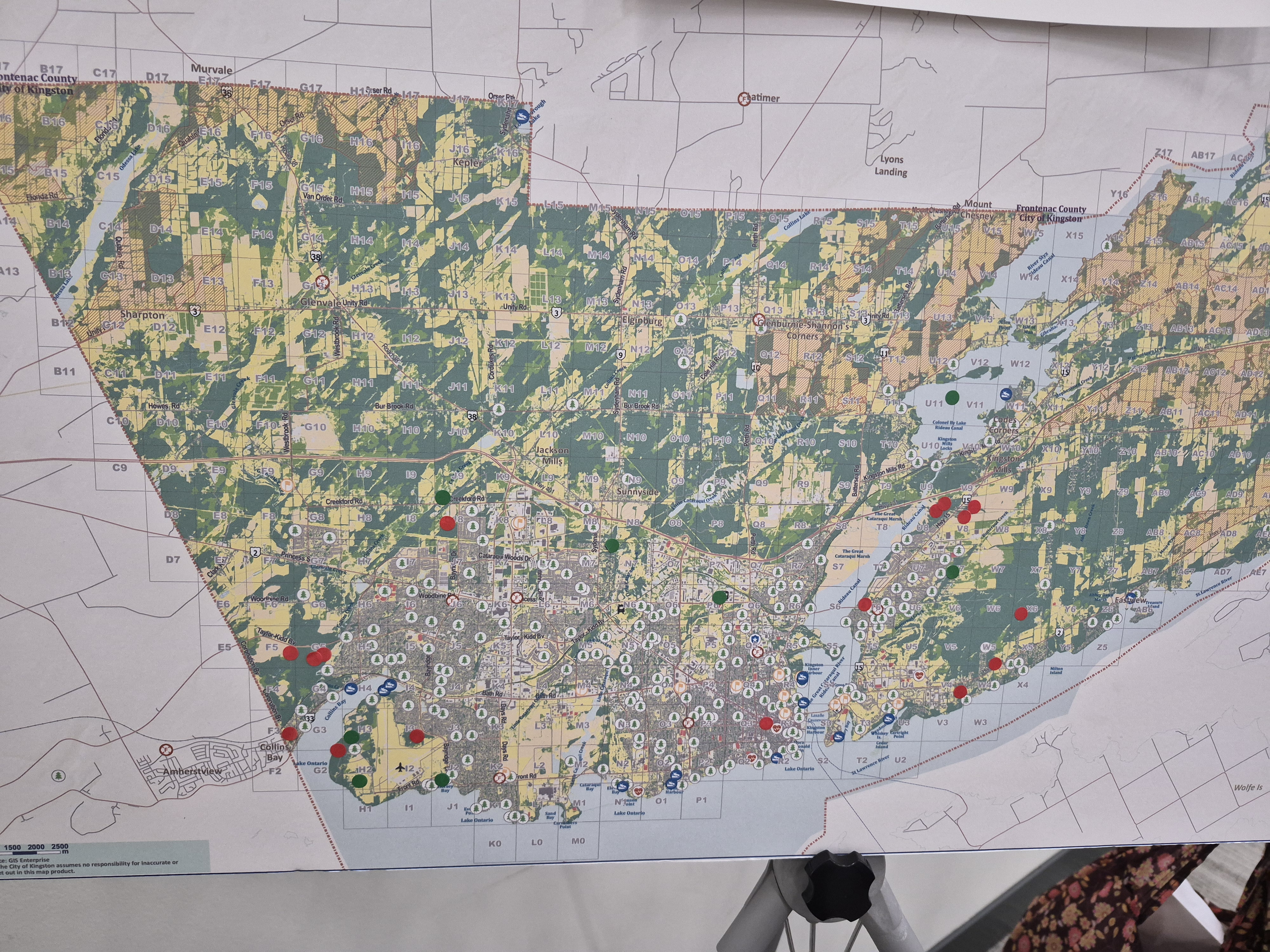
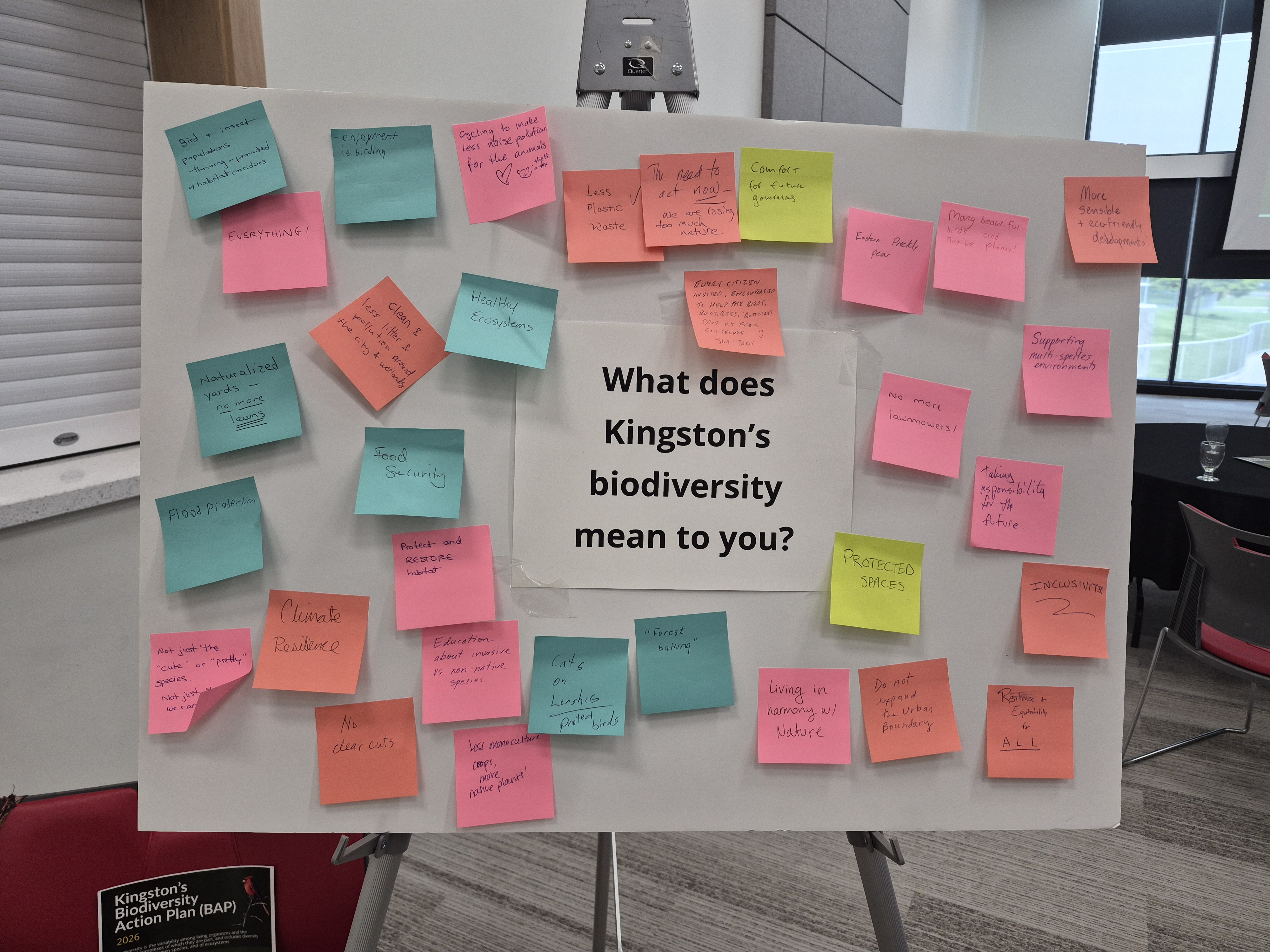
Photos: The biodiversity map and question board from the in-person engagement at the 2026 Kingston Climate Summit on June 3 and 4.
Next steps
The results of this public engagement will be shared with the Biodiversity Action Plan working group and ICLEI project team. The input received will be considered during the development of the biodiversity status report and the Biodiversity Action Plan.
The next phase of the project is to compile the biodiversity report, which will outline local biodiversity assets and challenges and assess Kingston’s status using the Cities Biodiversity Index (aligned with the Kunming-Montreal Global Biodiversity Framework). The report will consider input from community engagement and incorporate local knowledge and data sources related to Kingston’s biodiversity.

Thank you for your contribution!
Help us reach out to more people in the community
Share this with family and friends