Lafleur Park Improvements

The existing playground at Lafleur Park has reached the end of its service life and is scheduled for replacement in 2026.

The two existing play areas will be consolidated as a single playground with new play equipment, seating and pathway connections to the existing park pathways. Lafleur Park is located between Bath Road and Van Order Drive, west of Sir John A Macdonald Blvd.

Stay Informed and Get Involved

Sign up for Project updates using the follow project feature on this page to remain updated.

The existing playground at Lafleur Park has reached the end of its service life and is scheduled for replacement in 2026.

The two existing play areas will be consolidated as a single playground with new play equipment, seating and pathway connections to the existing park pathways. Lafleur Park is located between Bath Road and Van Order Drive, west of Sir John A Macdonald Blvd.

Stay Informed and Get Involved

Sign up for Project updates using the follow project feature on this page to remain updated.

  • What we learned

    Why we engaged

    Each year, the City of Kingston allocates funding through the Parks and Shoreline budget to renovate existing parks, improve accessibility and usability, and replace park assets that have reached the end of their life cycle.

    As part of the 2026 park renovation program, Lafleur Park will receive a new playground, accessible pathways and seating areas.

    Community feedback was sought to understand the preferred types of play equipment to be considered as part of the playground replacement project.

    How we engaged

    In May 2026 a public engagement survey was posted on Get Involved Kingston, providing residents with an opportunity to prioritize the types of playground equipment that could be included in an updated playground and provide comments on accessibility features.

    What we learned

    The survey received 20 responses. The survey responses are summarized below.

    Question 1: Please rank the age groups that the playground equipment should target, from most preferred (1) to least preferred (4).

    Results, in order of preference:

    1. Five to 12 years old.
    2. Two to five years old.
    3. 18 months to two years old.
    4. 12 years and older.

    Question 2: What type of play equipment would you like to see included? Please rank from most preferred (1) to least preferred (6).

    Results, in order of preference:

    1. Swings.
    2. Play structure with slide(s).
    3. Climber (free-standing net climber, monkey bars, or geodesic dome).
    4. See-saw / Spring toys /Spinner bowl.
    5. Sensory and Tactile Play Panels.
    6. Multi-user Spinner.


    Question 3: Please provide comments on accessibility features for residents with disabilities that could be incorporated into the design, such as sensory and active play components.

    The strongest theme was the need for continuous, accessible pathways through the park. Responses included requests for firm, stable paths suitable for wheelchairs, strollers, walkers, and other mobility devices, and paths of sufficient width to allow for winter maintenance equipment.

    Specific concerns included rough terrain, broken asphalt, difficult connections at park exits, and the need to continue accessible routes onto adjacent boulevards and neighbourhood connections. Lighting along pathways was identified as important to support safe access.

    Comments also emphasized inclusive play and rest areas. Respondents supported accessible swings with supportive seating, ground-level and sensory play features, and playground layouts that enable children with varying levels of mobility, balance, sensory, and vision needs to participate. Benches, picnic tables, shade structures, quiet lower-stimulation spaces, and clear, predictable park design were identified as measures that would improve comfort, rest opportunities, and usability for a wider range of residents.

    Next Steps

    Feedback from the survey, together with design and budget considerations, was used to inform the playground design. The final conceptual design includes:

    • A 2-bay swing set, with an accessible saucer/disk swing, baby seat and accessible seat.
    • A junior/senior (suitable for ages 18 months – 12 years) play structure with a transfer station, two slides, climbers, monkey bars, tactile and sensory play panels, a cable net climber and cable bridge. Shaded nooks beneath the decks are included for quiet contemplation or imaginative play.
    • A teeter totter.
    • Spinners.
    • Spring toys.

    The playground will have wood-fibre surfacing, concrete perimeter curbing, wheel-chair accessible route, accessible pathway connections, bike racks and accessible bench seating.

    Please see the following conceptual plan below for the Lafleur Park playground replacement project.

    The detailed design phase is underway with construction expected to start in 2026 and be completed in 2027.

    A new multi-use pathway was recently completed by the City, providing a formal connection between Van Order Drive and Bath Road.
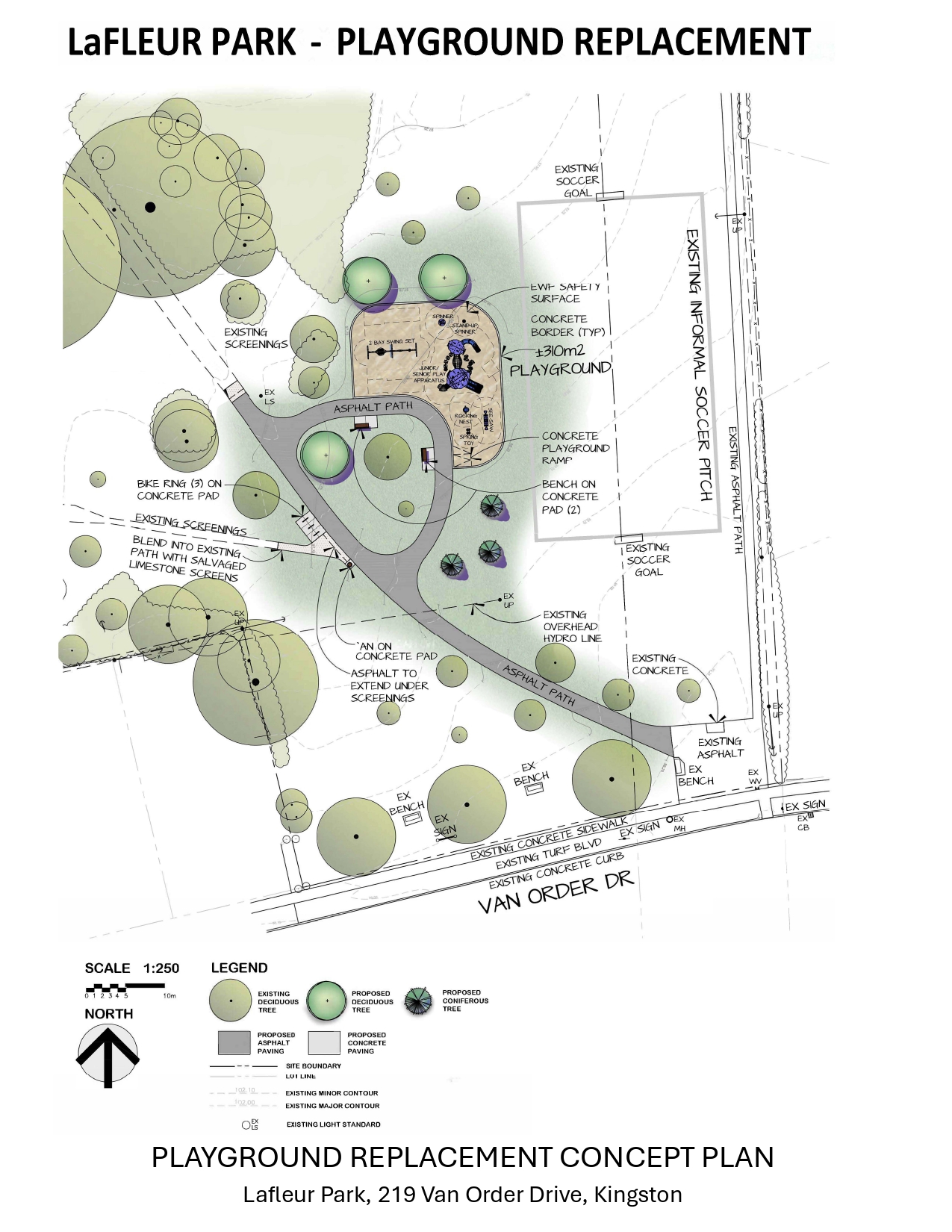
    A concept drawing of the site shows the new layout.

    The concept drawing above shows the new playground and park layout and the images below show renderings of what the playground equipment will look like.
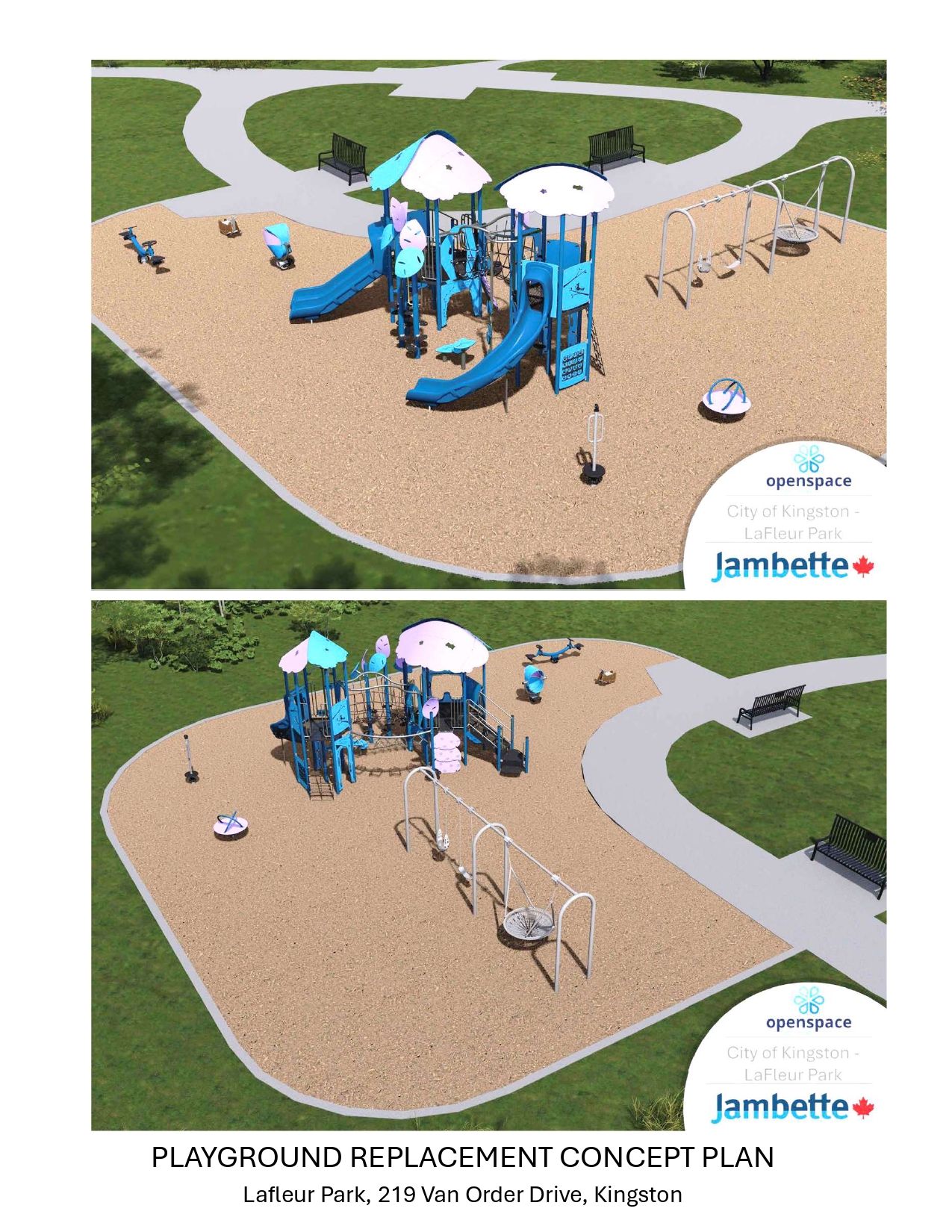
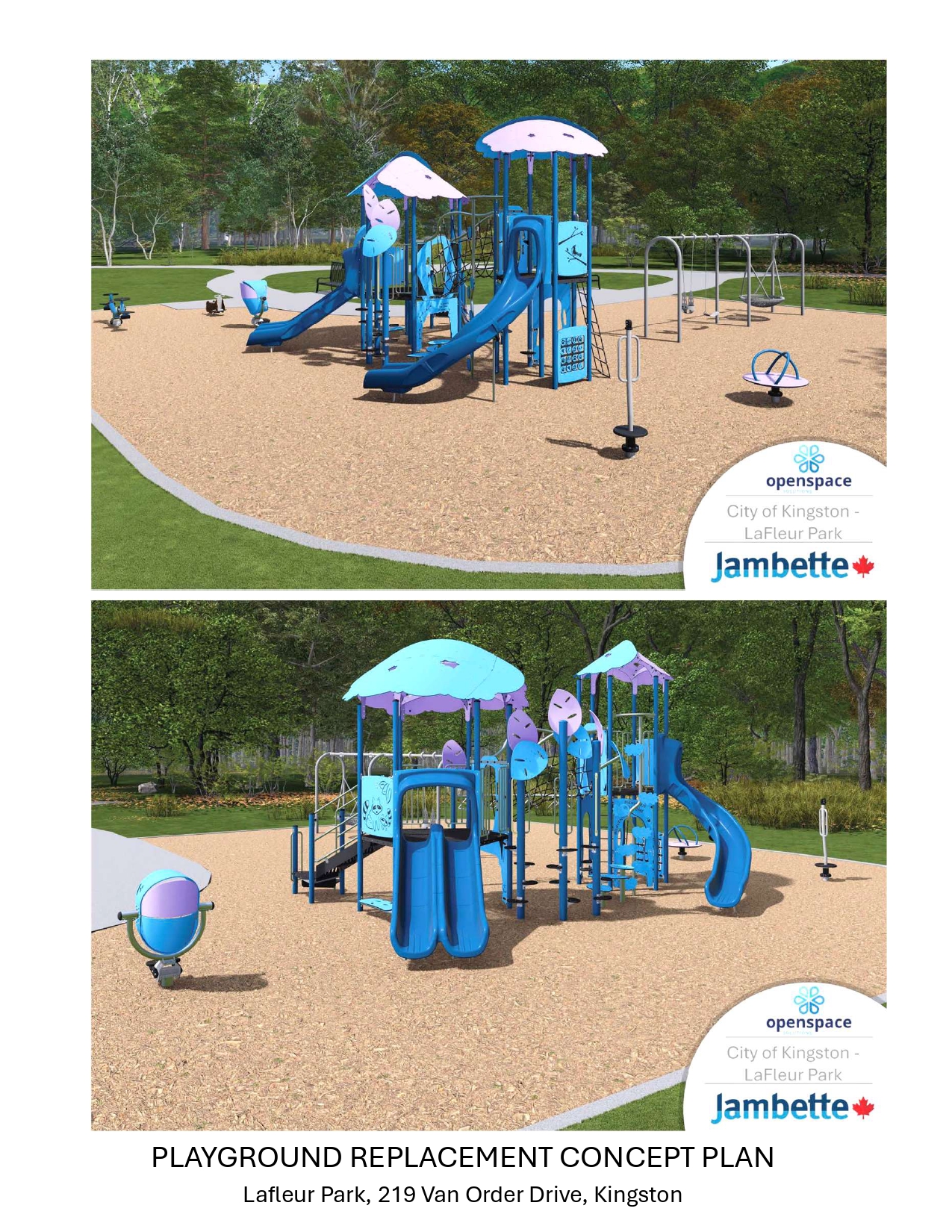
    A render of what the future playground equipment will look like.

    A render of what the future playground equipment will look like.


    Why we engaged

    Each year, the City of Kingston allocates funding through the Parks and Shoreline budget to renovate existing parks, improve accessibility and usability, and replace park assets that have reached the end of their life cycle.

    As part of the 2026 park renovation program, Lafleur Park will receive a new playground, accessible pathways and seating areas.

    Community feedback was sought to understand the preferred types of play equipment to be considered as part of the playground replacement project.

    How we engaged

    In May 2026 a public engagement survey was posted on Get Involved Kingston, providing residents with an opportunity to prioritize the types of playground equipment that could be included in an updated playground and provide comments on accessibility features.

    What we learned

    The survey received 20 responses. The survey responses are summarized below.

    Question 1: Please rank the age groups that the playground equipment should target, from most preferred (1) to least preferred (4).

    Results, in order of preference:

    1. Five to 12 years old.
    2. Two to five years old.
    3. 18 months to two years old.
    4. 12 years and older.

    Question 2: What type of play equipment would you like to see included? Please rank from most preferred (1) to least preferred (6).

    Results, in order of preference:

    1. Swings.
    2. Play structure with slide(s).
    3. Climber (free-standing net climber, monkey bars, or geodesic dome).
    4. See-saw / Spring toys /Spinner bowl.
    5. Sensory and Tactile Play Panels.
    6. Multi-user Spinner.


    Question 3: Please provide comments on accessibility features for residents with disabilities that could be incorporated into the design, such as sensory and active play components.

    The strongest theme was the need for continuous, accessible pathways through the park. Responses included requests for firm, stable paths suitable for wheelchairs, strollers, walkers, and other mobility devices, and paths of sufficient width to allow for winter maintenance equipment.

    Specific concerns included rough terrain, broken asphalt, difficult connections at park exits, and the need to continue accessible routes onto adjacent boulevards and neighbourhood connections. Lighting along pathways was identified as important to support safe access.

    Comments also emphasized inclusive play and rest areas. Respondents supported accessible swings with supportive seating, ground-level and sensory play features, and playground layouts that enable children with varying levels of mobility, balance, sensory, and vision needs to participate. Benches, picnic tables, shade structures, quiet lower-stimulation spaces, and clear, predictable park design were identified as measures that would improve comfort, rest opportunities, and usability for a wider range of residents.

    Next Steps

    Feedback from the survey, together with design and budget considerations, was used to inform the playground design. The final conceptual design includes:

    • A 2-bay swing set, with an accessible saucer/disk swing, baby seat and accessible seat.
    • A junior/senior (suitable for ages 18 months – 12 years) play structure with a transfer station, two slides, climbers, monkey bars, tactile and sensory play panels, a cable net climber and cable bridge. Shaded nooks beneath the decks are included for quiet contemplation or imaginative play.
    • A teeter totter.
    • Spinners.
    • Spring toys.

    The playground will have wood-fibre surfacing, concrete perimeter curbing, wheel-chair accessible route, accessible pathway connections, bike racks and accessible bench seating.

    Please see the following conceptual plan below for the Lafleur Park playground replacement project.

    The detailed design phase is underway with construction expected to start in 2026 and be completed in 2027.

    A new multi-use pathway was recently completed by the City, providing a formal connection between Van Order Drive and Bath Road.

    A concept drawing of the site shows the new layout.

    The concept drawing above shows the new playground and park layout and the images below show renderings of what the playground equipment will look like.

    A render of what the future playground equipment will look like.

    A render of what the future playground equipment will look like.


Page last updated: 09 Sep 2026, 01:25 PM