FAQs
Ryandale serves clients without prejudice, especially with respect to any past history of addiction, incarceration or mental illness. Clients, however, must meet program standards for addictions and level of risk to the community.
Ryandale respects and accepts everyone’s gender status, racial and cultural background, and is mindful of factors such as poverty that drive marginalization and homelessness.
Ryandale works with other agencies and partners to support client self-sufficiency and transform lives.
- New residents are welcomed into a supportive environment. During this phase, they familiarize themselves with the house rules, staff, and fellow residents. The goal is to establish stability and a sense of safety before deeper personal work begins. Residents engage in self-assessment exercises to understand their strengths, weaknesses, abilities, and limitations. A key component of this phase is connecting residents with appropriate community supports, including healthcare, mental health services, employment programs, and addiction recovery resources.
- Residents are assigned daily and weekly household chores as part of their stay at Ryandale · If addiction is part of their story, residents are required to attend outside 12-step meetings (AA/NA) or other recovery programs regularly. · Staff assist residents in completing applications to be placed on relevant housing waitlists as early as possible. Staff assist residents with obtaining ID, Health cards and getting connected with outside resources in this phase.
- Residents receive training in life skills such as: Financial literacy and budgeting Cooking and meal planning Conflict resolution and communication Maintaining a sober and healthy lifestyle
- Support is provided for transitioning into independent living, ensuring residents feel prepared to take on responsibilities outside of the program. This phase helps residents begin taking ownership of their journey while developing a support network beyond Ryandale. This structured, holistic approach empowers residents to reintegrate into society with confidence, stability, and the necessary skills for long-term success
Section 3.19.14. Special Needs Facility means the use of any lot or building for housing providing a group living arrangement for people who have specific needs beyond economic needs and that is not a group home, including but not limited to, needs such as mobility requirements or support functions required for daily living. This includes any dedicated facilities for such use and may include a wellness clinic as an accessory use.
3.4.13. Dwelling Unit means the use of a building, comprised of one or more habitable rooms designed to provide at least one washroom and kitchen for residential accommodation. This definition may include a short term rental as defined in the Short Term Rental By-law where it is comprised of one or more habitable rooms designed to provide at least one washroom and kitchen for residential accommodation. This definition excludes bunkhouses, recreational vehicles, travel trailers, tent trailers or motor homes.
3.2.10. Bedroom means any room in a dwelling unit that is not:
1. A common area, being:
(a) A living room open to all occupants of the unit; or
(b) A dining room open to all occupants of the unit;
2. An area used for sanitary purposes, such as a washroom;
3. An area used for cooking purposes, such as a kitchen;
4. An area occupied solely by mechanical equipment, such as furnaces, hot water heaters, or laundry equipment;
5. A circulation space, such as a stairway or hallway;
6. A room less than 6 square metres in area where there are built-in cabinets and/or closets;
7. A room less than 7 square metres in area where there are no built-in cabinets and/or closets; or
8. A room without a window or similar alternative source of natural light when the door is closed.
6.19.1. An emergency shelter, group home, supportive housing, transitional housing, community home and other similar uses are considered a dwelling unit where the nature of such use does not qualify as a special needs facility. Where such use is considered a dwelling unit, it is permitted on any lot where the Zone permits a dwelling unit, and must be in a permitted building according to the applicable Zone
What is supportive housing?
Supportive housing provides safe, stable housing to persons who might otherwise face homelessness and to those who have been consistent, stable shelter users. Supportive housing combines housing stability with 24/7 wraparound programming and life skill support. It is based on the Housing First model, which prioritizes housing as a foundation for improving health, well-being, and independence. Supportive housing differs from emergency shelters in that it provides a physical environment that is home-like, with on-site support.
What supports will be available to residents?
Residents will have access to a comprehensive range of wraparound supports, including but not limited to: life skills training, case management, social and recreational activities, housekeeping and property management, trauma-informed care, health, mental health and recovery services where appropriate and connections to broader services such as employment supports, legal aid, and cultural programming.
How will the City and service providers engage with the neighbourhood?
Near-neighbour meetings will be hosted by The City on Jan. 28, 2026, at 5pm and 7:30pm at the INVISTA centre meeting rooms A&B (due to the closure of Centre 70) with Ryandale staff in attendance. Questions can also be asked here on the Get Involved Kingston Page
Where can I ask questions or leave feedback about supportive housing?
Get Involved Kingston is a central location with information about each of the housing solutions. Answers to many frequently asked questions can be found here. Questions and feedback are always welcome by emailing GetInvolvedKingston@CityofKingston.ca or by leaving a question or comment on the project pages. Feedback is collected throughout each project, aggregated and themed, and reported back to the community on Get Involved Kingston.
Why weren't residents given the opportunity to comment on this project before the City purchased the property?
Council has provided specific direction to continue moving emergency shelter and transitional/supportive housing across a broader geography to ensure that the concentration of housing services does not further concentrate and thereby stigmatize vulnerable populations. Properties acquired by the City for a supportive housing must meet some key criteria including being geographically dispersed, on or near transit routes, appropriately sized to support smaller-scale operation for ease of community integration. Once a property is found that meets these criteria the property is brought to City Council for consideration in closed session. Once the property is selected for acquisition it’s then voted on in open session. Please see following link to relevant Council report providing further details on the direction to make these purchases. Acquisition of Supportive Housing Properties
Why did the City wait to tell neighbours about the purchase?
As shared at Council meeting on Sept. 2, 2025 through Report Number 25-218 addresses and operators will be shared as property transactions close. This is to ensure and respect the confidentiality of the property owners. The property closed on Dec. 5, 2025, allowing the City to share both the address and potential operator publicly.
How was Ryandale chosen as the operator for this site?
To secure operators for each site, the City issued a Request for Supplier Qualifications (RFSQ) for those operators that have demonstrated experience and expertise in operating supportive housing properties. Once operators are in place, they reached out to near neighbours to share program info, build relationships, address program questions, correct misinformation/misunderstanding of services and ensure that new residents become valued members of the community. The flyer that was sent out was a first step and there will be an information session on January 28, 2026, to answer questions that neighbours may have about supportive housing, the operator and the future residents.
Were technical studies needed to establish supportive housing at this location such as zoning, traffic, servicing or other assessments?
Only a small number of people can be accommodated at supportive housing properties. That is why there are over 28 supportive housing sites already in operation across our community. The small number of residents helps to ensure adequate support levels and foster community integration. The modest renovations to be undertaken are to update the property and ensure that the bedrooms and common kitchen and living spaces are up to code. A building permit for this work is required. Planning approvals are not required and no servicing changes are needed to accommodate the number of people who will live at this site. Most residents of supportive housing use public transportation. Residents do not tend to own personal vehicles and parking on the site is sufficient to meet the resident and staff needs. Vans are often used to assist residents in attending offsite programs, attending medical appointments, getting to work, etc.
Is this a confirmed site or is there still opportunity for this to change? Will neighbours have a say in whether this project moves forward or has that already been decided?
The property was purchased by the City to serve as a new supportive housing site. It will join the 28 other supportive housing sites in operation across our community. Council approved this direction and City staff and Ryandale as the intended operator are preparing the site for new residents to move in. There will be an information session on Jan. 28, 2026, to connect more directly with neighbours., The information session will provide an opportunity to answer questions about the site, the operation of supportive housing, who the residents will be, and how concerns can be mitigated ahead of the site opening. It will also provide information about how questions and concerns will continue to be addressed after the site opens.
How many people can be accommodated in this location?
Supportive housing is small scale in size and site impact. Supportive housing sites can accommodate 7 to 8 people. Each resident has their own bedroom and shares communal kitchen and living spaces. Staff space is also included at the sites.
What is the timeline for construction and opening, and how will residents be informed?
The next steps for this project are property renovations and community engagement. Renovations began in December 2025. Invitations to a near-neighbour meeting run by Ryandale were delivered to houses within a 150-metre radius. and shared on the Get Involved Kingston page. This community outreach by the operator will allow those living closest to the property to connect in person, ask questions, learn about residents and understand the support and programming provided at the site. The hope is that residents will move in by the end of March 2026. Near neighbours are an important part of building successful connections with the community and the feedback and suggestions received from near neighbours will help to shape how the residents engage, how challenges are addressed and how relationships can be built.
How can community get involved moving forward?
Members of Council, neighbours, partner agencies and City staff are equally important in helping integrate supportive housing services into communities. The City and Ryandale are committed to providing ongoing updates, receiving questions, and guiding a constructive community-led engagement process to those neighbourhoods that will include supportive housing projects. The intent is to ensure clear and consistent communication with the community and raise awareness of future engagement opportunities designed to hear concerns and to collaborate on how sites can be successfully integrated into their neighbourhoods. Supportive housing operators alongside City staff will host near neighbour community meetings and if interest allows, move toward the creation of Community Liaison Committees (CLC). CLCs are a means of connecting near neighbours, business owners, site operators and City support teams to share information, address questions, discuss challenges and collaborate on addressing community concerns.
What experience does the intended site operator have?
Ryandale has successfully operated for 40 years. Their programs have provided essential services to members of the community and supported them in their individual goals and to achieve independent living. It is important to note that since the opening of Fieldstone Cres. (a recent Ryandale supportive housing site in Pittsburgh District), there have been no issues identified by the local community property owners. The supportive housing site on Fieldstone Crescent is now an integral part of their near neighbour community.
How will supportive housing residents be chosen?
These supportive housing units are intended for individuals who have been staying in shelters for an extended period and are ready to transition to more stable housing but have been unable to do so due to a shortage of appropriate options. Not all persons currently accessing shelter would be eligible to move in. Residents will be chosen through a coordinated access process. Coordinated Access is a centralized system that connects people needing service to those locations best suited to successfully support them. For some, that can mean remaining in shelter, others may be best supported by moving into stabilization programs or into transitional housing, and some are ready to move into a supportive housing site where they can receive a little extra assistance as they move toward independent housing. Residents of supportive housing have low to medium acuity, meaning they do not need complex health/mental health supports, are stable and are ready to work toward their individual independent living goals.
What security checks take place?
1. Independent police record check
Currently, all background and disclosure materials are submitted by applicants or their referring case managers as part of the application process. A criminal record summary is required to be included with the application and is used to assess eligibility. An independently initiated police record check (CRJMC or higher) is not presently required to validate self-disclosed history or address gaps in the referral documentation.
2. Identification of probation orders, warrants, or peace bonds
The current screening process relies on information disclosed by the applicant and their case manager, including any known legal conditions, outstanding charges, or court obligations. It does not independently flag active probation orders, outstanding warrants, or peace bonds beyond what is disclosed through the referral process. Applications are reviewed carefully, and any known outstanding legal matters are assessed on a case-by-case basis.
3. Timing of verification relative to placement
All application materials, including criminal history disclosures and information related to legal status, are reviewed prior to placement. If an applicant has outstanding legal issues or upcoming court dates, these are evaluated to determine suitability for the program. Depending on the nature and severity of the issue, such circumstances may preclude acceptance. Applicants with a history of violent charges are not considered by Ryandale unless the charges are not severe, the offence occurred at least 5 years in the past and the applicant can demonstrate growth. Ryandale does not accept applicants with any history of charges of a sexual nature or charges involving children.
4. Accuracy of application information
At any time, if Ryandale determines that an application was not completed accurately, or that material information was withheld or misrepresented, this may result in termination of the occupancy agreement. In such cases, the resident may be required to leave the program.
What rules are in place and what happens if the rules are broken?
At supportive housing sites, rule-breaking is usually handled in a supportive, step-by-step way rather than through immediate penalty unless the severity of the action warrants it, with the goal of keeping people housed and safe. Staff typically start by talking with the resident to understand what happened and offer services or support. If problems continue, responses may escalate gradually through warnings, behavior agreements, or restrictions. Eviction is a last resort, generally used when safety is at risk and other interventions have failed. Ryandale staff will be at the Jan. 28 community meeting to share more about its specific program agreements, resident expectations and how violations are dealt with.
What security measures will be in place for residents and the surrounding community?
The supportive housing program will have staff on site to provide support to residents. Staff will be available at all times to respond to needs, provide guidance, and support individuals as they work toward greater independence and housing stability. The operator is responsible for the security of the site as they are with all of the sites they successfully operate. While the operator will be available to answer any questions about safety and security at the meeting taking place on Jan. 28, 2026, they will be engaging with the community well before that date. In addition, ongoing engagement by the operator both before and after the site opens will continue to provide opportunities for the community to share any issues or concerns and for the Ryandale staff and the future residents to work to address them. It is important to note that since the opening of other Ryandale operated supportive housing, there have been no issues identified by the community or by local property owners and in fact they are now an integral part of their near neighbour community.
Will there be on-site staff or case managers available 24/7?
The supportive housing program will have staff available at all times to respond to needs, provide guidance, and support individuals as they work toward greater independence and housing stability. These staff are fully trained and will work with an individual to develop a plan tailored to support their needs as they move towards independent living. An individual plan may include things like counselling, life skills training, budgeting support, housing searches and other items identified in development of the plan.
How does Ryandale structure its program and support residents to be successful?
Ryandale uses a 4-Phase Program Approach
Phase 1:
Phase 2
Phase 3:
Phase 4:
Is there a plan for regular reporting on the program’s outcomes and neighborhood impact?
City staff will be working very closely with the operators to support the success of the program. Through regular meetings with the City and as part of contractual reporting requirements, Ryandale provides details on monthly programming taking place, what if any issues have arisen and how they have been addressed. Ryandale will also report on the ongoing progress of clients including those that have secured permanent housing.
How does Ryandale approach its work?
Ryandale’s mission is to ensure safe accommodation and support access to essential support services for people in KFL&A who are struggling with the economic, social and often emotional challenges of being without permanent housing. Ryandale Transitional Housing aims to bridge the gap between shelter dependency and sustainable, independent living. Beyond the provision of a safe and comfortable place to stay. Ryandale works to build greater social inclusion and a renewed sense of hope in their residents, while focusing on perseverance and a realistic view of the road ahead. Learn more by reading Ryandale’s 2025 Annual Report.(External link)
What is the difference between unsheltered homelessness, emergency shelters and transitional/supportive housing?
Unsheltered or absolute homelessness is the type of homelessness that is generally thought of when talking about homelessness. It is a narrow concept that includes individuals that are living in public or private spaces without consent, as well as those living in places not fit for permanent human habitation (Statistics Canada).
Emergency sheltered homelessness includes individuals that are currently living in shelters that are specifically designed to temporarily accommodate people who are homeless or at risk of homelessness. This includes homeless shelters, shelters designed to house those fleeing domestic violence or emergency shelters for those impacted by natural disasters (Statistics Canada).
Transitional supportive housing provides a physical environment that is specifically designed to be safe, secure, and home-like, with support services such as social services, life skill supports, housekeeping, and social and recreational activities, to maximize residents’ independence, privacy, and dignity (CMHC, 2018). Persons in transitional housing pay rent and live there full time. Transitional housing is intended to support people day-to-day as they work towards independent living.
Why is Security monitoring this property?
The City ensures any vacant property is regularly checked and secure through the vacant building insurance provider protocol. Paladin security is monitoring the property as per this standard protocol.
What transportation will be available for residents?
Ryandale has volunteer drivers who assist with transportation. Supportive Housing residents as part of their programming also learn how to use public transportation to travel to appointments, employment, etc. as they will need to be comfortable using public transit once they secure their own housing. When possible, if the travel is extensive, they are provided taxi chits for travel.
Will there be rules around cannabis use?
Residents are only permitted to use cannabis if they have a valid medical prescription. As of February 2026, Ryandale has changed their cannabis policy which removes the ability for individuals with valid medical prescriptions to smoke cannabis and instead they are required to use an alternate method such as edibles, gummies or oil. This change has been in the works for multiple years and has now been implemented.
Where do tenants get their food?
Tenants buy their own food and in addition meals are prepared together as part of life skills training and they eat meals together.
How many bags of garbage will the house be permitted for weekly waste collection?
The site is a single dwelling and as such would have the same waste collection supports as other residential properties. Other Ryandale sites have been granted up to 8 bags for collection. All Ryandale homes compost and recycle. Their program called “recycling rodeo” is a requirement for all residents to attend. This program is a fun way to learn about recycling, what to recycle and how to determine what can be recycled. On an average a home of 8 individuals would have about 4 to 6 bags of garbage a week plus recycling.
Where do tenants go when they move out of supportive housing?
Residents of Ryandale's transitional housing have success moving into a variety of places. Residents move into apartments, subsidized housing, permanent supportive housing as well as moving in with family or friends. Through supportive housing, many residents have the stability and support to apply for the Canada-Ontario Housing Benefit and overcome barriers such as credit checks.
What is the definition of low and medium risk tenants?
Residents of supportive housing have low to medium acuity, meaning they exhibit independence, do not need complex health/mental health supports, are stable and are ready to work toward their individual independent living goals. Residents will work towards achieving their goals that may include employment, education, volunteering, or moving into their own apartment. Goals will depend on the individual.
What is the sobriety requirement for residents of Ryandale Supportive Housing Sites?
Ryandale requires a minimum of two months of sobriety at the time of application or intake. Over the past year, several men living with us have reached one year of sobriety while in our program, but that is a milestone achieved during residency, not a requirement to enter. Abstinence is a cornerstone of what we do. We are serious about recovery from addictions and about creating a stable, safe living environment for everyone in the home.
What safety measures will be put in place and will there be physical dividers on the property?
Safety and privacy considerations have been part of the planning for this site from the outset.
There are no plans for physical dividers beyond standard residential features; however, a privacy fence will be installed in the spring. This has always been part of the site plan and is intended to support the privacy of residents.
In addition, ongoing engagement after opening will continue to provide opportunity for the near neighbour community to share any issues or concerns and for the Ryandale staff and the future residents to work to address them.
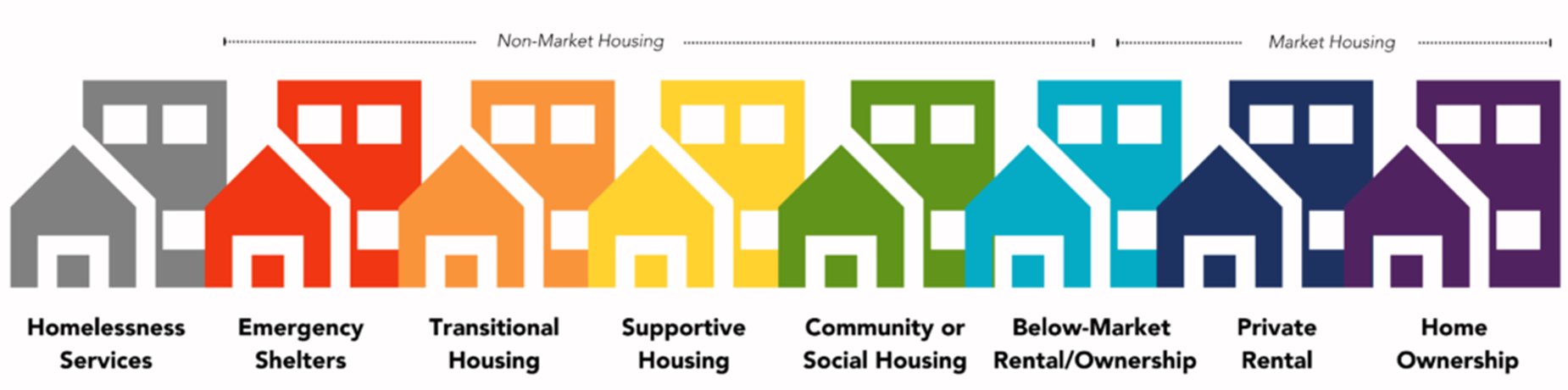
Where does Supportive Housing fit on the Housing Continuum?
The graphic below helps to illustrate the important role Supportive Housing plays in the Housing Continuum:
What is the City's Zoning Interpretation for supportive housing in residential neighbourhoods?
The two different zone categories for the provision of supportive housing are a special needs facility, and a dwelling unit.
Special Needs Facilities
A special needs facility as defined by the KZBL is considered a more intensive supportive housing option. These types of facilities are often designed to accommodate a larger population either in separate rooms or communal rooms, with onsite supports for counselling, management, healthcare, and programmed day services. There is no maximum number of occupants in the regulation. Because of their intensive scale and ability to house a large population, they are permitted by the by-law in select commercial, mixed-use, and institutional zones. The definition in the KZBL is as follows:
Dwelling Units
A dwelling unit is the defined term in the by-law for what constitutes the base needs for a residential building (house, semi-detached house, apartment, etc.) to be considered habitable. Any lot within an Urban Residential Zone is permitted to have up to a maximum of 8 bedrooms, thus limiting the intensity of the use within the low-rise areas of the City (Section 4.28). Definitions for dwelling unit and bedroom are as follows:
Section 6.19 of the KZBL outlines the various housing continuum options that are considered a residential use where it can meet the definition of a dwelling unit as defined in the by-law. These types of facilities are considered less intensive supportive housing options because they are limited to a maximum of eight occupants and no onsite supports like those seen in a special needs facility. Lower occupancy supportive or transitional housing would still have daily workers to attend the site and require an office space within the dwelling. They are permitted in all Urban Residential Zones across the City. The specified types of supportive housing are as follows:
The intent for the supportive housings sites in development across the City are to provide housing for individuals that require support to move into the next step, which is independent living. The use as proposed is supportive / transitional housing under Section 6.19 of the KZBL, on lots within an Urban Residential Zone where they must meet the requirements of the zoning by-law including consisting of a dwelling unit having a maximum of eight bedrooms.
Are there testimonies from neighbours of other Ryandale properties?
Yes! Below are quotes from neighbours of other Ryandale properties in Kingston:
“The Ryandale property and our property are backyard adjacent. We don’t view that property any differently than other properties in our neighbouring community. The residents in the Ryandale home are just like all the other neighbours in our community: peaceful, respectful, quiet, and would lend helping hand if we asked for assistance. We appreciate their smiling faces and friendly waves when we happen to see them outside. We have absolutely no issues or concerns about having a Ryandale property in our community.”
“As a neighbour from Greenwood Park, I was grateful to be welcomed at Ryandale’s community barbecue and to meet several of the men living there. Their openness and effort underscored just how vital — and complex — this work of building community and support truly is.”
Who would a neighbour call about an incident at the property?
The neighbors can contact the Operator using the contact information provided prior to the opening of the home. Once the contact information is available, it will be posted on the Get Involved Kingston Project page and on Ryandale’s website.
What can I do if I do not feel my concern or complaint is being appropriately responded to by the site operator?
If near neighbours have concerns or complaints about the supportive housing operations or the residents' behaviours and they feel these have not been addressed by the operator they are encouraged to report on these to the City. This can be accomplished using the City Service Request portal: https://mycity.cityofkingston.ca/app/ask. Service requests are sent directly to the appropriate staffing department and allow the City to track requests and responses.
Who works for Ryandale? What experience do they have?
Ryandale’s properties are managed and maintained by paid staff with a range of backgrounds and experience. While some members of our team do bring lived experience, not all staff do, and lived experience is not a replacement for education or professional accountability. Our staff include individuals with formal education in social justice, counseling psychology, and related fields, as well as staff currently completing advanced professional training. We also have staff with significant prior professional experience, including a former psychologist and a staff member who just completed his Masters in psychology. As Ryandale does not provide on-site counseling, licensure for clinical practice is not required for that role.
Ryandale staff do not act as counselors or therapists. Our model is focused on housing stability, structure, accountability, and recovery-oriented support. When residents require counseling, mental health treatment, or specialized clinical services, they are referred to appropriate community agencies and providers. This approach ensures residents receive professional clinical care while Ryandale staff focus on day-to-day support, safety, and program delivery.