Local Food

Illustrated graphic with various food stands. A family with two children is walking towards a farmer.

Local Food Economic Development Surveys

We’re seeking feedback from farmers, food producers, restaurants and food service businesses to inform projects related to the City of Kingston’s Food Framework and Rural Economic Development Initiatives including:

  • Foodpreneur Training Program

  • Farm and Agricultural Business Support

  • Succession Planning

  • Networking and Collaborative Opportunities

The surveys are now closed. Reporting out will be published to this page.


Illustrated graphic with various food stands. A family with two children is walking towards a farmer.

Local Food Economic Development Surveys

We’re seeking feedback from farmers, food producers, restaurants and food service businesses to inform projects related to the City of Kingston’s Food Framework and Rural Economic Development Initiatives including:

  • Foodpreneur Training Program

  • Farm and Agricultural Business Support

  • Succession Planning

  • Networking and Collaborative Opportunities

The surveys are now closed. Reporting out will be published to this page.


  • 2025: Local Food Business Surveys

    Why we engaged

    In May 2025, Council adopted the Kingston Food Framework. The framework aims to strengthen Kingston’s local and regional food system by mapping existing programs, identifying collaboration opportunities and creating a structure to monitor progress across five distinct but interconnected pillars.

    In Fall 2025, the local food engagement aimed to gain insights from farmers & food producers and restaurants & food services to better understand how municipal resources and partnerships would support the production and sale of local food in Kingston.

    How we engaged

    Two digital surveys were open from Nov. 3 until Dec. 3. The first survey (Appendix A) focused on farmers and food producers, asking them about local production capacity, sales practices and infrastructure needs among local growers and producers. The second survey (Appendix B) asked restaurants and food services for feedback on how local food is sourced and integrated into menus, examined barriers to procurement and asked about opportunities for partnerships.

    Respondents were also provided with the option to submit their feedback offline. The surveys were shared with various partners and promoted on digital channels including:

    • Direct outreach to the National Farmers’ Union, Kingston’s Rural Working Group, Kingston Economic Development Corporation, Tourism Kingston, Kingston Public Market and Memorial Centre Farmers’ Market
    • Social media posts on the City’s LinkedIn, Facebook, X and Instagram channels
    • Promotion to subscribers of Get Involved Kingston, Kingston Economic Development and Tourism Kingston newsletters
    • Inclusion in weekly Inside Kingston video segment

    Who we heard from

    38 participants completed the surveys. 24 participants completed the Farmer/Food Producers survey:
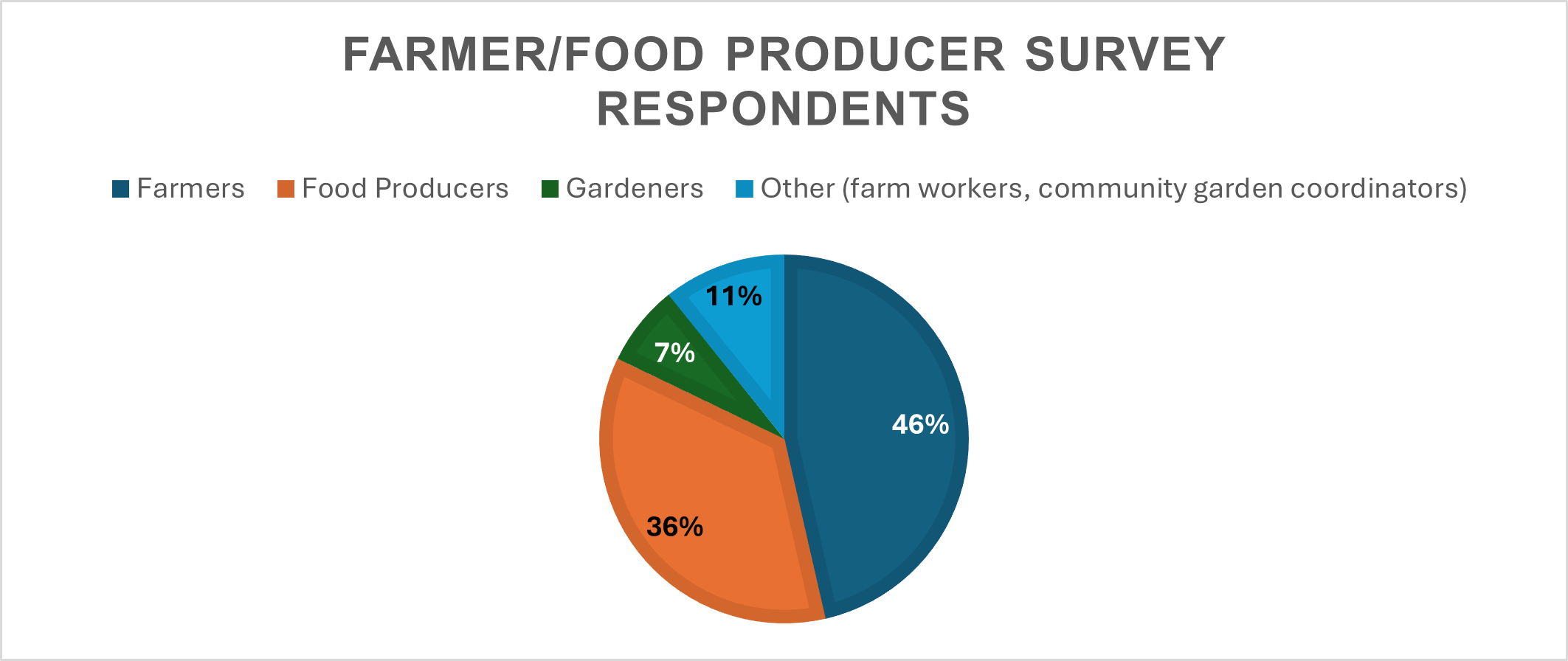
    Fig A: Farmer/Food Producer Survey Respondents. 46% farmers, 36% food producers, 11% other (farmer workinger, community garden coordinators), 7% gardeners

    Figure A: Farmer/food producer survey respondents

    14 participants completed the Restaurant/Food Service survey.
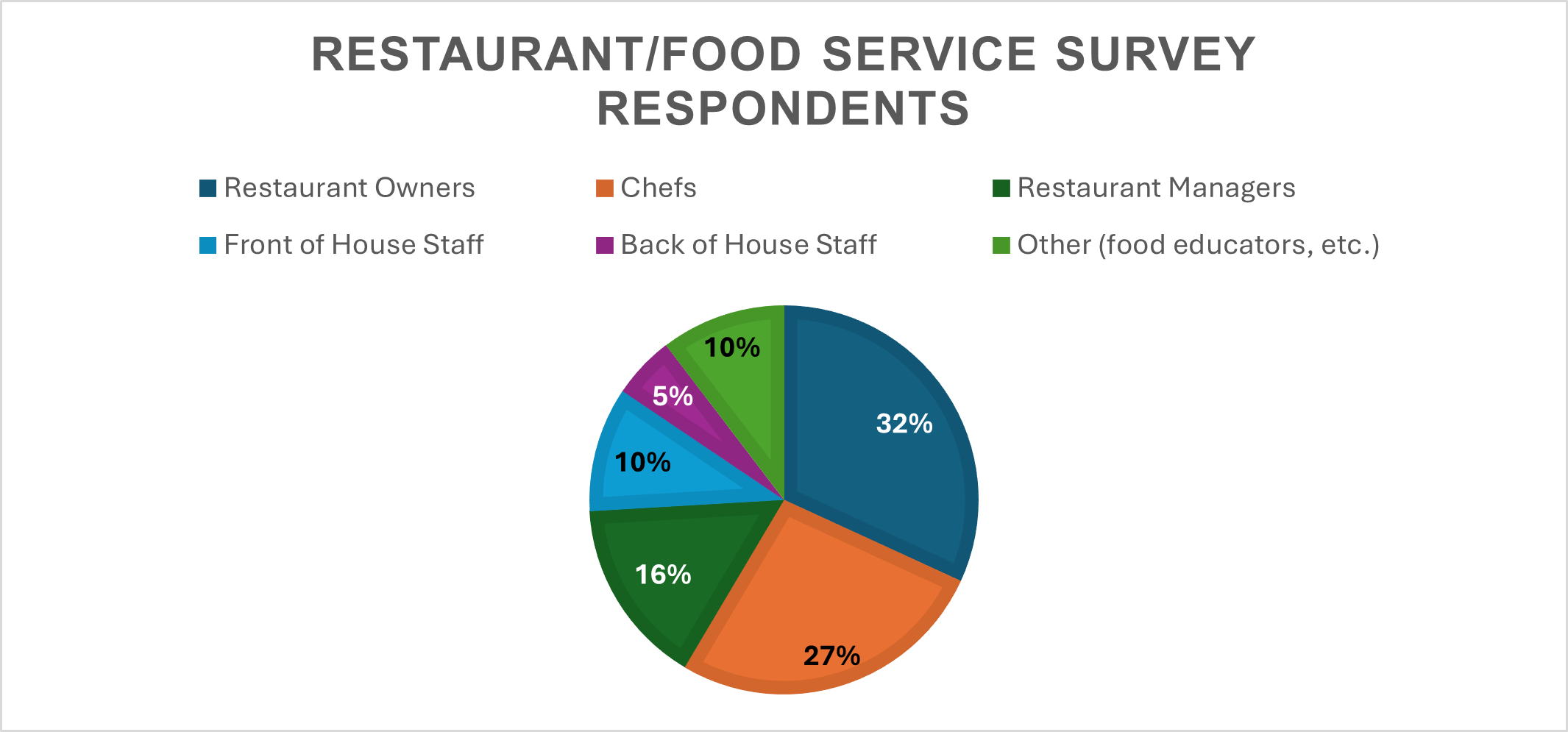
    Fig B: Restaurant/Food Service Survey Respondents: 32% Restaurant Owners, 27% chefs, 16% Restaurant Managers, 10% Front of House, 10% Other (Food educators, etc.), 5% back of house staff

    Figure B: Restaurant/food service survey respondents

    What we heard: Farmer/Food Producer Survey

    Production and Capacity

    79% of respondents sell their products locally (within 100 km), with a wide range of products sold:
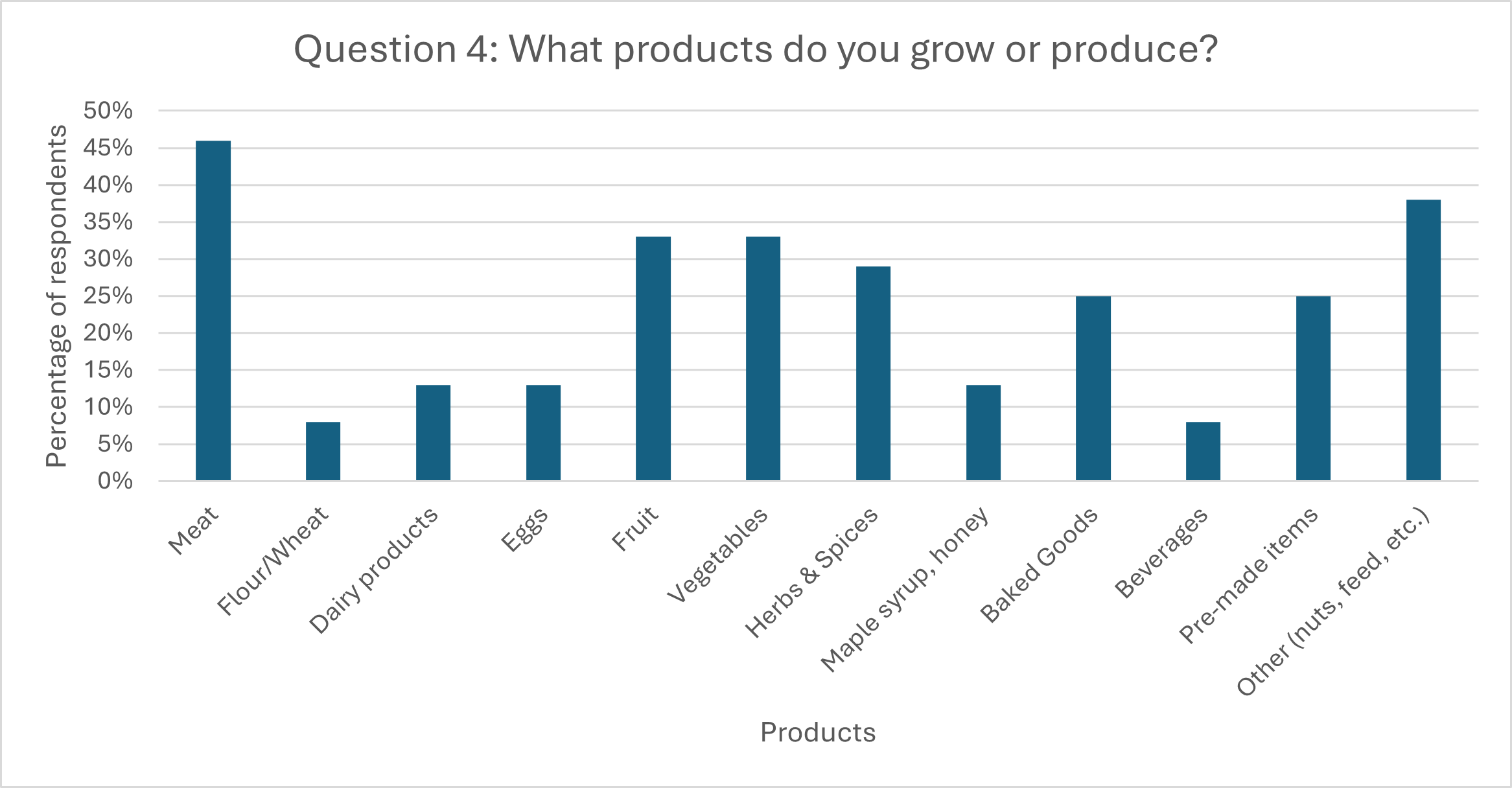
    Fig C: Question 4: What products do you grow or produce? 46% Meat, 8% Flour/Wheat, 13% dairy products, 13% eggs, 33% fruit, 33% vegetables, 29% herbs & spices, 13% maple syrup and honey, 25% baked goods, 8% beverages, 25% beverages, 25% pre-made items, 38% other (nuts, feed, etc.)

    Figure C: Products grown/produced

    50% of respondents said they might consider selling other products if there was more demand.

    • 25% answered that they would like to sell fruit, nuts, frozen meals and meat specifically.
    • One respondent added that it’s “less about demand” and “more about resources and land needed to grow” what they want to.

    50% of respondents agree that certain crops are more profitable when sold locally, specifically: fruit, vegetables, dairy products, beef, chicken and pork.

    • Multiple respondents mention that it’s almost always more profitable to sell locally, as “it costs less to transport” and “it’s easier to keep a loyal customer base.”

    When asked about how respondents manage seasonality and supply consistency, responses included: adjusting production schedules, inventory planning, limiting operations to peak seasons and using year‑round greenhouses. A few respondents answered that they produce shelf-stable products, while others rely on preservation methods (freezing, freeze‑drying, canning). Some mention that they sell year-round at winter markets or via online channels, and others emphasize the need for more resources, including: cold storage and processing (butchering) facilities.

    Respondents expressed interest in access to the following infrastructure and support services:
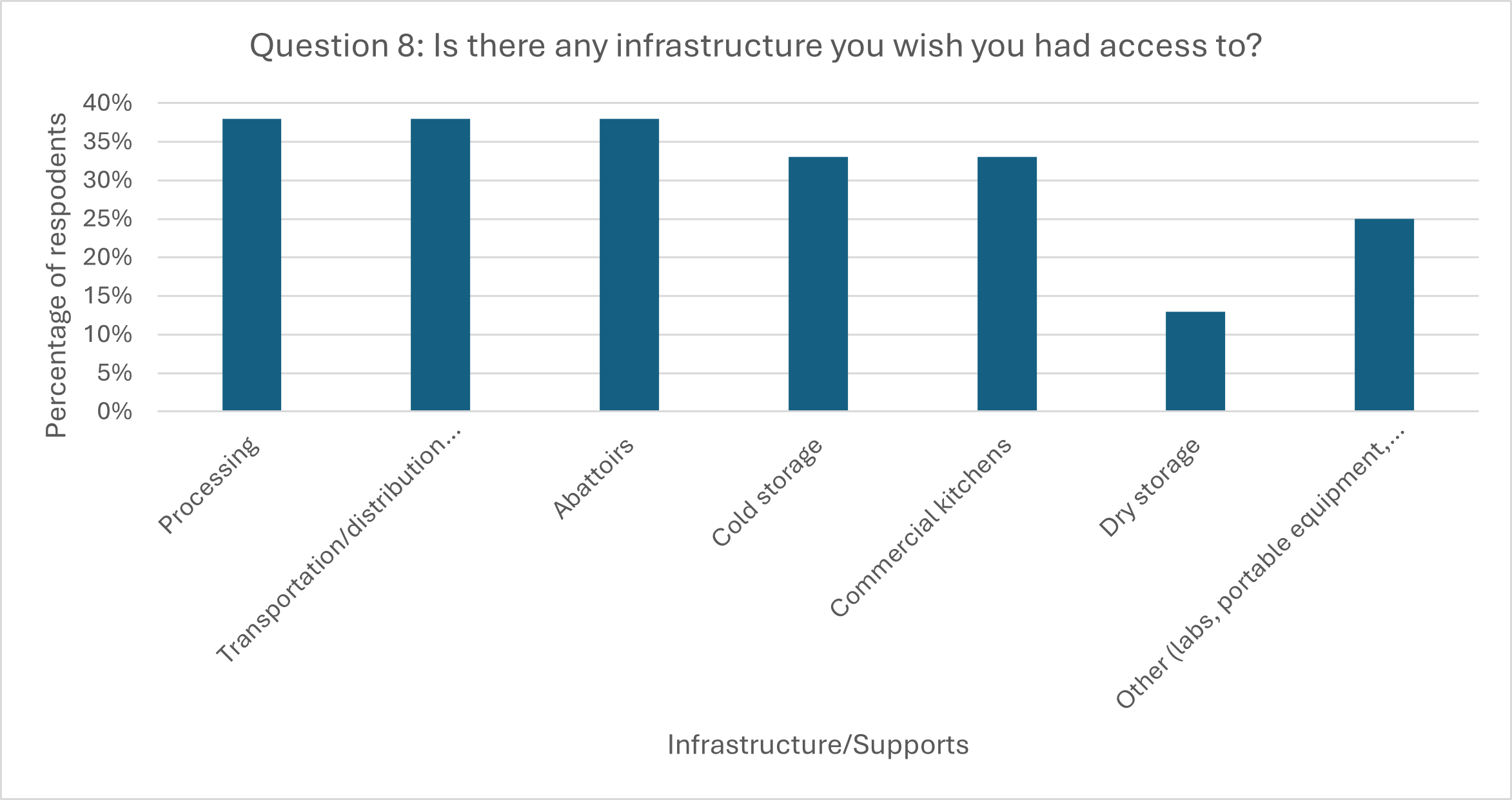
    Fig D: Question 8: Is there any infrastructure you wish you had access to? 38% processing, 38% transportation/distribution support, 38% abattoirs, 33% cold storage, 33% commercial kitchens, 13% dry storage, 25% other (labs, portable equipment, classes)

    Figure D: Infrastructure and supports

    Sales and Distribution

    Of those who sell their products within 100 km, the majority (75%) sell between 76-100% locally. Respondents sell their products to customers using the following channels:
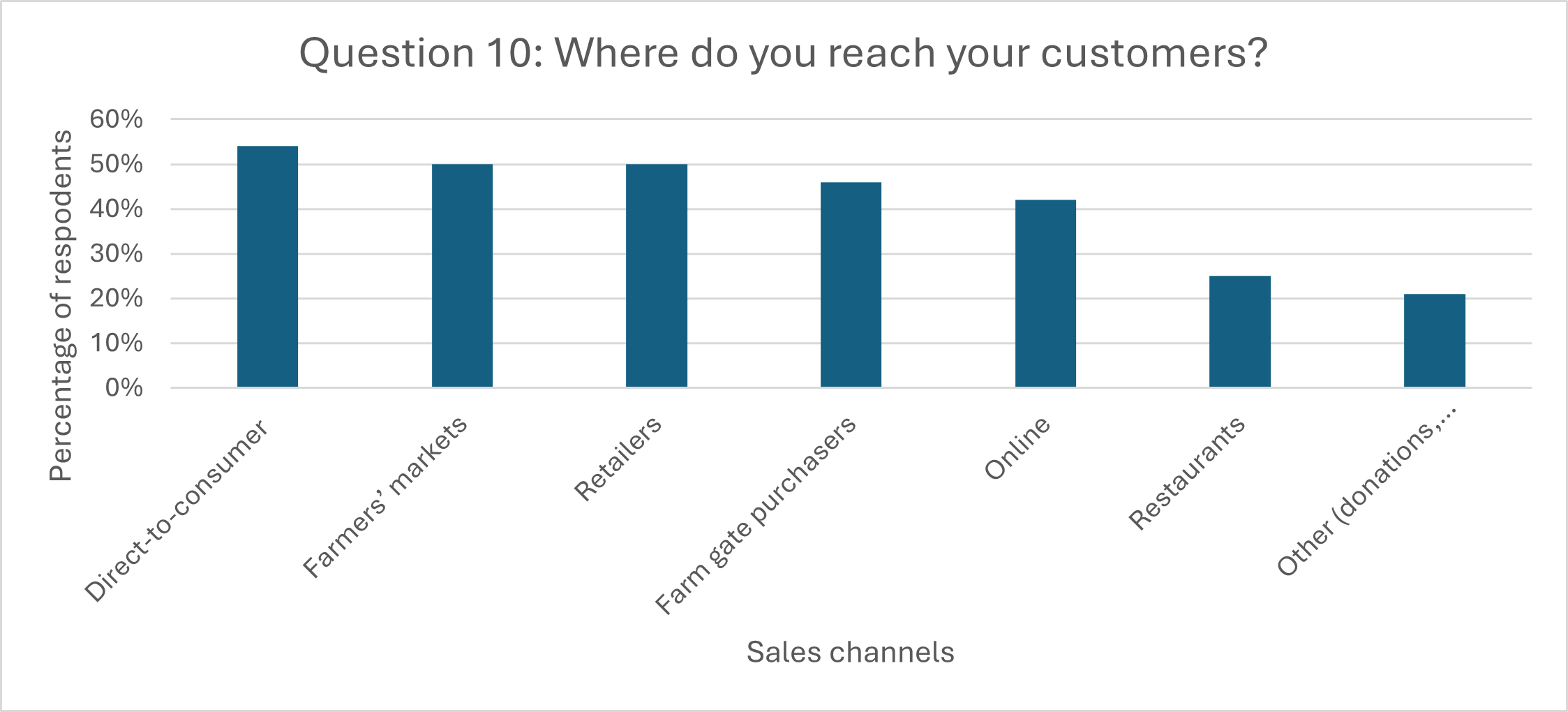
    Fig E: Question 10: Where do you reach your customers? 54% direct-to-consumer, 50% farmers' markets, 50% retailers, 46% farm gate purchasers, 42% online, 25% restaurants, 21% other (donations, collective buying)

    Figure E: Farmers’ distribution channels

    The biggest sales challenges respondents face include: time required to promote and sell (42% of respondents), costs associated with promoting/selling and difficult policies/regulations (29% each), time required to deliver, cost associated with delivery and product availability (25% each) and minimum quantities requested (17%). Other responses provided (38%) include: land ownership challenges, lack of funding, low profitability, maintaining a consistent supply of quality products despite external factors, processing capacity in the region and higher costs for small-scale farms vs. big box stores.

    When asked where restaurants and retailers find them, 54% mentioned existing relationships and 42% selected social media and farmers’ markets, respectively. 38% said they approach restaurants and retailers directly, 33% are found through their website, 17% are contacted by phone, and 13% said buyers visit the farm or purchase through distributors. Half of all respondents noted they were interested in connecting with restaurants and retailers in the future and provided contact information.

    Support & Vision

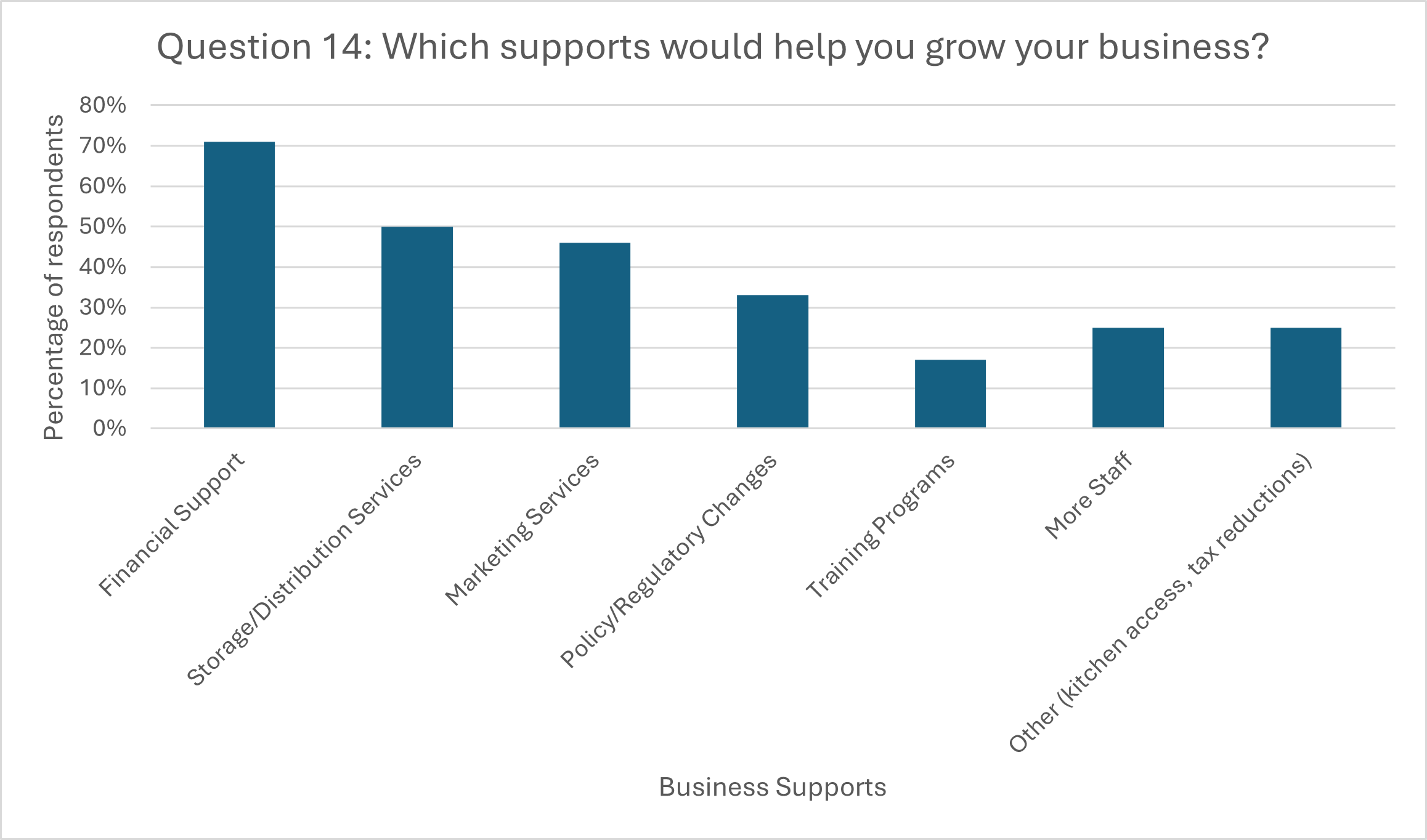
    Respondents emphasized that the following supports would help their businesses:Fig F: Question 14: Which supports would help you grow your business? 71% financial support, 50% storage/distribution services, 46% marketing services, 33% policy/regulatory changes, 17% training programs, 25% more staff, 25% other (kitchen access, tax reductions)

    Figure F: Supports for farmers/food producers

    Finally, respondents provided open-ended feedback about specific challenges they face, including difficulty finding suppliers and lack of access to affordable kitchen spaces and processing facilities. Other respondents stress the need for funding to support local programs and express frustration with provincial policies and public health regulations. One notes that the rising cost of local food production makes competing with larger producers difficult. Suggestions for support include creating an online platform for local food, City-led initiatives like winter greenhouses, subsidies and a municipal local procurement policy. Overall, there is a strong call for practical solutions to strengthen local food systems and foster resilience amid economic uncertainty.

    What we heard: Restaurant/Food Service Survey

    Sourcing and Procurement

    The percentage of food that respondents source locally (within 100 km) varies:

    • 29% source more than 76% of their ingredients locally
    • 57% source more than 50% of their ingredients locally
    • 35% source less than 25% of their ingredients locally

    The following products are being purchased from farms, local retailers, butchers and distributors: vegetables (purchased by 86% of respondents), meat (79%), maple syrup/honey (64%), eggs (50%), dairy products (43%), beverages (36%), fruits (29%), flour, pre-made items such as sauces and jams, herbs and spices (29% each) and baked goods (21%).

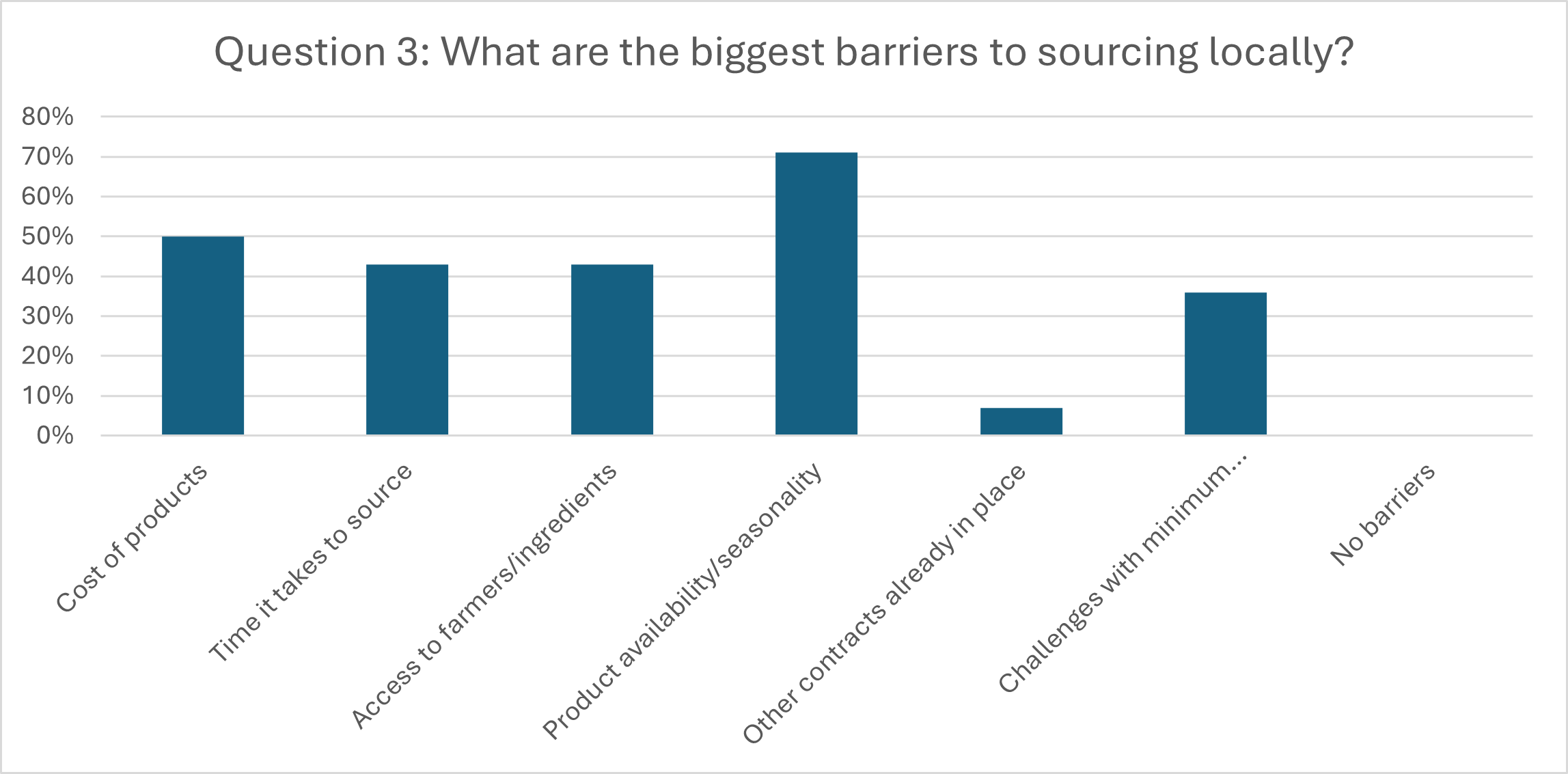
    All respondents identified barriers to sourcing more local ingredients:Fig G: Question 3: What are the biggest barriers to sourcing locally? 50% cost of products, 43% time it takes to source, 43% access to farmers/ingredients, 71% product availability/seasonality, 7% other contracts already in place, 35% challenges with minimum quantities, 0% no barriers

    Figure G: Barriers for restaurants sourcing locally

    One respondent noted that there are fewer farm suppliers than there used to be. Another answered that they would benefit from a directory of what is available and where (with contact information). Nearly all respondents (93%) said they would use more local food if it were easier to access.

    The following local products were stated as items that they regularly look for but can’t find: malted bakery flour, wholesale cheese, dried chickpeas, meat (rabbits, pork on consistent basis), fresh high-quality produce and Asian cuisine (specifically meat and deli).

    More than half of respondents (57%) prioritize certifications (such as organic, pasture-raised, etc.) in local sourcing. 14% responded “sometimes,” specifying that they do for meat or that that they seek information on farming practices on their own.

    Menu and Marketing

    14% of respondents noted they were accredited with the ‘Feast On’ food certification program. 43% are interested in receiving local food accreditation. Responses as to why respondents are not accredited include that there is no perceived benefit (does not increase customers as accreditations are not widely known), they have simply not pursued it yet and that it does not fit with their service (food literacy). One respondent expresses a desire for a tax levy for businesses who support local by contributing to the cost of the accreditation.

    When asked about the role of local food, the majority of respondents state that local food is promoted on their restaurant’s menu (93%), local food plays a role in their restaurant’s identity (86%) and local food ingredients support menu creativity (71%). 57% agreed that customers ask where food is sourced from, but only 29% feel that local food accreditations are an asset for their business.

    Relationships and Community

    Most respondents (71%) are interested in exploring additional partnership opportunities with local producers and an additional 14% “might be” interested (depending on logistics). Supports that would help respondents source more local food include: directories, long-term partnerships with local farms/suppliers, direct purchasing ingredients and support for all levels of government. Others state that prices and local climate are barriers to sourcing more local food.

    When asked for advice on how restaurants could incorporate more local food, respondents emphasized the importance of 1) having a good personal relationship with farmers, 2) sharing information about food sources directly with customers, and 3) understanding the benefits of keeping money local.

    Finally, respondents added that supporting local farmers could be done by ‘creating seasonal and local menus.’ There were also suggestions for other ways the municipality can support businesses outside of local food partnerships including maintenance of City facilities (i.e. public washrooms), equal representation in marketing campaigns and parking discounts for restaurant staff.

    Next Steps

    Results from this engagement will be shared with Council in the first quarter of 2026 to inform current municipal programs, including agricultural business support, collaborations with local economic partners and the development of the food entrepreneur training program. Some respondents expressed interest in future engagement, and staff will explore potential for ongoing conversations

    Overall Summary

    While Kingston has a strong foundation for its local food system, the landscape for producers and restaurants remains fragmented, with significant gaps in infrastructure, communication and coordination. Information flow is inconsistent, relationships are informal and supply chain linkages depend on individual effort rather than a structured system.

    The feedback received from this engagement has strong alignment with the goals of the Kingston Food Framework. Results suggest that targeted investment in physical assets, matchmaking programs and business assistance could support both producers and purchasers, stimulate rural economic growth and help build a more resilient and connected food system.

    Appendix A – Farmer/Food Producer Survey Questions

    1. Which of the following best describes your role?

    • Farmer
    • Food producer
    • Gardener
    • Other (please specify)

    2. Do you sell your products to customers, retailers, institutions or restaurants locally (within 100km)?

    • Yes
    • No

    3. If no, would you like to?

    • Yes
    • No
    • Maybe/depends (please specify)

    4. What products do you grow or produce? Check all that apply.

    • Meat
    • Fruits
    • Vegetables
    • Flour, wheat, etc.
    • Dairy products including milk, cheese, yogurt
    • Eggs
    • Maple syrup, honey
    • Herbs, spices, mixes
    • Pre-made items such as sauces, jams, pickles, etc.
    • Beverages
    • Baked goods
    • Other (please specify)

    5. Are there products you would grow or produce if more local demand existed?

    • Yes (please specify)
    • Maybe/unsure
    • No

    6. Are there certain crops or livestock that are more profitable when sold locally?

    • Yes (please specify)
    • Maybe/unsure
    • No/not applicable to my business

    7. How do you manage seasonality and supply consistency for local buyers?

    8. Is there any infrastructure you wish you had access to?

    • Cold storage
    • Dry storage
    • Transportation/distribution
    • Processing
    • Commercial kitchens
    • Abattoirs
    • Other (please specify)

    9. What percentage of your products are sold locally (within 100km)?

    • Less than 10%
    • 10-25%
    • 26-50%
    • 51-75%
    • 76-100%

    10. Where do you reach your customers to sell your product(s)?

    • Restaurants
    • Farmers’ Markets
    • Farm Gate Purchasers
    • Retailers
    • Direct to consumer
    • Online
    • Other (please specify)

    11. What are your biggest challenges in selling food to local buyers?

    • Time required to deliver
    • Time required to promote & sell
    • Cost associated with delivering
    • Cost associated with promoting & selling
    • Minimum quantities or product sizes requested
    • Difficult policies and regulations
    • My products aren’t always available when requested
    • Other (please specify)

    12. How do restaurants and retailers typically find you?

    • Website/online search
    • Social media
    • Phone call
    • Visit the farm
    • Approached at farmers’ markets
    • Existing relationships
    • I approach restaurants & retailers
    • Distributors
    • Other (please specify)

    13. If you are interested in connecting to restaurants and/or retailers in the future, please provide your contact information.

    14. What supports would help you grow your business?

    • Financial supports (i.e. grants, loans, government investments)
    • Training programs
    • Share storage and/or distribution services
    • Policy & regulatory changes
    • Marketing support
    • More staff
    • Other (please specify)

    15. Do you have any other feedback you would like to share related to local food production?

    16. If you are interested in being contacted for future engagement and/or communications about related opportunities, please provide your contact information.

    Appendix B – Restaurant/Food Service Survey Questions

    1. What descriptor best describes your role in the industry? Select all that apply.

    • Chef
    • Owner
    • Manager
    • Front of house staff
    • Back of house staff
    • Other (please specify)

    2. What percentage of your ingredients are sourced locally, within 100km?

    • Less than 10%
    • 10-25%
    • 26-50%
    • 51-75%
    • 76-100%
    • Unsure

    3. What are the biggest barriers to sourcing more local ingredients?

    • Cost of products
    • Time it takes to source products
    • Access to farmers and local ingredients
    • Variety/nature of products available (i.e. seasonality)
    • Other contracts already in place
    • Challenges with minimum quantities or sizes available
    • No barriers
    • Other (please specify)

    4. What types of local products are you currently purchasing from a farm, local retailer, abattoir, butcher or distributor who sells local food? Check all that apply.

    • Meat
    • Fruits
    • Vegetables
    • Flour, wheat, etc.
    • Dairy products including milk, cheese, yogurt
    • Eggs
    • Maple syrup, honey
    • Herbs, spices, mixes
    • Pre-made items such as sauces, jams, pickles, etc.
    • Beverages
    • Baked goods
    • Other (please specify)

    5. Are there particular local ingredients, products you regularly look for but can’t find? If yes, please answer below.

    6. Would you use more local food if it were easier to access or order?

    • Yes
    • No
    • Depends/maybe
    • Unsure

    7. Do you prioritize any certifications (organic, pasture-raised, federally or provincially inspected, etc.) in local sourcing?

    • Yes
    • No
    • For some products (please specify)

    8. Do you have any other comments on the sourcing and procurement of local food?

    9. Are you accredited with any local food certification programs (i.e. Feast On)?

    • No, and I am not interested in being accredited
    • No, but I am interested in being accredited
    • Prefer not to say
    • Yes (please specify)

    10. If you are not accredited with a local food certification program, what is the barrier?

    11. How much do you agree with the following statements? (Rated: strongly disagree, disagree, neutral, agree, strongly agree).

    • Local food ingredients support my menu creativity
    • Local food plays a role in my restaurant’s identity or values
    • Local food is promoted on my restaurant’s menu or in my branding
    • Customers ask where food is sourced from
    • Local food accreditations (such as Feast On) are a valuable asset for a business

    12. Are you interested in exploring new/additional partnership opportunities with local producers?

    • Yes
    • No
    • Depends/maybe

    13. What kind of support would help you source more local food? Examples: direct purchasing agreements (CSA-style sourcing), long-term partnerships with local farms/suppliers, a directory of products with contact information, etc.

    14. What advice would you give to new restaurants trying to incorporate more local food?

    15. Is there any other feedback you would like to share related to local food in restaurants?

    16. If you are interested in being contacted for future engagement and/or communications on related opportunities, please provide your contact information.

  • 2023 Community Survey: Reporting Out

    Why we engaged

    The City of Kingston and its partners are looking to develop a local food strategy. With the goal of better understanding the perceptions and food-buying habits of Kingstonians, a survey was conducted to collect feedback to inform the strategy.

    This engagement directly supports the strategic priority of supporting local food, food production, agriculture, food security and sovereignty.

    How we engaged

    A survey was conducted on Get Involved Kingston from June 28 until August 18. The community was provided with the opportunity to engage online, by phone, by email or in-person at pop-up events, including Canada Day in Shannon Park and Pride at City Park. Social media and the Get Involved Kingston Newsletter were used to communicate this opportunity to the public, and the survey was also shared via email with city councillors and community partners such as Loving Spoonful and the Memorial Market.

    As an incentive for participation, respondents were invited to submit their email in a draw for a $100 grocery gift card. The draw was completed, and the winner was contacted on October 11, 2023.

    Who we heard from

    • 880 engaged participants completed the survey, with 870, or 98%, of respondents being consumers as compared to only 9% reporting they were farmers, home business or a community gardener.
    • 2,203 aware participants visited the project page
    • 80 participants engaged with the City for the first time on Get Involved Kingston


    What we heard

    It was important for staff to collect a broad range of opinions on a variety of topics related to food, and as a result, the survey was 16 questions long and took approximately 10 minutes to complete. The following is a summary of responses and themes identified by staff. Verbatim feedback and full results of the survey are available below in Exhibit C.

    Definition of local (Question 1)

    Nearly all respondents understood what “local food” meant when asked in a multiple-choice question, with the majority of respondents answered that local food mean that it was either grown in my region (80%), grown in Ontario (54%) or grown within 100 km (53%). Less than 1% said that they did not know what local food meant.

    Purchasing habits (Questions 2, 4, 5, and 6)

    In the past year, most respondents have bought local food weekly, with 90% of people buying local food in the past year, and 53% purchasing it weekly. Purchases of local food were most often made at local grocery stores (74%), farmers’ markets (72%) or at a farm or farm gate (47%). Culturally-specific food stores (4%) and online (6%) were the least frequent food purchase locations. The majority of respondents go out of their way to buy local food (90%) and find it easy to find it easy to get locally produced foods (80%). Most respondents are also willing to pay more for local food (70%) however half of respondents don’t believe the cost is comparable to food that isn’t grown or produced locally (50%).

    Barriers to buying local food (Question 8)

    A variety of barriers face respondents when they buy local food. These include the amount of time it takes to find local food or read labels (55% feel it is too long), and knowing if food is local or not in the store (45%) or in restaurants (72%). If food was specific to Indigenous producers would not influence a purchase according to survey respondents.

    Convenience, labelling and awareness key to influencing purchase behaviours (Question 9)

    If local food was more convenient to access, a large majority of respondents would purchase and consume it more often (83%). Wider availability in big box stores (80%), wider availability of products in winter (70%) and lower prices (73%) would also influence respondents to buy local foods more often. Visiting farms (18%) or participating in growing local food (19%) would have the least influence on purchasing behaviours. Clear labeling (42%) was moderately important to respondents and having more information available about local food being the least area of influence (16%).

    Next steps

    The results from this public engagement will be shared with the Rural Advisory Committee, and related departments. The feedback will be considered for the development of a local food strategy and provide messaging for future public awareness campaigns, as well as projects/programs to support Council Strategic Priorities related to food.

    Exhibit C

    All feedback, including verbatim written comments and number of responses to each question in the survey are included below. Feedback that does not follow the Guidelines for Participation are removed from the public engagement summary.


    Question one: What does “local food” mean to you? Check all that apply.

    • 477 participants selected “Ontario grown
    • 702 participants selected “Grown in my region
    • 144 participants selected “Grown in Canada
    • 12 participants selected “Grown in my country of birth
    • 233 participants selected “Grown on a family farm
    • 468 participants selected “Grown within 100 km
    • 228 participants selected “Processed in my region
    • 155 participants selected “Processed in Ontario
    • 53 participants selected “Processed in Canada
    • 13 participants selected “I’m not sure what local food means
    • Ten participants selected “Other


    Question two: Have you bought local food in the last 12 months?

    • 800, or 90.9 per cent of participants responded “Yes
    • 80, or 6.8 per cent of participants responded “I’m not sure
    • 20, or 2.3 per cent of participants responded “No”


    Question three: If you purchased local food in the past 12 months, which of the following did you purchase? Check all that apply.

    • 789 participants selected “vegetables
    • 670 participants selected “fruits
    • 393 participants selected “meat
    • 445 participants selected “cheese
    • 534 participants selected “maple syrup/honey
    • 168 participants selected “herbs, spices, mixes
    • 101 participants selected “ethnic foods
    • 94 participants selected “other


    Question four: If you have purchased local food in the past 12 months, how regularly do you purchase local food?

    • 369, or 43.6 per cent of participants responded “weekly
    • 269, or 31.8 per cent of participants responded “monthly
    • 177, or 10.9 per cent of participants responded “occasionally (once every few months)”
    • 32, or 3.8 per cent responded “rarely (a few times per year)”


    Question five: If you purchased local food in the past 12 months, where did you purchase it? Check all that apply.

    • 625 participants selected “local grocery store
    • 401 participants selected “farm or farm gate sale
    • 157 participants selected “health food store
    • 37 participants selected “culturally specific food store
    • 70 participants selected “residential food business
    • 151 participants selected “community-supported agriculture (including farm subscriptions and community gardens)”
    • 612 participants selected “farmer’s markets
    • 53 participants selected “online “via social media or digital platform
    • 89 participants selected “other local food supplier


    Question six: The following statements ask you about your food purchasing habits.

    • Whenever possible, I intentionally buy locally produced food
      • Two participants selected “definitely disagree
      • 37 participants Selected “somewhat disagree
      • 93 participants selected “neither agree nor disagree
      • 318 participants selected “somewhat agree
      • 397 participants selected “definitely agree
    • I make it a priority to buy locally produced food
      • 35 participants selected “definitely disagree
      • 87 participants Selected “somewhat disagree
      • 150 participants selected “neither agree nor disagree
      • 305 participants selected “somewhat agree
      • 290 participants selected “definitely agree
    • I find it easy to get locally produced foods in the summer
      • 27 participants selected “definitely disagree
      • 71 participants Selected “somewhat disagree
      • 71 participants selected “neither agree nor disagree
      • 346 participants selected “somewhat agree
      • 359 participants selected “definitely agree
    • I find it easy to get locally produced foods in the winter
      • 218 participants selected “definitely disagree
      • 379 participants Selected “somewhat disagree
      • 115 participants selected “neither agree nor disagree
      • 144 participants selected “somewhat agree
      • 18 participants selected “definitely agree
    • I have little choice whether the foods I buy are locally grown
      • 91 participants selected “definitely disagree
      • 223 participants Selected “somewhat disagree
      • 209 participants selected “neither agree nor disagree
      • 265 participants selected “somewhat agree
      • 81 participants selected “definitely agree
    • I am willing to pay more for local food to support local farmers and food producers
      • 45 participants selected “definitely disagree
      • 97 participants Selected “somewhat disagree
      • 118 participants selected “neither agree nor disagree
      • 391 participants selected “somewhat agree
      • 229 participants selected “definitely agree
    • The cost of local food is comparable to what I would otherwise buy at a grocery store
      • 113 participants selected “definitely disagree
      • 293 participants Selected “somewhat disagree
      • 158 participants selected “neither agree nor disagree
      • 262 participants selected “somewhat agree
      • 53 participants selected “definitely agree


    Question seven: The following statements ask you about your perceptions of local food.

    • The quality of local food is usually very high
      • Zero participants selected “definitely disagree
      • Nine participants Selected “somewhat disagree
      • 78 participants selected “neither agree nor disagree
      • 289 participants selected “somewhat agree
      • 500 participants selected “definitely agree
    • Local food stays fresh for as the same length of time as does nonlocal food
      • 39 participants selected “definitely disagree
      • 130 participants Selected “somewhat disagree
      • 192 participants selected “neither agree nor disagree
      • 236 participants selected “somewhat agree
      • 277 participants selected “definitely agree
    • I know what types of foods are available seasonally in our region
      • 22 participants selected “definitely disagree
      • 74 participants Selected “somewhat disagree
      • 78 participants selected “neither agree nor disagree
      • 385 participants selected “somewhat agree
      • 315 participants selected “definitely agree
    • It is possible to eat local foods all year-round
      • 108 participants selected “definitely disagree
      • 265 participants Selected “somewhat disagree
      • 174 participants selected “neither agree nor disagree
      • 247 participants selected “somewhat agree
      • 77 participants selected “definitely agree
    • The government should promote buying locally grown food
      • 17 participants selected “definitely disagree
      • 23 participants Selected “somewhat disagree
      • 96 participants selected “neither agree nor disagree
      • 198 participants selected “somewhat agree
      • 539 participants selected “definitely agree
    • The government should promote the institutional purchasing of locally grown food (e.g. for hospitals, schools, prisons)
      • 22 participants selected “definitely disagree
      • 25 participants Selected “somewhat disagree
      • 92 participants selected “neither agree nor disagree
      • 221 participants selected “somewhat agree
      • 518 participants selected “definitely agree
    • It does not matter to me if my food is locally grown
      • 406 participants selected “definitely disagree
      • 279 participants Selected “somewhat disagree
      • 118 participants selected “neither agree nor disagree
      • 52 participants selected “somewhat agree
      • 23 participants selected “definitely agree
    • It does not matter to me if my food is locally processed
      • 305 participants selected “definitely disagree
      • 305 participants Selected “somewhat disagree
      • 155 participants selected “neither agree nor disagree
      • 78 participants selected “somewhat agree
      • 27 participants selected “definitely agree
    • Buying local food is a way to maintain the vibrancy of rural communities in Ontario
      • Six participants selected “definitely disagree
      • Zero participants Selected “somewhat disagree
      • 69 participants selected “neither agree nor disagree
      • 229 participants selected “somewhat agree
      • 566 participants selected “definitely agree
    • Buying local food reduces the threat of losing family farms to suburban sprawl and large industrial farms
      • 12 participants selected “definitely disagree
      • 22 participants Selected “somewhat disagree
      • 67 participants selected “neither agree nor disagree
      • 210 participants selected “somewhat agree
      • 561 participants selected “definitely agree
    • Buying local food helps me connect with my culture
      • 73 participants selected “definitely disagree
      • 84 participants Selected “somewhat disagree
      • 372 participants selected “neither agree nor disagree
      • 165 participants selected “somewhat agree
      • 182 participants selected “definitely agree
    • Buying local is important to support the local economy
      • 5 participants selected “definitely disagree
      • 9 participants Selected “somewhat disagree
      • 46 participants selected “neither agree nor disagree
      • 225 participants selected “somewhat agree
      • 589 participants selected “definitely agree
    • Buying local is a positive choice for the environment
      • 11 participants selected “definitely disagree
      • 9 participants Selected “somewhat disagree
      • 74 participants selected “neither agree nor disagree
      • 181 participants selected “somewhat agree
      • 601 participants selected “definitely agree


    Question eight: The following statements ask you about barriers to buying local food.

    • The distance I have to travel to buy local food is difficult
      • 140 participants selected “definitely disagree
      • 234 participants Selected “somewhat disagree
      • 194 participants selected “neither agree nor disagree
      • 257 participants selected “somewhat agree
      • 52 participants selected “definitely agree
    • The amount of time it takes to find local food (e.g. having to read labels and travel to different stores and markets) is challenging
      • 94 participants selected “definitely disagree
      • 149 participants Selected “somewhat disagree
      • 152 participants selected “neither agree nor disagree
      • 353 participants selected “somewhat agree
      • 127 participants selected “definitely agree
    • Ethnocentric food is limited in my region
      • 37 participants selected “definitely disagree
      • 90 participants Selected “somewhat disagree
      • 434 participants selected “neither agree nor disagree
      • 215 participants selected “somewhat agree
      • 95 participants selected “definitely agree
    • I am concerned that local food does not meet public health standards
      • 486 participants selected “definitely disagree
      • 200 participants Selected “somewhat disagree
      • 121 participants selected “neither agree nor disagree
      • 46 participants selected “somewhat agree
      • 17 participants selected “definitely agree
    • I find it difficult to know if food is local or not
      • 112 participants selected “definitely disagree
      • 217 participants Selected “somewhat disagree
      • 150 participants selected “neither agree nor disagree
      • 320 participants selected “somewhat agree
      • 72 participants selected “definitely agree
    • I would order more locally produced foods in restaurants if the menu items were clearly marked as locally grown
      • 21 participants selected “definitely disagree
      • 35 participants Selected “somewhat disagree
      • 188 participants selected “neither agree nor disagree
      • 289 participants selected “somewhat agree
      • 340 participants selected “definitely agree
    • I would like to purchase/consume food that is specific to Indigenous people and/or my own cultural upbringing
      • 88 participants selected “definitely disagree
      • 82 participants Selected “somewhat disagree
      • 421 participants selected “neither agree nor disagree
      • 169 participants selected “somewhat agree
      • 116 participants selected “definitely agree


    Question nine: What would make you more likely to purchase and consume local foods? Check all that apply.

    • 704 participants selected “wider availability of products in the winter
    • 336 participants selected “wider availability of processed products (jams, sauces)
    • 728 participants selected “availability in my local store
    • 201 participants selected “the opportunity to visit local farms
    • 116 participants selected “the chance to participate in growing
    • 267 participants selected “the option to purchase in bulk from local farmers
    • 213 participants selected “knowing the farmer
    • 644 participants selected “lower prices
    • 142 participants selected “more information about the importance of buying local food
    • 370 participants selected “clearer, more specific labeling
    • 615 participants selected “wider availability in big box stores (i.e., Walmart & Costco) or large grocery chain (i.e., Loblaws, Metro, etc.)”
    • 397 participants selected “having a central location to purchase local foods
    • 449 participants selected “more convenient access to locations that sell local foods
    • 192 participants selected “wider access to indigenous food and cuisine
    • 165 participants selected “variety of ethnocentric food made available commercially
    • 9 participants selected “nothing
    • 29 participants selected “other


    Question ten: What is your role (or roles) in the local food economy? Check all that apply.

    • 870 participants selected “Consumer
    • 76 participants selected “producer (farmer, home business or community gardener, etc.)”
    • Nine participants selected “processor (dairies and cheesemakers, slaughterhouses, butchers, canneries, brewers and winemaker, community kitchens, food venture centres)”
    • Nine participants selected “distributor (marketing, transportation, sourcing local foods)”
    • Seven participants selected “government agent (policy maker, council member, etc.)”
    • 51 participants selected “educators (teacher, researcher, etc.)”
    • 41 participants selected “contributor (funder, investor, non-profit, grassroots, volunteer, etc.)”
    • 41 participants selected “other
Page last updated: 23 Jan 2026, 11:56 AM