2025: Local Food Business Surveys
Why we engaged
In May 2025, Council adopted the Kingston Food Framework. The framework aims to strengthen Kingston’s local and regional food system by mapping existing programs, identifying collaboration opportunities and creating a structure to monitor progress across five distinct but interconnected pillars.
In Fall 2025, the local food engagement aimed to gain insights from farmers & food producers and restaurants & food services to better understand how municipal resources and partnerships would support the production and sale of local food in Kingston.
How we engaged
Two digital surveys were open from Nov. 3 until Dec. 3. The first survey (Appendix A) focused on farmers and food producers, asking them about local production capacity, sales practices and infrastructure needs among local growers and producers. The second survey (Appendix B) asked restaurants and food services for feedback on how local food is sourced and integrated into menus, examined barriers to procurement and asked about opportunities for partnerships.
Respondents were also provided with the option to submit their feedback offline. The surveys were shared with various partners and promoted on digital channels including:
- Direct outreach to the National Farmers’ Union, Kingston’s Rural Working Group, Kingston Economic Development Corporation, Tourism Kingston, Kingston Public Market and Memorial Centre Farmers’ Market
- Social media posts on the City’s LinkedIn, Facebook, X and Instagram channels
- Promotion to subscribers of Get Involved Kingston, Kingston Economic Development and Tourism Kingston newsletters
- Inclusion in weekly Inside Kingston video segment
Who we heard from
38 participants completed the surveys. 24 participants completed the Farmer/Food Producers survey:
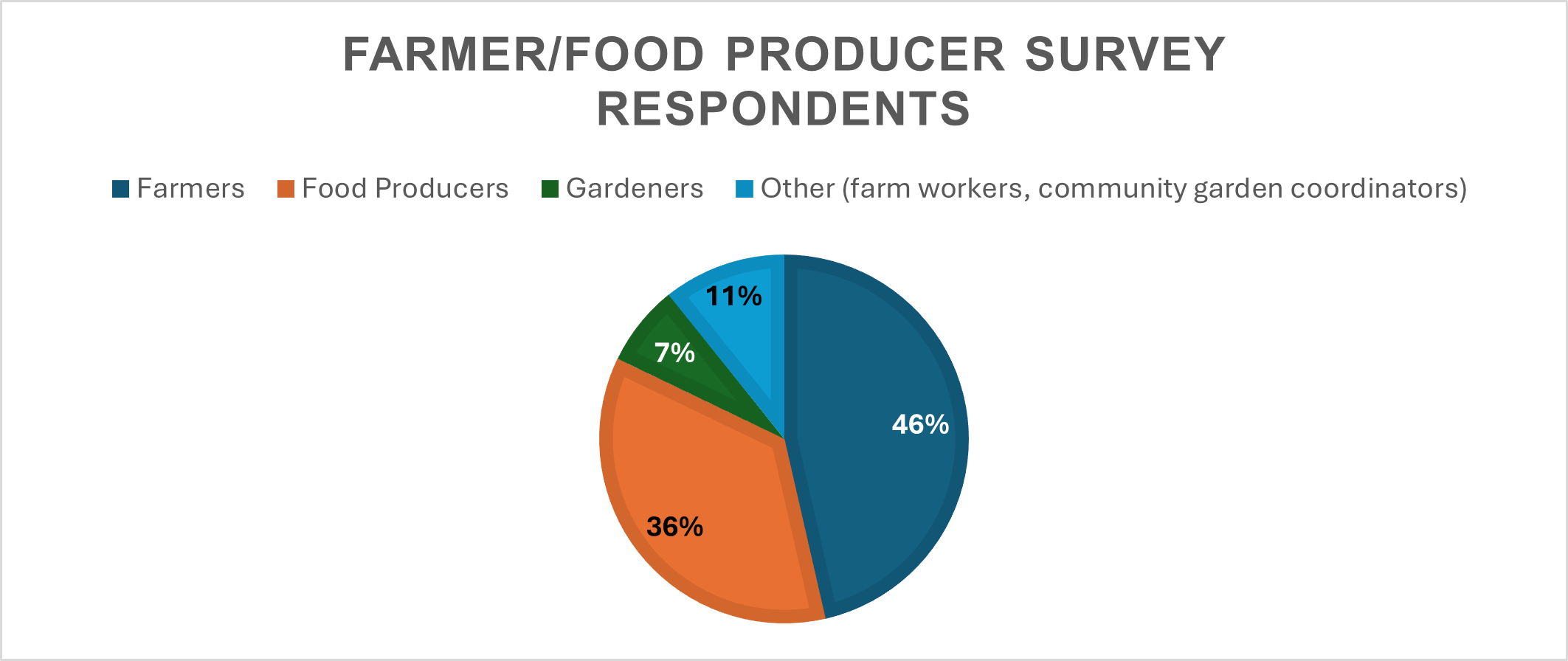
Figure A: Farmer/food producer survey respondents
14 participants completed the Restaurant/Food Service survey.
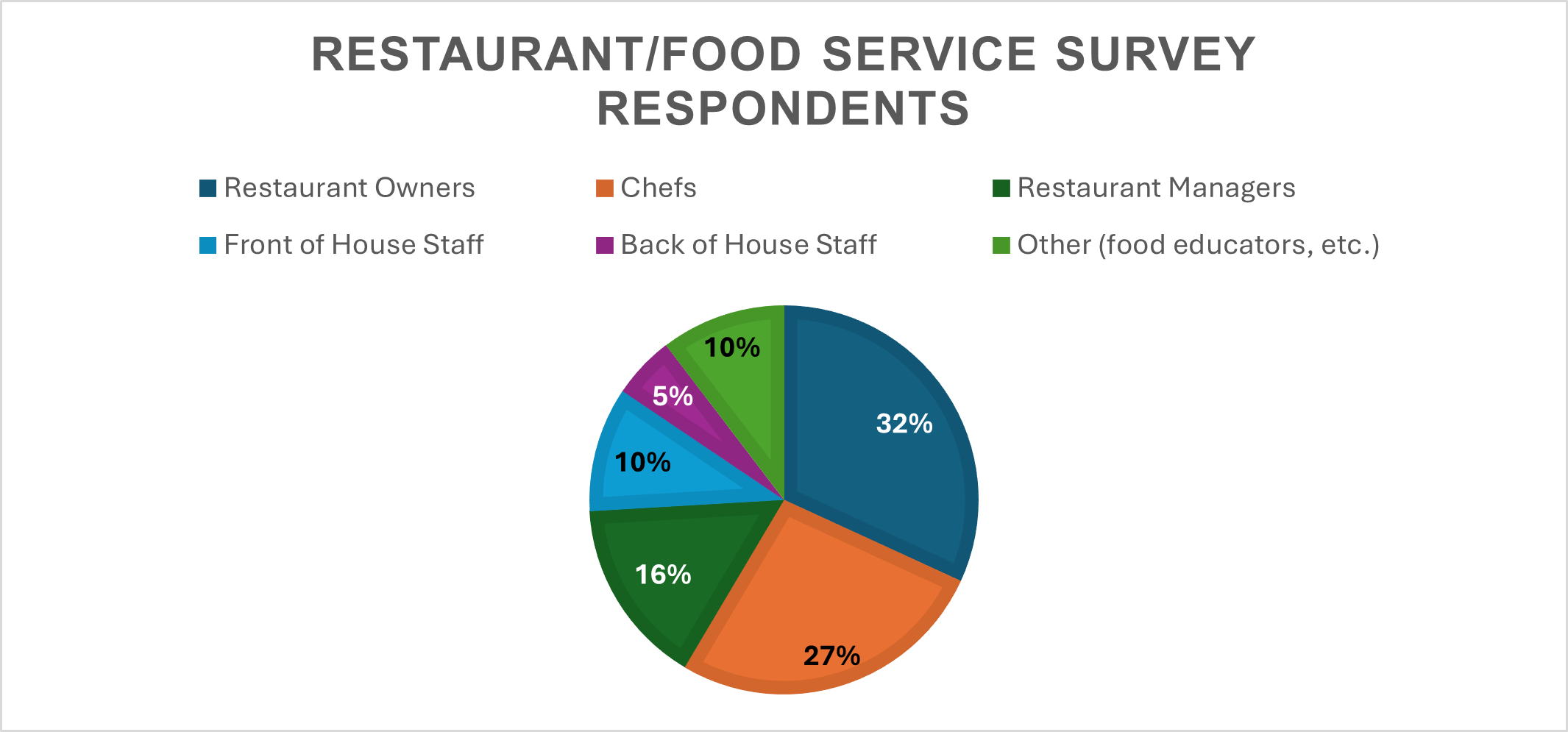
Figure B: Restaurant/food service survey respondents
What we heard: Farmer/Food Producer Survey
Production and Capacity
79% of respondents sell their products locally (within 100 km), with a wide range of products sold:
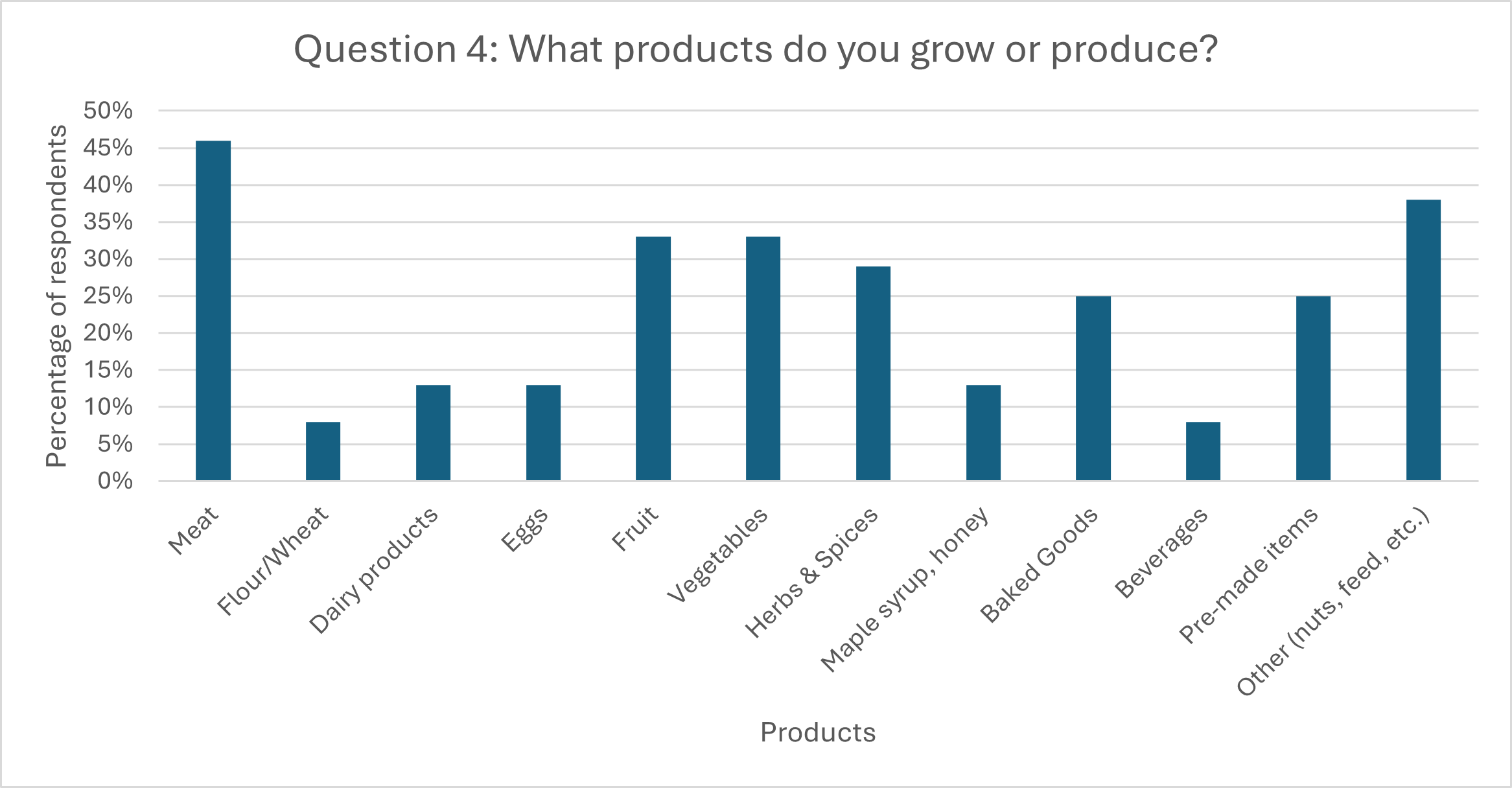
Figure C: Products grown/produced
50% of respondents said they might consider selling other products if there was more demand.
- 25% answered that they would like to sell fruit, nuts, frozen meals and meat specifically.
- One respondent added that it’s “less about demand” and “more about resources and land needed to grow” what they want to.
50% of respondents agree that certain crops are more profitable when sold locally, specifically: fruit, vegetables, dairy products, beef, chicken and pork.
- Multiple respondents mention that it’s almost always more profitable to sell locally, as “it costs less to transport” and “it’s easier to keep a loyal customer base.”
When asked about how respondents manage seasonality and supply consistency, responses included: adjusting production schedules, inventory planning, limiting operations to peak seasons and using year‑round greenhouses. A few respondents answered that they produce shelf-stable products, while others rely on preservation methods (freezing, freeze‑drying, canning). Some mention that they sell year-round at winter markets or via online channels, and others emphasize the need for more resources, including: cold storage and processing (butchering) facilities.
Respondents expressed interest in access to the following infrastructure and support services:
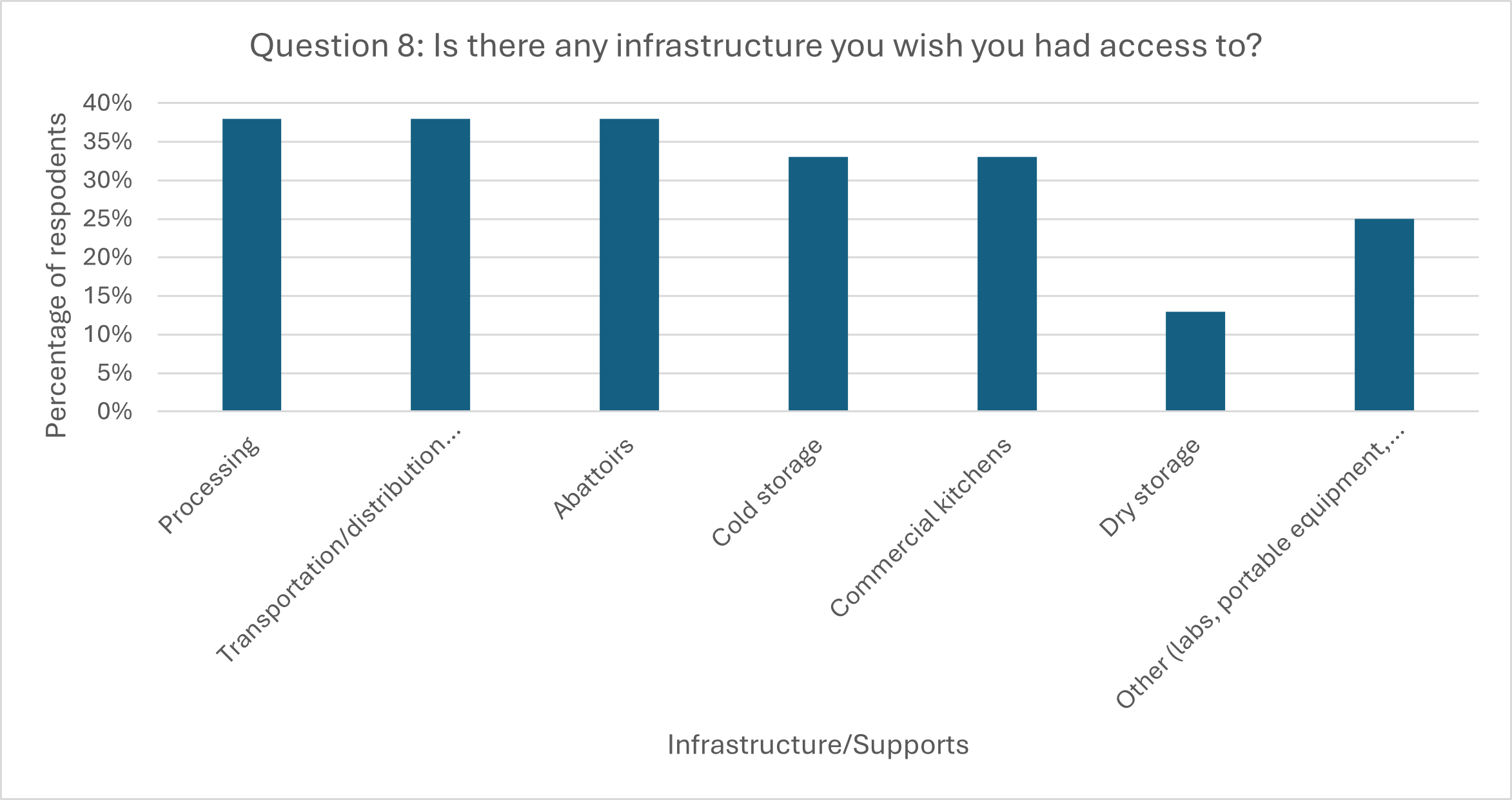
Figure D: Infrastructure and supports
Sales and Distribution
Of those who sell their products within 100 km, the majority (75%) sell between 76-100% locally. Respondents sell their products to customers using the following channels:
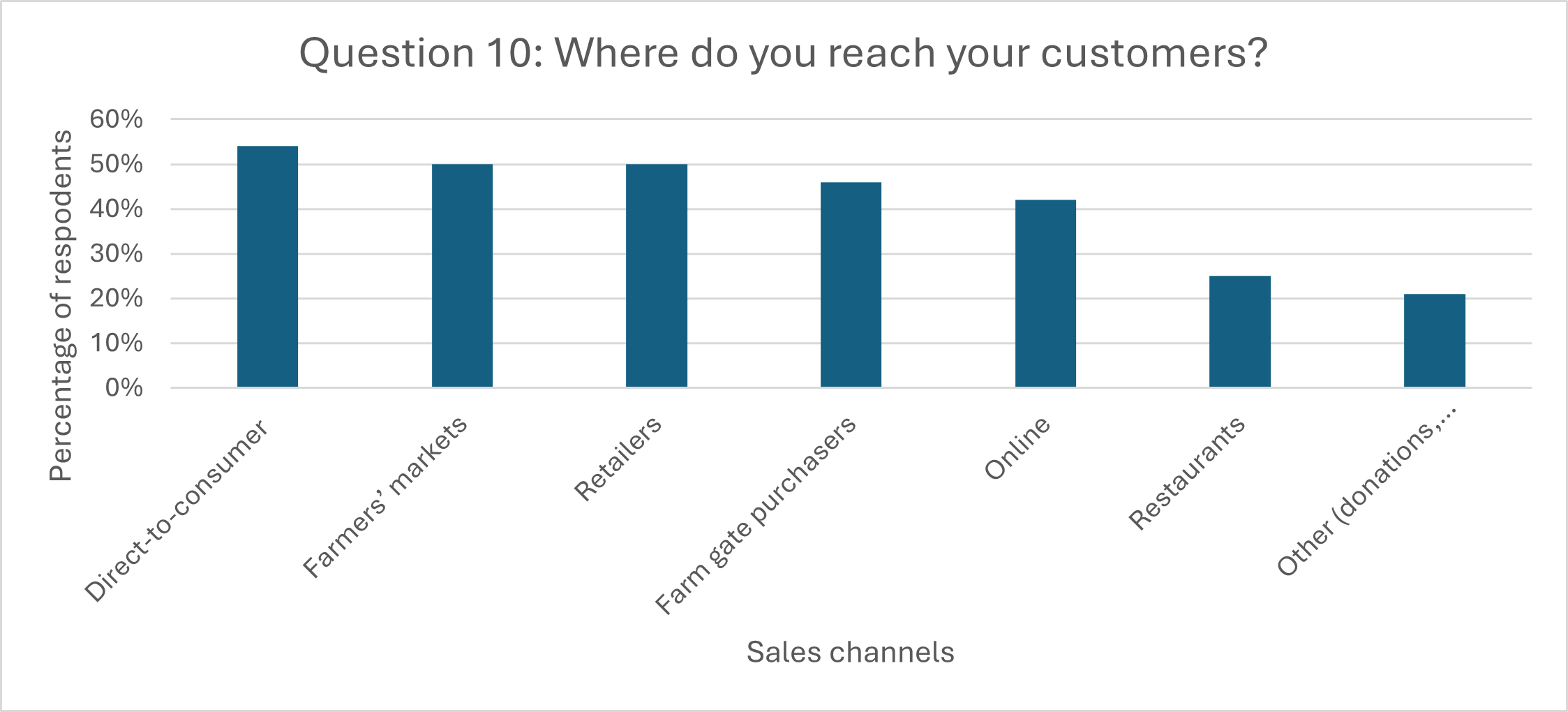
Figure E: Farmers’ distribution channels
The biggest sales challenges respondents face include: time required to promote and sell (42% of respondents), costs associated with promoting/selling and difficult policies/regulations (29% each), time required to deliver, cost associated with delivery and product availability (25% each) and minimum quantities requested (17%). Other responses provided (38%) include: land ownership challenges, lack of funding, low profitability, maintaining a consistent supply of quality products despite external factors, processing capacity in the region and higher costs for small-scale farms vs. big box stores.
When asked where restaurants and retailers find them, 54% mentioned existing relationships and 42% selected social media and farmers’ markets, respectively. 38% said they approach restaurants and retailers directly, 33% are found through their website, 17% are contacted by phone, and 13% said buyers visit the farm or purchase through distributors. Half of all respondents noted they were interested in connecting with restaurants and retailers in the future and provided contact information.
Support & Vision
Respondents emphasized that the following supports would help their businesses: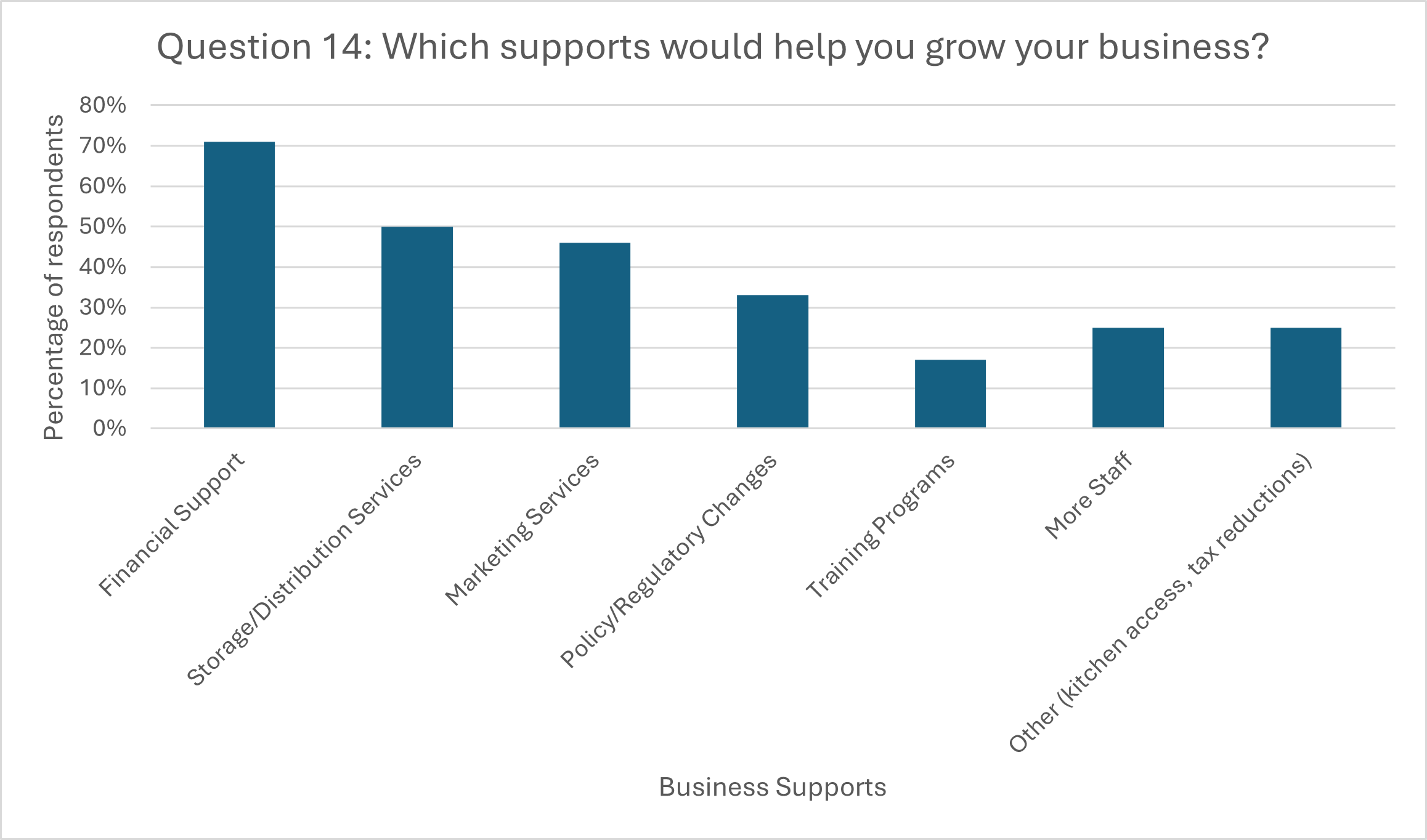
Figure F: Supports for farmers/food producers
Finally, respondents provided open-ended feedback about specific challenges they face, including difficulty finding suppliers and lack of access to affordable kitchen spaces and processing facilities. Other respondents stress the need for funding to support local programs and express frustration with provincial policies and public health regulations. One notes that the rising cost of local food production makes competing with larger producers difficult. Suggestions for support include creating an online platform for local food, City-led initiatives like winter greenhouses, subsidies and a municipal local procurement policy. Overall, there is a strong call for practical solutions to strengthen local food systems and foster resilience amid economic uncertainty.
What we heard: Restaurant/Food Service Survey
Sourcing and Procurement
The percentage of food that respondents source locally (within 100 km) varies:
- 29% source more than 76% of their ingredients locally
- 57% source more than 50% of their ingredients locally
- 35% source less than 25% of their ingredients locally
The following products are being purchased from farms, local retailers, butchers and distributors: vegetables (purchased by 86% of respondents), meat (79%), maple syrup/honey (64%), eggs (50%), dairy products (43%), beverages (36%), fruits (29%), flour, pre-made items such as sauces and jams, herbs and spices (29% each) and baked goods (21%).
All respondents identified barriers to sourcing more local ingredients: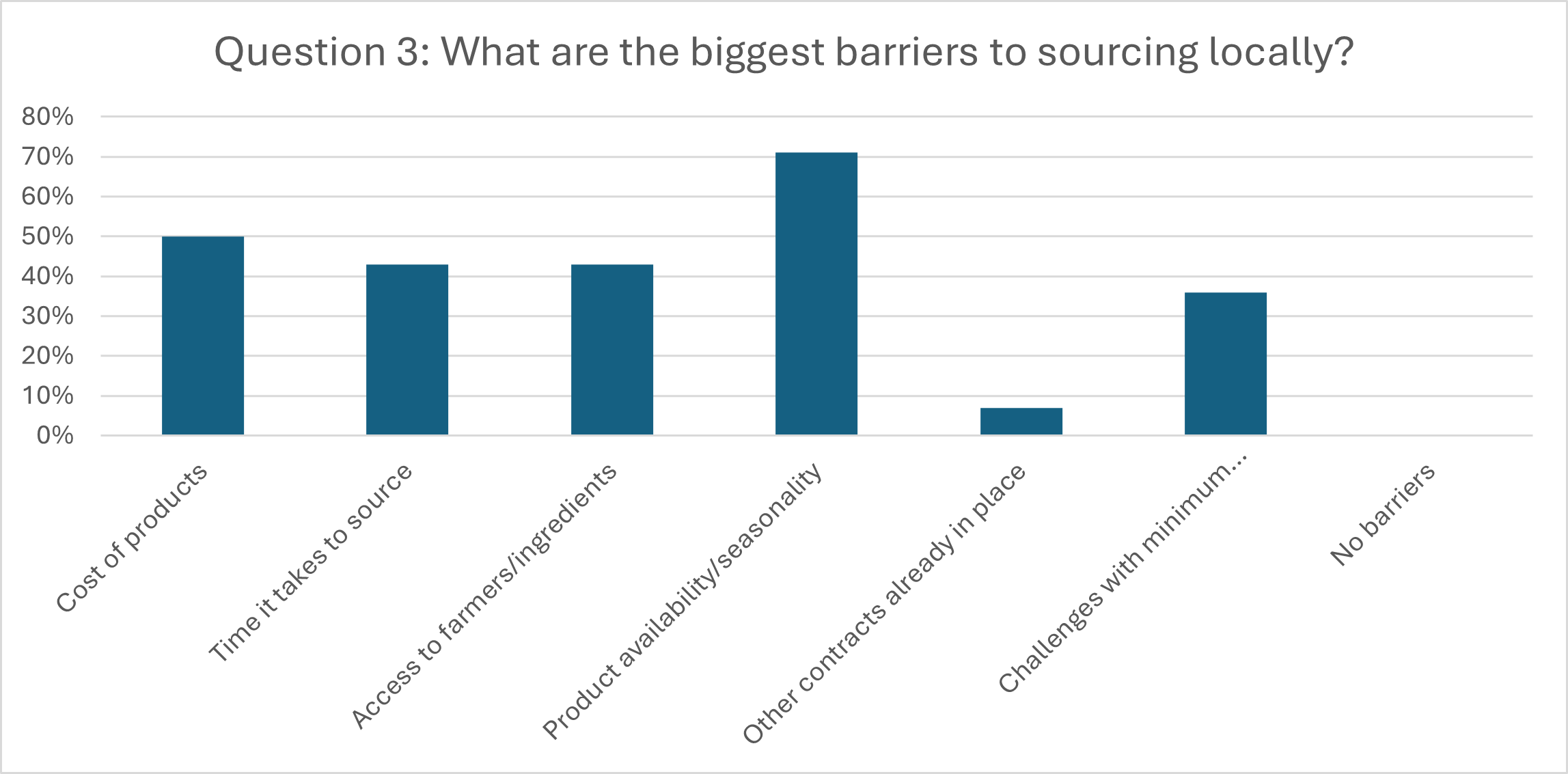
Figure G: Barriers for restaurants sourcing locally
One respondent noted that there are fewer farm suppliers than there used to be. Another answered that they would benefit from a directory of what is available and where (with contact information). Nearly all respondents (93%) said they would use more local food if it were easier to access.
The following local products were stated as items that they regularly look for but can’t find: malted bakery flour, wholesale cheese, dried chickpeas, meat (rabbits, pork on consistent basis), fresh high-quality produce and Asian cuisine (specifically meat and deli).
More than half of respondents (57%) prioritize certifications (such as organic, pasture-raised, etc.) in local sourcing. 14% responded “sometimes,” specifying that they do for meat or that that they seek information on farming practices on their own.
Menu and Marketing
14% of respondents noted they were accredited with the ‘Feast On’ food certification program. 43% are interested in receiving local food accreditation. Responses as to why respondents are not accredited include that there is no perceived benefit (does not increase customers as accreditations are not widely known), they have simply not pursued it yet and that it does not fit with their service (food literacy). One respondent expresses a desire for a tax levy for businesses who support local by contributing to the cost of the accreditation.
When asked about the role of local food, the majority of respondents state that local food is promoted on their restaurant’s menu (93%), local food plays a role in their restaurant’s identity (86%) and local food ingredients support menu creativity (71%). 57% agreed that customers ask where food is sourced from, but only 29% feel that local food accreditations are an asset for their business.
Relationships and Community
Most respondents (71%) are interested in exploring additional partnership opportunities with local producers and an additional 14% “might be” interested (depending on logistics). Supports that would help respondents source more local food include: directories, long-term partnerships with local farms/suppliers, direct purchasing ingredients and support for all levels of government. Others state that prices and local climate are barriers to sourcing more local food.
When asked for advice on how restaurants could incorporate more local food, respondents emphasized the importance of 1) having a good personal relationship with farmers, 2) sharing information about food sources directly with customers, and 3) understanding the benefits of keeping money local.
Finally, respondents added that supporting local farmers could be done by ‘creating seasonal and local menus.’ There were also suggestions for other ways the municipality can support businesses outside of local food partnerships including maintenance of City facilities (i.e. public washrooms), equal representation in marketing campaigns and parking discounts for restaurant staff.
Next Steps
Results from this engagement will be shared with Council in the first quarter of 2026 to inform current municipal programs, including agricultural business support, collaborations with local economic partners and the development of the food entrepreneur training program. Some respondents expressed interest in future engagement, and staff will explore potential for ongoing conversations
Overall Summary
While Kingston has a strong foundation for its local food system, the landscape for producers and restaurants remains fragmented, with significant gaps in infrastructure, communication and coordination. Information flow is inconsistent, relationships are informal and supply chain linkages depend on individual effort rather than a structured system.
The feedback received from this engagement has strong alignment with the goals of the Kingston Food Framework. Results suggest that targeted investment in physical assets, matchmaking programs and business assistance could support both producers and purchasers, stimulate rural economic growth and help build a more resilient and connected food system.
Appendix A – Farmer/Food Producer Survey Questions
1. Which of the following best describes your role?
- Farmer
- Food producer
- Gardener
- Other (please specify)
2. Do you sell your products to customers, retailers, institutions or restaurants locally (within 100km)?
- Yes
- No
3. If no, would you like to?
- Yes
- No
- Maybe/depends (please specify)
4. What products do you grow or produce? Check all that apply.
- Meat
- Fruits
- Vegetables
- Flour, wheat, etc.
- Dairy products including milk, cheese, yogurt
- Eggs
- Maple syrup, honey
- Herbs, spices, mixes
- Pre-made items such as sauces, jams, pickles, etc.
- Beverages
- Baked goods
- Other (please specify)
5. Are there products you would grow or produce if more local demand existed?
- Yes (please specify)
- Maybe/unsure
- No
6. Are there certain crops or livestock that are more profitable when sold locally?
- Yes (please specify)
- Maybe/unsure
- No/not applicable to my business
7. How do you manage seasonality and supply consistency for local buyers?
8. Is there any infrastructure you wish you had access to?
- Cold storage
- Dry storage
- Transportation/distribution
- Processing
- Commercial kitchens
- Abattoirs
- Other (please specify)
9. What percentage of your products are sold locally (within 100km)?
- Less than 10%
- 10-25%
- 26-50%
- 51-75%
- 76-100%
10. Where do you reach your customers to sell your product(s)?
- Restaurants
- Farmers’ Markets
- Farm Gate Purchasers
- Retailers
- Direct to consumer
- Online
- Other (please specify)
11. What are your biggest challenges in selling food to local buyers?
- Time required to deliver
- Time required to promote & sell
- Cost associated with delivering
- Cost associated with promoting & selling
- Minimum quantities or product sizes requested
- Difficult policies and regulations
- My products aren’t always available when requested
- Other (please specify)
12. How do restaurants and retailers typically find you?
- Website/online search
- Social media
- Phone call
- Visit the farm
- Approached at farmers’ markets
- Existing relationships
- I approach restaurants & retailers
- Distributors
- Other (please specify)
13. If you are interested in connecting to restaurants and/or retailers in the future, please provide your contact information.
14. What supports would help you grow your business?
- Financial supports (i.e. grants, loans, government investments)
- Training programs
- Share storage and/or distribution services
- Policy & regulatory changes
- Marketing support
- More staff
- Other (please specify)
15. Do you have any other feedback you would like to share related to local food production?
16. If you are interested in being contacted for future engagement and/or communications about related opportunities, please provide your contact information.
Appendix B – Restaurant/Food Service Survey Questions
1. What descriptor best describes your role in the industry? Select all that apply.
- Chef
- Owner
- Manager
- Front of house staff
- Back of house staff
- Other (please specify)
2. What percentage of your ingredients are sourced locally, within 100km?
- Less than 10%
- 10-25%
- 26-50%
- 51-75%
- 76-100%
- Unsure
3. What are the biggest barriers to sourcing more local ingredients?
- Cost of products
- Time it takes to source products
- Access to farmers and local ingredients
- Variety/nature of products available (i.e. seasonality)
- Other contracts already in place
- Challenges with minimum quantities or sizes available
- No barriers
- Other (please specify)
4. What types of local products are you currently purchasing from a farm, local retailer, abattoir, butcher or distributor who sells local food? Check all that apply.
- Meat
- Fruits
- Vegetables
- Flour, wheat, etc.
- Dairy products including milk, cheese, yogurt
- Eggs
- Maple syrup, honey
- Herbs, spices, mixes
- Pre-made items such as sauces, jams, pickles, etc.
- Beverages
- Baked goods
- Other (please specify)
5. Are there particular local ingredients, products you regularly look for but can’t find? If yes, please answer below.
6. Would you use more local food if it were easier to access or order?
- Yes
- No
- Depends/maybe
- Unsure
7. Do you prioritize any certifications (organic, pasture-raised, federally or provincially inspected, etc.) in local sourcing?
- Yes
- No
- For some products (please specify)
8. Do you have any other comments on the sourcing and procurement of local food?
9. Are you accredited with any local food certification programs (i.e. Feast On)?
- No, and I am not interested in being accredited
- No, but I am interested in being accredited
- Prefer not to say
- Yes (please specify)
10. If you are not accredited with a local food certification program, what is the barrier?
11. How much do you agree with the following statements? (Rated: strongly disagree, disagree, neutral, agree, strongly agree).
- Local food ingredients support my menu creativity
- Local food plays a role in my restaurant’s identity or values
- Local food is promoted on my restaurant’s menu or in my branding
- Customers ask where food is sourced from
- Local food accreditations (such as Feast On) are a valuable asset for a business
12. Are you interested in exploring new/additional partnership opportunities with local producers?
- Yes
- No
- Depends/maybe
13. What kind of support would help you source more local food? Examples: direct purchasing agreements (CSA-style sourcing), long-term partnerships with local farms/suppliers, a directory of products with contact information, etc.
14. What advice would you give to new restaurants trying to incorporate more local food?
15. Is there any other feedback you would like to share related to local food in restaurants?
16. If you are interested in being contacted for future engagement and/or communications on related opportunities, please provide your contact information.

Thank you for your contribution!
Help us reach out to more people in the community
Share this with family and friends