Public Engagement Summary: Public MSC
Why we engaged
In the evolving landscape of water and wastewater services, the creation of a public MSC is an opportunity for the City and Utilities Kingston to support a faster pace for asset replacement and new infrastructure to meet growing needs while reducing financial impact on other municipal services such as roads and recreation services. Under Ontario’s Municipal Act, 2001 and Regulation 599/06, municipalities are authorized to establish public MSCs for delivering municipal services.
Public consultation with respect to the proposed public MSC model is required under Ontario Regulation 599/06.
The feedback summarized below reflects the range of comments received during consultation. In response to the feedback, the Public MSC Business Case has been updated to provide additional analysis, clarification, and supporting information.
How we engaged
The engagement period began on Dec. 4 2025. Community members were invited to read the KPMG Business Case, which outlined context and drivers for the proposal, details on the proposed governance structure, financial considerations and an overview of an implementation plan. A short survey provided an opportunity for residents to provide feedback on the business case, and there was a Q&A tool for participants to ask questions.
The engagement was promoted on Get Involved Kingston and on the City of Kingston and Utilities’ Kingston’s websites. A news release was distributed to media and news subscribers and the survey was included in social media posts on the City’s LinkedIn, Facebook, X and Instagram channels.
Residents were also given the opportunity to submit feedback offline and via email/CRM. An additional update that included detailed information about the proposed organizational structure, agreements, and financial models was published on Jan. 12. The survey was extended until Jan. 19, 2026.
Who we heard from
- 385 participants completed the survey*
- 30 questions asked using the Q&A tool
- 1,941 participants visited the project page to learn more
- 30 participants engaged with the City for the first time on Get Involved Kingston
- 825 downloads of the MSC Business Case
- 63,996 social media impressions
- 1,819 social media engagements
- 67 social media comments received**
- 13 CRM/emails sharing feedback on the proposal for an MSC
Locations of participants
- 25% Southwest Kingston (K7M)
- 39% Central-East Kingston (K7K)
- 7% Northwest Kingston (K7P)
- 24% Central-South Kingston (K7L)
- 4% Rural Kingston and Frontenac County (K0H)
- Less than 1% Other/outside of Kingston (L9G, A1C)
*Survey results are not statistically representative of the entire community, as engaged participants account for less than 0.29% of the total population of Kingston.
** Comments received on social media are not included in the public engagement summary. Statistics are provided to indicate community interest and social media reach.
What we heard
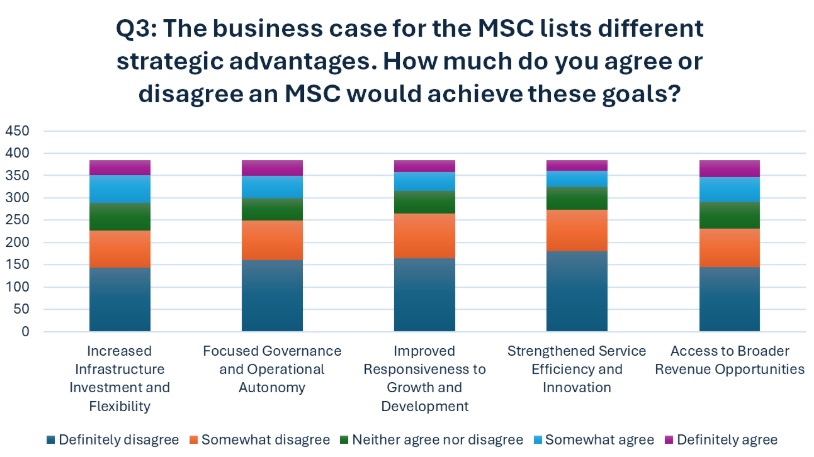
Most engagement participants told us they were somewhat familiar (68%) or not familiar (17%) with a public MSC model. After reading the business case, respondents shared that they are not supportive of the proposed public MSC. When asked about the strategic advantages of a public MSC, survey respondents consistently disagreed with all the strategic advantages offered in the business case. In open-ended feedback received in the survey and through emails and CRM submissions, respondents cited concerns about privatization, affordability, and transparency.
Figure A: Familiarity with a public MSC model
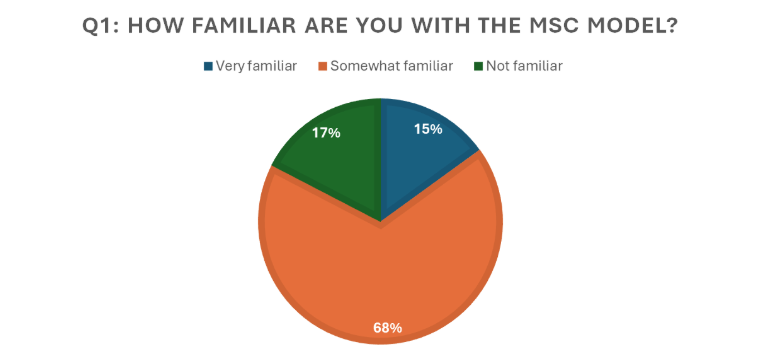
Figure B: Support of public MSC
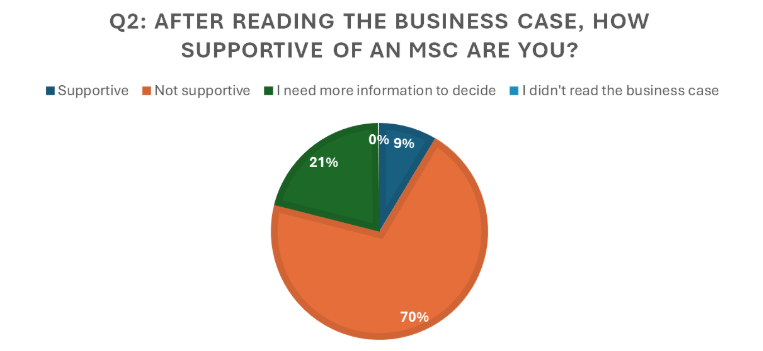
Figure C: Agreement with Strategic Advantages
 Summary of Feedback Themes (312 comments)
Preference for current model and opposition to Privatization of Water Wastewater Services: A dominant theme is participant concern that a public MSC opens the door to privatization or profit-driven motives for essential services. Residents emphasize that water is a public good and must remain publicly owned and publicly managed. Many believe that if improvements are required they could be made within the existing water wastewater structure.
Accountability and Transparency: Many respondents worry that a public MSC reduces oversight by Council and residents. Concerns include nontransparent decision making, weaker public reporting and lack of accountability in cases of service failure or rate increases.
Skepticism of Business Case, Financial Uncertainty and Population Projections: Comments highlight a perceived lack of clear financial justification, missing comparisons to current model, minimal risk assessment and concerns about hidden liabilities and long-term cost implications. Some respondents questioned the population projections underpinning the rationale for change. Other respondents ask for case studies, performance data from other municipalities, and analyses of alternative approaches.
Concern about Impact on Rates and Affordability: Some respondents are concerned that a public MSC will lead to higher user fees, new charges, or cost-shifting that could disproportionately impact low-income residents.
Concern about risks to Service Quality and Public Health: Participants worry that a business-oriented approach could negatively affect water quality. Some cite international examples (notably the U.K.) and past crises (such as Walkerton) as warning that privatization can lead to reduced maintenance, environmental harm and compromised safety.
Insufficient Public Engagement: Some commenters criticize the public engagement process, stating they felt rushed and did not have the information needed to engage meaningfully.
Support and Positive Feedback: A few respondents are open to and/or supportive of a public MSC model, recognizing that population growth may require a new approach. Many supportive comments are conditional, emphasizing the need for clear governance, strong accountability and transparency, and insurance that the model remain fully publicly owned.

Thank you for your contribution!
Help us reach out to more people in the community
Share this with family and friends