10-year Housing and Homelessness Plan Review and Update

The City of Kingston, as Service Manager for Kingston and the County of Frontenac, is required under the Housing Services Act, 2011, to maintain a 10-Year Housing and Homelessness Plan that guides local efforts to improve housing supply and affordability, prevent homelessness, and strengthen supports for vulnerable residents.
This update matters because it will incorporate new data, reflect evolving community needs, and align with current provincial priorities, including increasing affordable and attainable housing supply, supporting mixed-income housing, preventing and reducing homelessness, and improving system coordination.
The update of the 10-Year Housing and Homelessness Plan will be informed by recent population and housing forecasts, the 2023 Housing Needs Assessment, Centralized Waiting List and By Name List data, Homeless Individuals and Families Information System, municipal planning documents, and community consultation that includes representation from affected and interested groups.
The City last updated its Plan in 2019 and is now undertaking the next legislated update for completion in 2026.To support this work, the City issued a Request for Proposal in late 2025 and selected Beam Group as the successful proponent. Beam Group will facilitate the community engagement and program evaluation.
How to engage with us on the plan review and update
Residents are invited to help shape the future of housing and homelessness services by sharing their input and experiences. Feedback collected through this process will directly inform the draft Plan before it is presented to City and County Council later this year.
- Register for a webinar on Thursday, May 7 at 6 p.m. to learn more about the review process and how community surveys and open houses will influence the updated plan.
- From April 29 to May 30, complete a survey to share your input. The survey will be available here on Get Involved Kingston. To receive an alternate version of the survey, or to complete the survey by phone, contact us.
- Send comments to us at GetInvolvedKingston@CityofKingston.ca throughout the engagement period.
- Visit an open house throughout the engagement period:
- Wednesday May 20, 4 p.m.- 8 p.m. @ the INVISTA Centre
- Friday May 22, 2 p.m.- 6 p.m. @ the Rideau Heights Community Centre
- Saturday May 23, 11a.m. - 3 p.m. @ the Kingston East Community Centre
Watch the Webinar for an Overview of the 10-Year Plan review & update!
The City of Kingston, as Service Manager for Kingston and the County of Frontenac, is required under the Housing Services Act, 2011, to maintain a 10-Year Housing and Homelessness Plan that guides local efforts to improve housing supply and affordability, prevent homelessness, and strengthen supports for vulnerable residents.
This update matters because it will incorporate new data, reflect evolving community needs, and align with current provincial priorities, including increasing affordable and attainable housing supply, supporting mixed-income housing, preventing and reducing homelessness, and improving system coordination.
The update of the 10-Year Housing and Homelessness Plan will be informed by recent population and housing forecasts, the 2023 Housing Needs Assessment, Centralized Waiting List and By Name List data, Homeless Individuals and Families Information System, municipal planning documents, and community consultation that includes representation from affected and interested groups.
The City last updated its Plan in 2019 and is now undertaking the next legislated update for completion in 2026.To support this work, the City issued a Request for Proposal in late 2025 and selected Beam Group as the successful proponent. Beam Group will facilitate the community engagement and program evaluation.
How to engage with us on the plan review and update
Residents are invited to help shape the future of housing and homelessness services by sharing their input and experiences. Feedback collected through this process will directly inform the draft Plan before it is presented to City and County Council later this year.
- Register for a webinar on Thursday, May 7 at 6 p.m. to learn more about the review process and how community surveys and open houses will influence the updated plan.
- From April 29 to May 30, complete a survey to share your input. The survey will be available here on Get Involved Kingston. To receive an alternate version of the survey, or to complete the survey by phone, contact us.
- Send comments to us at GetInvolvedKingston@CityofKingston.ca throughout the engagement period.
- Visit an open house throughout the engagement period:
- Wednesday May 20, 4 p.m.- 8 p.m. @ the INVISTA Centre
- Friday May 22, 2 p.m.- 6 p.m. @ the Rideau Heights Community Centre
- Saturday May 23, 11a.m. - 3 p.m. @ the Kingston East Community Centre
Watch the Webinar for an Overview of the 10-Year Plan review & update!
-
Engagement Update & Survey Reminder
Last week we heard from residents as part of the 10-year Housing & Homelessness Plan review and update for the City of Kingston and County of Frontenac!
Focus groups engaged people with lived and living experience, Indigenous partners, service providers and community partners to ensure their perspectives are included.
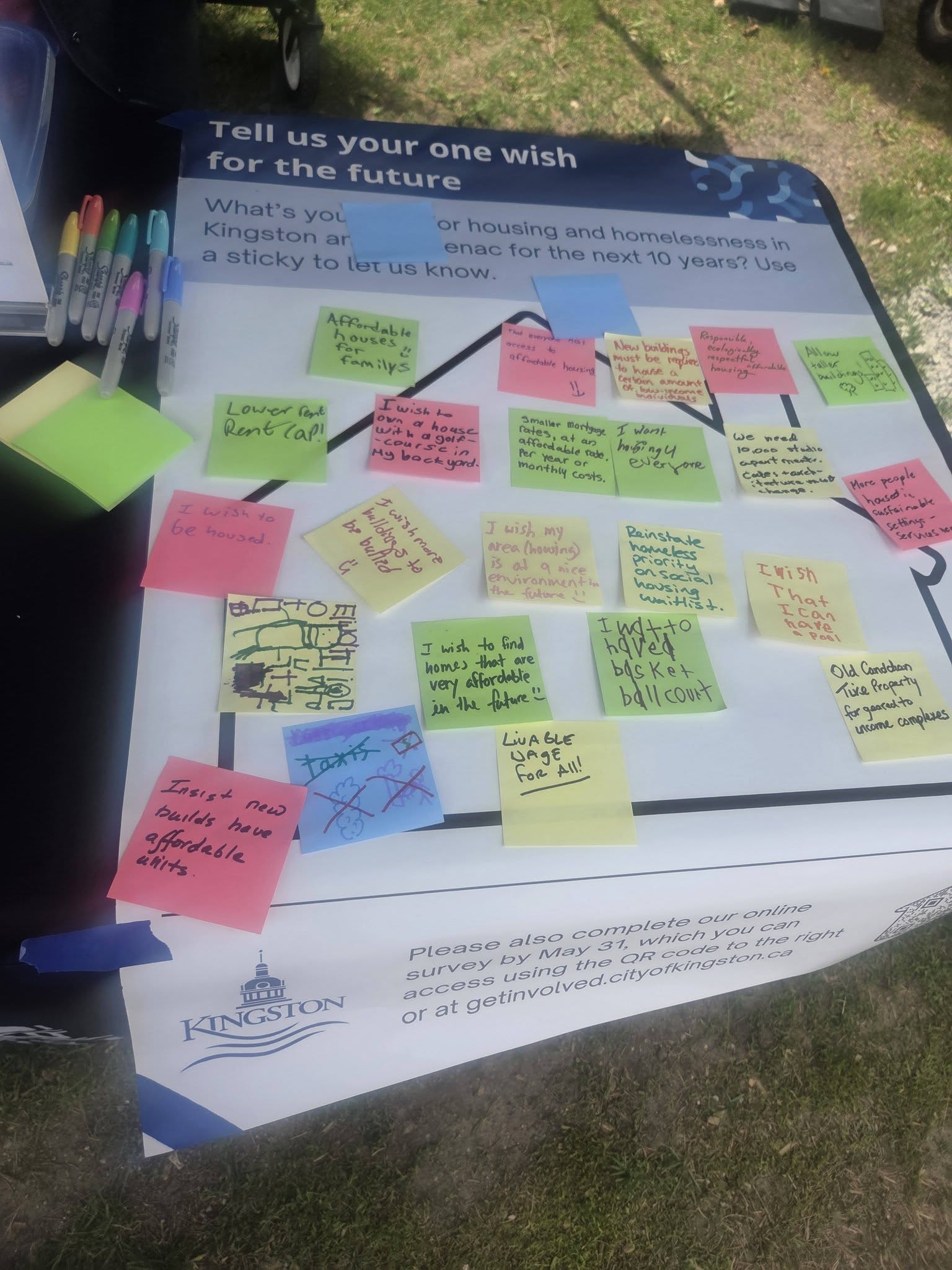
Three Open Houses across the City of Kingston heard from over 100 residents who shared their experiences, ideas, and priorities.
Community members can still share your input to help inform the next 10-year plan by completing the survey by May 31: https://getinvolved.cityofkingston.ca/10-year-housing-homelessness-plan-review/surveys/public-survey
This public input will inform the draft plan alongside local data, needs assessments, and planning documents which will be presented to the Housing & Homelessness Advisory Committee later this year before going to Council.
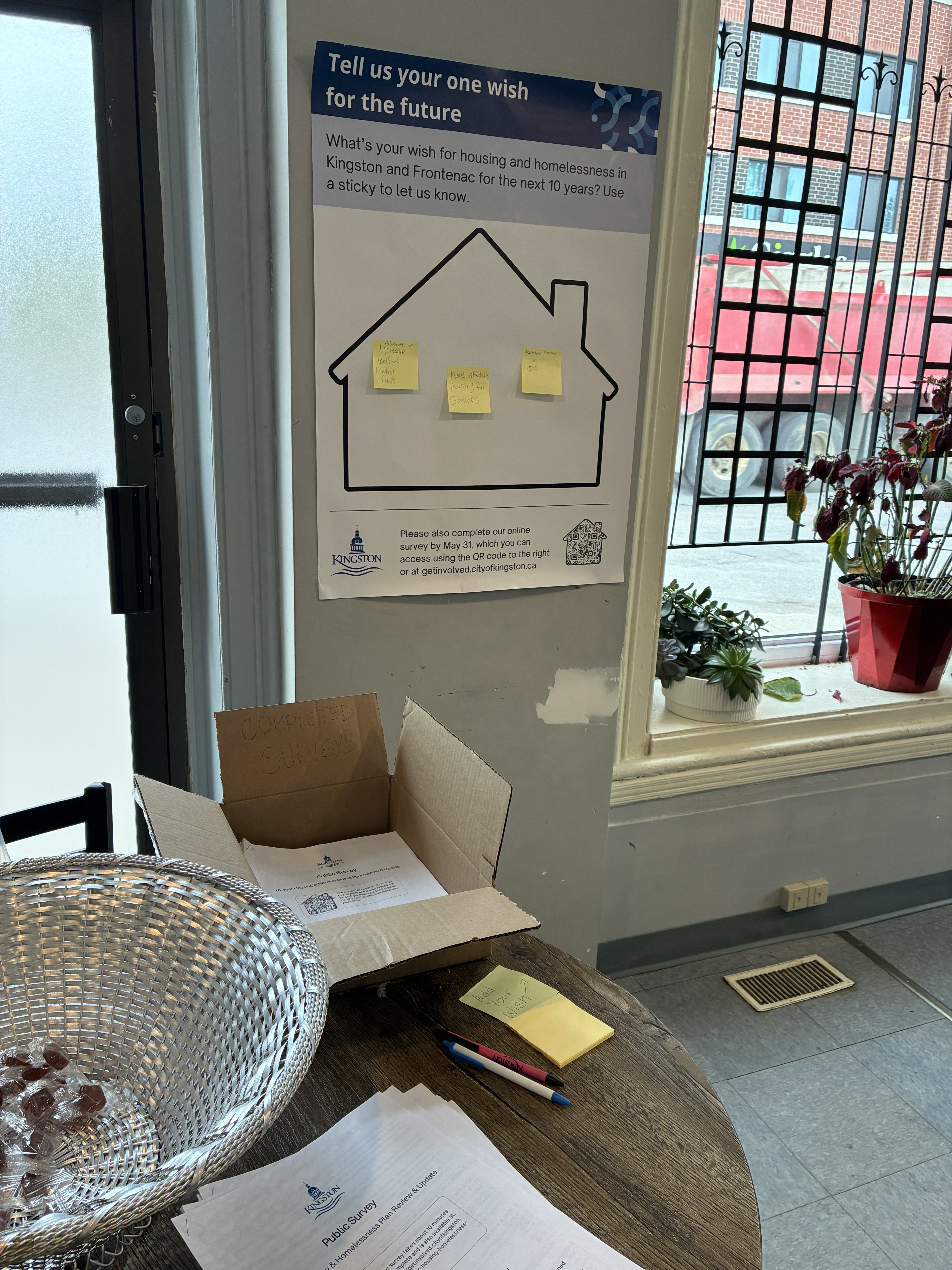
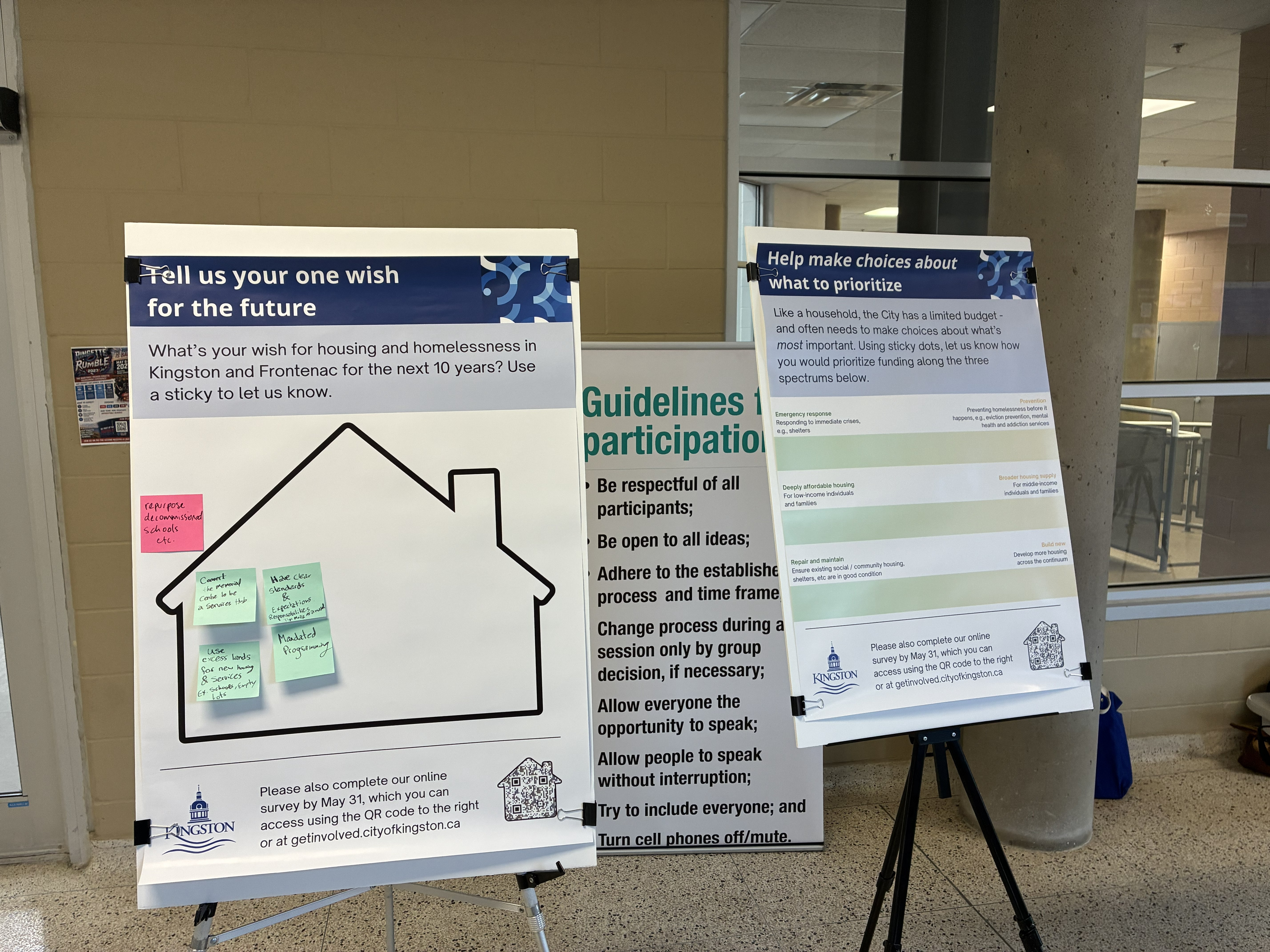
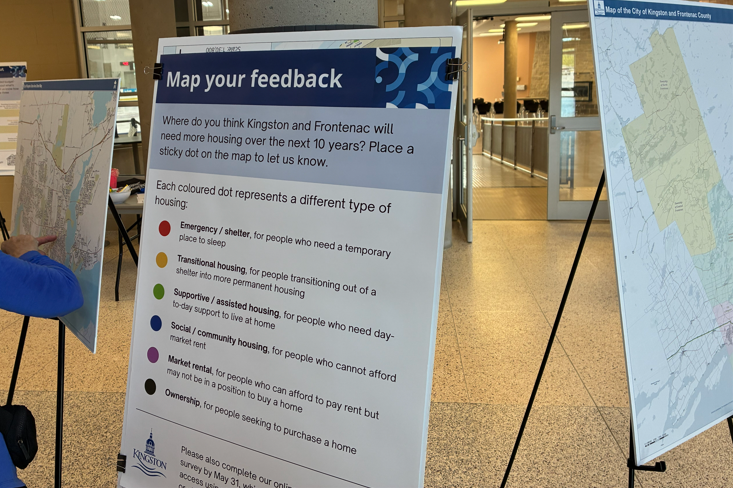
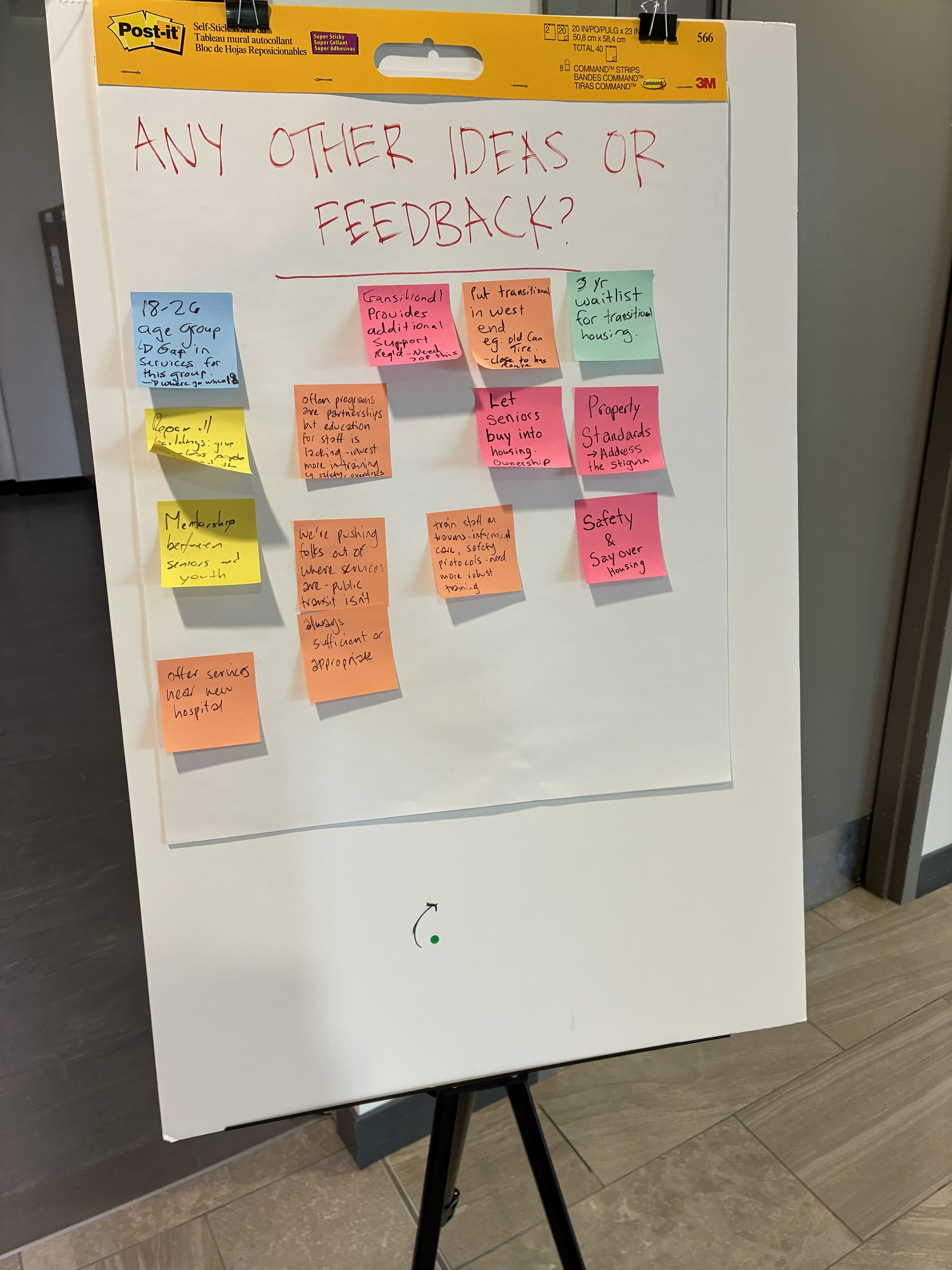
Photos from the Open House


Last week we heard from residents as part of the 10-year Housing & Homelessness Plan review and update for the City of Kingston and County of Frontenac!
Focus groups engaged people with lived and living experience, Indigenous partners, service providers and community partners to ensure their perspectives are included.
Three Open Houses across the City of Kingston heard from over 100 residents who shared their experiences, ideas, and priorities.
Community members can still share your input to help inform the next 10-year plan by completing the survey by May 31: https://getinvolved.cityofkingston.ca/10-year-housing-homelessness-plan-review/surveys/public-survey
This public input will inform the draft plan alongside local data, needs assessments, and planning documents which will be presented to the Housing & Homelessness Advisory Committee later this year before going to Council.
Photos from the Open House


-
Reminder: Open Houses this Week!
Reminder to Kingston & Frontenac Residents of the following opportunities to engage on the housing & homelessness plan review and update.
Drop-in to share insights at one of the three Open Houses this week:
- Wednesday May 20, 4 p.m. - 8 p.m. @ the INVISTA Centre
- Friday May 22, 2 p.m. - 6 p.m. @ the Rideau Heights Community Centre
- Saturday May 23, 11a.m. - 3 p.m. @ the Kingston East Community Centre
And
- Complete the brief survey until May 31, 2026: Public Survey
Additional focus groups throughout the month of May are engaging people with lived and living experience, Indigenous partners, service providers and community partners to ensure theses valued perspectives are included.
Public feedback, recent population and housing forecasts, the 2023 Housing Needs Assessment, Centralized Waiting List and By Name List data, Homeless Individuals and Families Information System and municipal planning documents will contribute to the review and update.
Reminder to Kingston & Frontenac Residents of the following opportunities to engage on the housing & homelessness plan review and update.
Drop-in to share insights at one of the three Open Houses this week:
- Wednesday May 20, 4 p.m. - 8 p.m. @ the INVISTA Centre
- Friday May 22, 2 p.m. - 6 p.m. @ the Rideau Heights Community Centre
- Saturday May 23, 11a.m. - 3 p.m. @ the Kingston East Community Centre
And
- Complete the brief survey until May 31, 2026: Public Survey
Additional focus groups throughout the month of May are engaging people with lived and living experience, Indigenous partners, service providers and community partners to ensure theses valued perspectives are included.
Public feedback, recent population and housing forecasts, the 2023 Housing Needs Assessment, Centralized Waiting List and By Name List data, Homeless Individuals and Families Information System and municipal planning documents will contribute to the review and update.
-
Webinar Recording & Summary: Learn about the 10-year Housing & Homelessness Plan Review and Update
On May 7, the City of Kingston and Beam Group hosted a webinar for residents of Kingston and Frontenac County to learn about the 10-year Housing and Homelessness Plan (10-Year Plan) review and update.
Presentation Overview
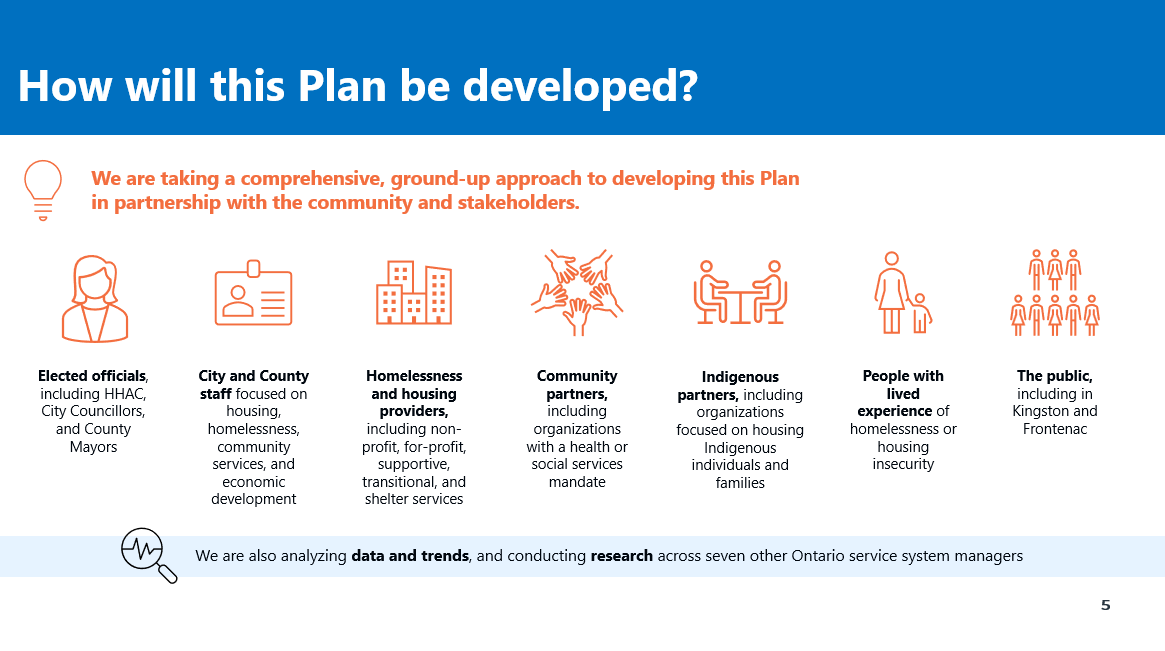
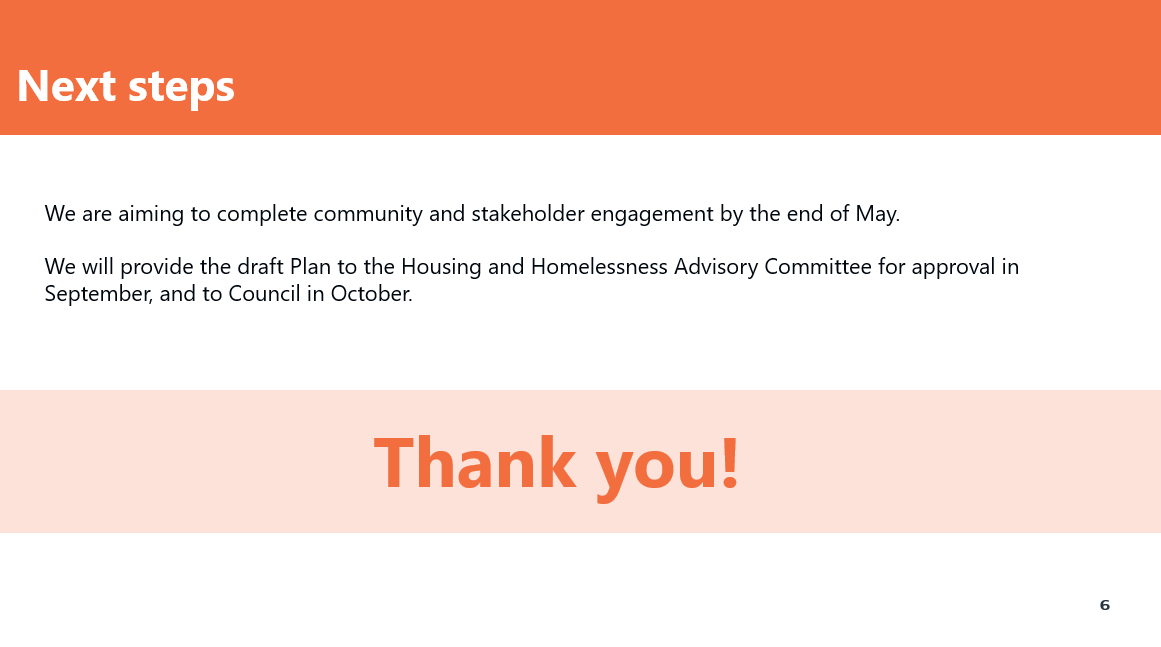
Beam Group and City staff from the Housing & Social Services Team presented on what the 10-Year housing and homelessness plan is, the accomplishments since the last update, the status of the current plan, the City’s role as Service Manager for the City of Kingston and the County of Frontenac, and how the plan will be developed. The slides are provided below and a recording of the full webinar is available here.
Questions
Following the presentation, attendees were invited to participate in a Q&A covering pre-submitted questions and emerging questions from the presentation. A summary of all questions and answers, including answers to questions that were taken back to gather more information, are available below the presentation slides.
Input
Attendees were invited to share their experiences of housing, describe what success will look like, and complete a polling exercise on housing priorities. Staff further encouraged residents to complete the brief survey (open until May 31) and drop-in to one of the open houses on May 20, 22 and 23 to provide their experiences and perspectives for the HHP review and update.
Presentation Summary


Q & A Summary
What is it? How do you decide? / What are your plans?
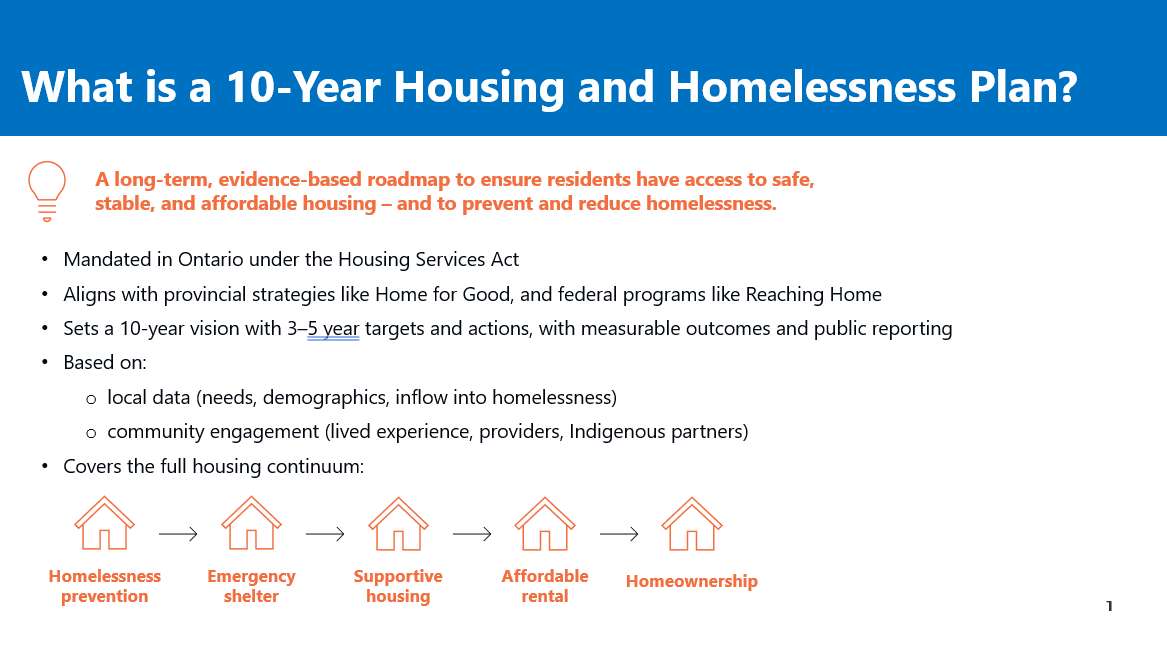
The 10-Year Municipal Housing and Homelessness Plan for the City of Kingston and County of Frontenac (the 10-Year Plan) is a locally developed strategy that guides how municipalities will address housing needs and homelessness over the next decade. It sets key goals, objectives, and measurable targets aimed at creating a more stable and coordinated housing system for all residents. The 10-Year Plan is reviewed and updated every five years to ensure it reflects changing community needs and priorities.
The review and update of the 10-Year Plan is being informed by extensive community engagement, including input from residents, service providers, community partners, city and county staff, elected officials and those individuals with lived and living experience of housing instability or homelessness.
The input will guide decisions and shape priorities of Council over the next 10 years, with a focus on increasing housing supply and affordability, preventing homelessness, improving system coordination, and strengthening supports for vulnerable residents in the City and in the County. This Plan will work alongside other municipal plans such as the Official Plan to support more efficient and coordinated housing development.
Is there a copy of the draft plan for citizens to review?
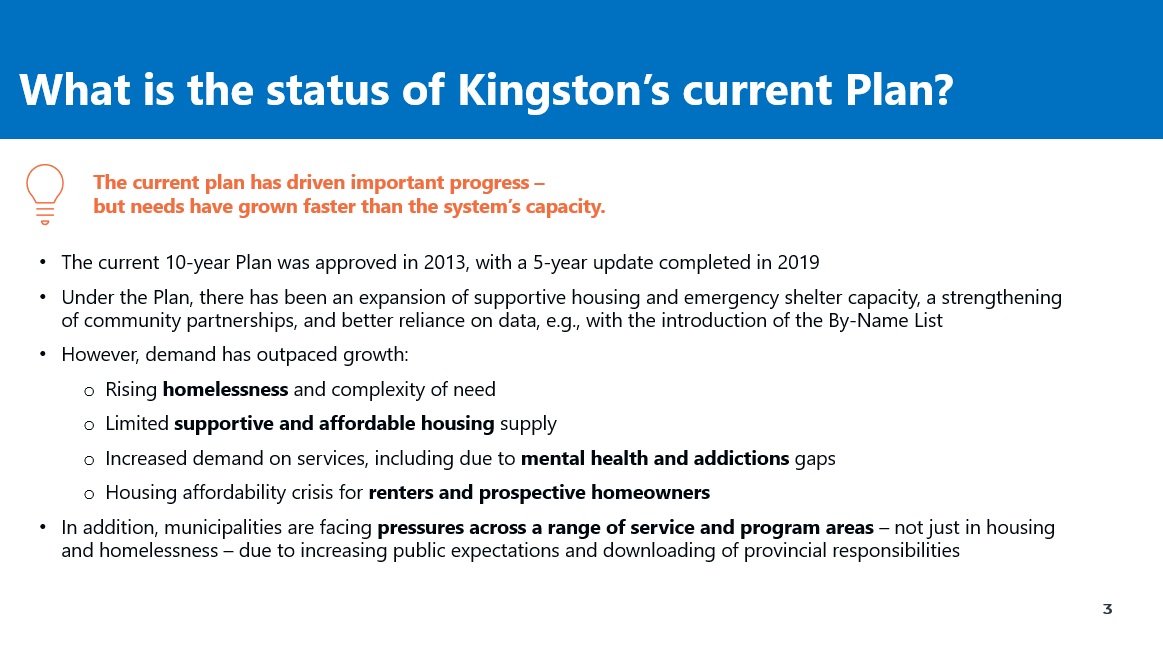
The current 10-Year Plan is available on the City of Kingston's website. Beam Group is supporting City staff with the review and update of the Plan, which will be brought before City Council in October 2026. A draft of the updated Plan will be presented to the Housing and Homelessness Advisory Committee at its September meeting prior to going to City Council.
How will it address the underlying causes of homelessness?
The updated 10-Year Plan is being informed by an environmental scan looking at current housing and homelessness trends, service gaps and emerging community needs, to inform the goals and objectives over the next 10 years.
The underlying causes of homelessness are complex and include factors such as lack of affordable and stable housing, mental health and substance use challenges, poverty and income instability. Addressing these issues requires coordinated action from many partners throughout the City and the County.
The City recognizes that stable housing plays a critical role in improving individuals' outcomes and reducing incidents of homelessness. The updated 10-Year Plan will focus on increasing housing options, improving coordination across systems, and strengthening supports to help address the factors that contribute to homelessness over time.
Could we get more rent geared to income housing using existing homes?
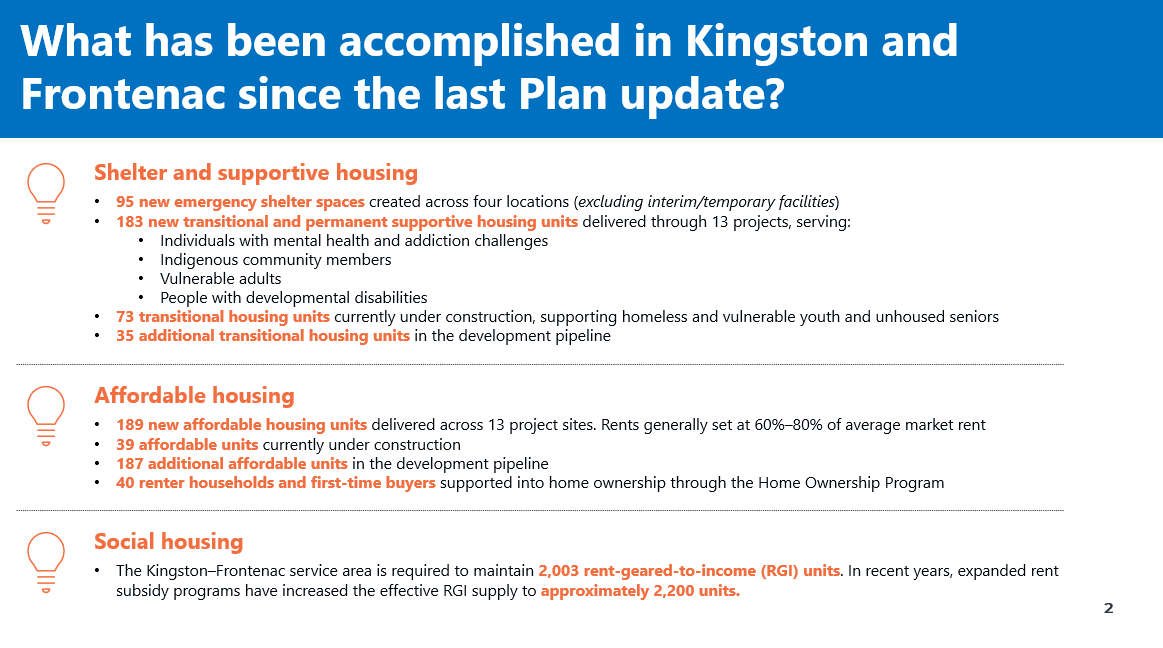
The Kingston-Frontenac service area currently exceeds the provincially required rent-geared-to-income (RGI) units with approximately 2,150 units available locally. However, demand continues to outpace supply, and wait times remain significant. Expanding RGI housing using existing homes can be challenging, as it depends on factors such as available funding, partnerships with housing providers, and the condition and suitability of units. As part of the 10-Year Plan review, the City is exploring a range of approaches to improve affordability across the housing system.
If expanding RGI housing is something residents feel the City should prioritize as service manager; the 10-Year Plan review is the opportunity to provide that feedback. Public input, alongside local data, needs assessments, and planning documents, will inform the updated 10-Year Plan to be approved by Council and guide housing and homelessness priorities across the system over the next 10 years
How do you ensure that planned housing complexes meet the needs of those in the lower price range? / What is the city's plan to address housing challenges for its lowest earning residents? / How will Kingston reduce the unhoused? How do you plan to allow people on the streets to transition to appropriate housing? What are the plans for outreach to homeless? / Interested in knowing the city's ideas on how best to deal with the lack of affordable housing and homelessness?
The 10-Year Plan review and update is a comprehensive approach to better understand and respond to the needs of residents across the housing continuum, particularly those with the lowest income; those experiences homelessness and housing precarity.
This includes looking at ways to improve affordability, increase appropriate housing options, strengthen supports, and enhance pathways from homelessness to stable housing.
Public input, alongside local data, needs assessments, planning documents and community feedback will inform the updated Plan. Importantly, individuals with lived and living experience are being engaged through focus groups and outreach with service providers to ensure their experiences and needs are included.
The final Plan will guide local housing and homelessness priorities, services and system coordination across the system over the next 10 years.
Will there be provisions for a medical designate (provincial and/or federal) to help the homeless in identifying dangerous drugs? / What about risk reduction to active users? Or support for active users of substances? / Does this review include the integration of a social medicine model?
Supporting people experiencing homelessness who are also dealing with substance use challenges requires coordination across housing, health care, and community services.
The City supports community-based harm reduction efforts and, through recent Council direction on May 5, has committed to a contribution of up to $350,000 to expand community-based harm reduction initiatives as the community transitions from the current Consumption and Treatment Services (CTS) site to a new HART (Homelessness and Addiction Recovery Treatment) Hub expected to open in October 2026.
Decisions related to clinical services, safe supply programs, and the operation of Consumption and Treatment Services sites are made by provincial and federal governments and fall outside the municipality’s role as Service Manager. The current CTS site also operates under federal exemptions that expire in October 2026.
The 10-Year Housing and Homelessness Plan focuses on the housing and support systems the municipality can influence, while continuing to work with health and community partners to improve outcomes for vulnerable residents.
Additionally, the 10-Year Plan update covers a wide range of services, some of which incorporate the principles of the social medicine model. Transitional and Supportive housing, harm reduction, and homelessness prevention/diversion are some examples. Feedback on further integration of the model is also welcomed during the review and update. Public input, along with local data and policy direction will help inform the updated Plan.
Will the city be informing residents before purchasing housing in residential areas before they actually purchase the property?
The City follows the requirements of the Municipal Act, 2001, and because property acquisitions often involve sensitive negotiations, they are typically conducted in closed session to protect taxpayers and the City’s bargaining position; as a result, advance notice is not possible. That said, the City is committed to transparency and will inform residents as soon as possible following the acquisition. Where any changes to zoning or property use are proposed, public notice and engagement requirements under the Planning Act will be followed.
At the Council meeting on February 3, 2026, City Council directed staff to review current public consultation and engagement practices related to new supportive and emergency housing solutions, with a specific focus on communications and engagement with near neighbours. Staff have been directed to bring forward recommendations to Council by July 2026 on improvements to these processes, including but not limited to consideration of the timing and methods of information sharing with near neighbours; the scale and format of engagement meetings; confirmation of the role of the site operators in these engagements, and the processes for receiving, responding to, and reporting back on community concerns.
Did you consult with senior citizens who are under housed?
Beam Group and city staff held a focus group with Housing Providers including those with senior mandates and will be meeting with the Older Adults and Belonging Table in May for an engagement session. Further a public survey is available on the City of Kingston’s Get Involved Kingston page, where residents of the City of Kingsotn and the County of Frontenac can share their thoughts, experiences and ideas. Responses from the survey will be used to inform revisions and updates to the Plan.
What are your current stats on the number of people unhoused in Kingston? What percentage of new buildings in Kingston are RGI?
As of March 2026, there were 572 active individuals experiencing homelessness in Kingston and the County of Frontenac on the By Name List (BNL), which tracks known individuals experiencing homelessness in real time. Individuals must consent to having their name added to the list, and there is a continuous effort by community partners to make those experiencing homelessness aware of the BNL. The BNL is updated monthly and shared to the Homelessness Registry By Name List | Open Data Kingston .
The province sets service level requirements with respect to the number of rent-geared-to-income (RGI) units a service manager area is required to maintain. In Kingston & Frontenac County 2,003 RGI units are the service level requirement however recent investment in rent subsidy programs have increased the RGI supply to approximately 2,150 units. Check Open Data Kingston and follow reports to the Housing and Homelessness Advisory Committee for up-to-date data.
Have you spoken with the homeless population in the city about their needs?
Hearing directly from people with lived and living experience of homelessness or housing precarity is an important part of updating the 10-Year Plan.
Beam Group and city staff have two planned engagement sessions with people with lived and living experience of homelessness – one focuses on you and one with adults. These engagement sessions will provide an opportunity to hear their perspectives, experiences, needs, and ideas that will inform the updated 10-Year Plan.
People with lived or living experience of homelessness are valued members of our community, and their input is critical in shaping a plan that reflects real experiences and priorities over the next 10 years.
In addition to these engagement sessions, input is also gathered through outreach and engagement with service providers who work closely with individuals experiencing homelessness.
Is there a plan for more affordable senior housing?
Yes—expanding affordable housing options for seniors is an important priority. The City recognizes that an aging population, fixed incomes, and increasing housing costs are creating real pressures for older adults across the City of Kingston and throughout the County of Frontenac. While there is not a standalone “seniors housing strategy,” housing needs for seniors, it is part of the broader 10-Year Plan, with a focus on increasing supply, improving accessibility, and supporting seniors to age in place.
It is important to note that the City does not build housing on its own. Progress depends on strong partnerships with the province, the federal government, the non-profit sector, and the private sector, as well as access to sustainable funding programs.
Will the review cover all housing sectors or just be limited to the City's housing under KFHC?
The review and update of the 10-Year Plan will cover housing across the full housing continuum including encampments and emergency responses, shelters, transitional housing, supportive housing, affordable rental housing and pathways into homeownership.
This includes a variety of sectors such as non-profit and cooperative housing, new builds with private developers, and programs that provide financial assistance to households to support housing affordability.
The 10-Year Plan applies across the City of Kingston and the County of Frontenac service area; it is not limited to housing operated through the Kingston & Frontenac Housing Corporation (KFHC).
Can the city buy homes to make public social housing & retrofit them for accessibility & multiunit?
This is one possible approach that could be considered as part of the updated 10-Year Plan. Since the last update in 2019, new properties have been purchased and retrofitted to create accessible units. Each opportunity depends on factors such as property availability, cost, zoning requirements, retrofit feasibility, and funding partnerships with the province, the federal government, housing providers, and the private sector. The updated 10-Year Plan will support decisions on approaches that are most effective to meet community housing needs.
Will there be any overnight warming centers created for next winter?
Overnight warming centres and daytime cooling centres open during provincially declared extreme weather events. The City of Kingston has a Winter Response Plan and is developing an Extreme Heat Response Plan to help guide staff decisions during extreme weather events and ensure people have access to safe spaces when needed.
Feedback on these services is welcomed and will be considered alongside provincial guidelines, local data, best practices, available resources, and other relevant information as part of the Plan update. Decisions about future overnight warming and daytime cooling centres will continue to be informed by community needs, weather conditions and operational considerations
Will there be tiny homes in the future for public housing?
Tiny homes represent one possible approach to increasing housing options. The 10-Year Plan is focused on high-level planning priorities to guide decisions on future housing and homelessness services, rather than specific projects. Through the survey and engagement activities, residents are being asked to share their views and priorities on the types of housing they would like to see in the community. This input will help inform the updated 10-Year Plan and future decisions made in Kingsotn and Frontenac County.
Is social public housing part of the spectrum? / How many people are currently on the waitlist for affordable housing or social housing
Yes –Social and public housing are part of the housing continuum, as outlined in the webinar presentation materials and are included in the update of the 10-Year Plan.
There are currently approximately 1500 households on the social housing waitlist in the Kingston and Frontenac service area. The local Homelessness By-Name-List and social housing waitlist are available via Open data Kingston. Data is also reported to the Housing & Homelessness Advisory Committee who meets quarterly. For the most up to date figures residents can access the Social Housing Registry Program - Centralized Waitlist | Open Data Kingston
What is considered “Affordable Housing”?
Affordable housing generally refers to housing that costs no more than 30% of a household's gross income - a commonly used benchmark for housing affordability. Affordable housing can include a range of options, such as rent-geared-to-income housing, below market rental units, and rent supplements, as well as supportive housing with additional wrap-around supports. Definitions can vary depending on the program or funding source which is why the 10-Year Plan will include a glossary to clearly outline and explain the various housing terms to help reduce confusion.
How many of the new housing projects, shelters and supportive housing is mixed male and female and how many are only for women? Women do not feel safe in mixed housing especially if they are survivors of violence.
A new women's shelter opened in November 2025 operated by Dawn House, adding 20 beds to the shelter system. In addition, one of the three new supportive housing properties that opened recently is dedicated for women while two are for males.
The City supports the operation of co-ed emergency shelters, while continuing to work with community partners to ensure a range of housing options are available for people with differing needs.
Also, in recent years Dawn House opened 30 spaces for women alongside existing women-specific facilities in the community, including those operated by Kingston Interval House, Dawn House, and the Elizabeth Fry Society.
Ensuring people have access to safe and appropriate spaces remains an important consideration in the updated 10-Year Plan.
Is information being gathered from people who become homeless about how they became homeless? Such as they asked if they are renters & the rent increased too much, did they lose their job and couldn't afford their mortgage/rent, did a landlord evict them and what was the reason? Are there trends and are they being tracked and reported? for example, are people also being left out of housing options because of racism of landlords? / How is the plan targeting those who are most vulnerable?
Through the 10-Year Plan review, focus groups are being held with individuals experiencing homelessness across different demographics. Where participants feel comfortable, engagement includes discussion about the circumstances that led to their homelessness, such as housing loss, income changes, or barriers within the housing system. The City is also engaging housing and homelessness service providers and using available data sources to better understand trends, patterns in homelessness, and the experiences of navigating the system. This information helps to identify patterns and inform prevention strategies. A key focus of the 10-Year Plan update is to better respond to those most vulnerable by providing access to support, strengthening prevention and diversion efforts, and enhancing pathways to stable housing.
What is the demographic in Kingston and Frontenac that no one is serving as yet? Is City funding available if a non-profit wishes to create new housing for that demographic?
As Service Manager, the City of Kingston works to ensure services are available to meet the diverse needs of the community. The 10-Year Plan review and update provides the opportunity to hear from the community and reflect on local data to better understand if there are groups that may be underserved. Municipal funding is available for new projects through the Affordable Housing Capital Investment Program, which provides capital funding assistance to private and non-profit housing providers who commit to including affordable housing units in a project. Additional funding opportunities are available through provincial and federal programs, such as the National Housing Strategy and the Ontario Priorities Housing Initiative.
Given that Kingston rental rates are considered higher than other cities of our size, how is it possible to find " affordable housing"?
The City recognizes that rental rates in Kingston are high, and that demand for affordable housing currently exceeds supply, which can result in long wait times for affordable housing. The City manages the centralized waitlist for social housing and continues to work with partners to expand the supply of affordable housing options. “Affordable housing” can take different forms, including rent-geared-to-income units, rent supplements, and below-market rental units supported through government programs. The City also maintains an up-to-date affordable housing listing online for residents: Affordable Housing Programs | City of Kingston
Its wonderful that you are engaging with all key support groups however is there one central cross-functional team that all work together with the execution on a regular/monthly basis?
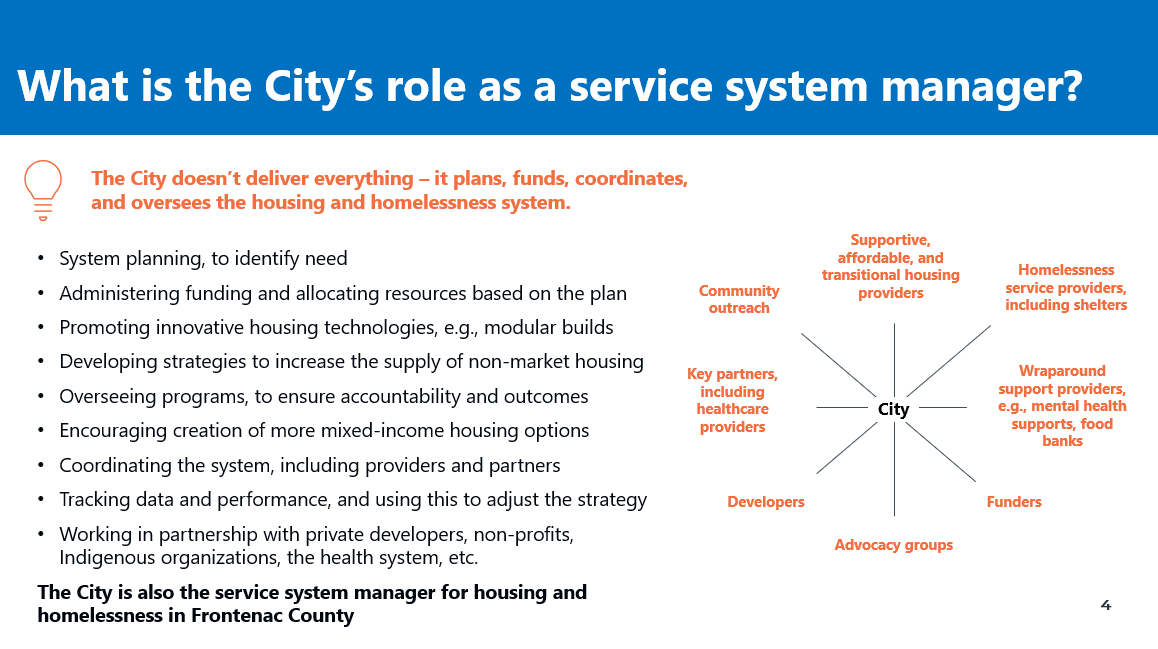
There is not a single central team that oversees all housing and homelessness work on a monthly basis. Instead, coordination happens through a network of cross-functional tables and working groups that focus on different parts of the system. The City of Kingston as the service system manager is responsible for overall system planning.
Within the Kingston service area, there are regular weekly and monthly working groups focused on specific areas such as encampment response, strategic growth, and affordable housing. These groups bring together City staff and community partners to coordinate operational work and problem-solve in real time.
In addition, the City participates in broader provincial and national tables and working groups to align local work with emerging best practices and funding frameworks. While there is no single centralized execution body, coordination is achieved through these interconnected structures working together on a regular basis.
How are you measuring the success of the plan? City directives, funded partners, etc. Moving folks from homeless to harm reduction to housing?
Performance measurements and targets will be developed through the 10-Year Plan update process. These metrics will be clearly defined and tied to the Plan’s goals and communicated publicly so the community can track progress over time in a transparent way. Performance measures are expected to include a combination of system-level outcomes such as changes in the number of people experiencing homelessness, access to housing, and housing stability over time, as well as outcomes achieved through City programs and funded partners.
We welcome feedback on how success should be measured in the updated Plan over the next 10 years.
The Township of South Frontenac is working on plans for building Social Housing in Verona. How will the selection process proceed? We have many homeless rural residents in Frontenac County.
The Verona project is being developed by the township of South Frontenac. The project is expected to include approximately 100 units, with about 80 designated as affordable housing units. The Township has identified seniors as the priority population based on the Township’s assessment of the current housing needs. Questions about the project, including tenant selection processes and eligibility, should be directed to the Township of South Frontenac.
As part of the housing and homelessness plan, will there be recommendations made concerning building non-student based affordable housing?
Yes –the 10-Year Plan review and update will address broader affordability and will guide local efforts to increase housing supply and affordability, prevent homelessness, improve system coordination, and strengthen supports for vulnerable residents across the City and in the County of Frontenac. As part of the 10-Year Plan review and update, the City is engaging with local post-secondary institutions about student housing needs. This helps ensure the Plan reflects the needs of the full community and supports a more balanced housing system.
One February 3, 2026, City Council directed staff to develop a Student Housing Strategy following the adoption of the new Official Plan which includes consideration of zoning tools, density permissions, and built-form guidelines specific to student housing; strategies to establish partnerships with institutions and the private sector to reduce pressure on the traditional rental market and enhance overall housing affordability; measures to support neighbourhood compatibility, safety, and infrastructure capacity; and alignment with the City’s broader housing, affordability, and climate objectives.
Will there be communications from the city to the public that dispel misconceptions of causes of homelessness or conflating some things, such as drug use with homelessness?
Public education and stigma reduction are part of the ongoing work that will continue.
The City and local service providers share information and resources to support a better understanding of the root causes of homelessness to help reduce stigma and correcting common misconceptions such as the assumption that homelessness is primarily cause by substance use.
One example is the Path Home Kingston campaigned by the United Way, which focuses on awareness and providing accurate data about homelessness and housing instability. The City regularly shares resources from community partners as they become available and will continue to support efforts to promote informed and compassionate understanding of homelessness and its complex causes.
We are seeing newly established encampments back at the Hub and Belle Park. After the city took such serious measures to close these down, why is this happening again?
As Service Manager, the City of Kingston funds and works alongside By-law and street outreach teams that actively monitor known encampments to help connect individuals to housing and support services. Outreach teams regularly check in on the status of individuals experiencing homelessness, including known encampments such as Belle Park, to encourage individuals to come inside to shelters where they can access support and service referrals.
Despite the ongoing work of City by-law and outreach teams and community partners, encampments can re-emerge over time due to ongoing pressures such as limited housing availability, barriers to accessing housing, and individual circumstances. The City continues to work with community partners on outreach teams, housing placements, and system coordination to reduce reliance on encampments while also ensuring people are supported with safety and dignity in the interim. To read more about the City manages camping in public spaces/ encampments visit: Homelessness Services | Camping in public spaces/encampments
On May 7, the City of Kingston and Beam Group hosted a webinar for residents of Kingston and Frontenac County to learn about the 10-year Housing and Homelessness Plan (10-Year Plan) review and update.
Presentation Overview
Beam Group and City staff from the Housing & Social Services Team presented on what the 10-Year housing and homelessness plan is, the accomplishments since the last update, the status of the current plan, the City’s role as Service Manager for the City of Kingston and the County of Frontenac, and how the plan will be developed. The slides are provided below and a recording of the full webinar is available here.
Questions
Following the presentation, attendees were invited to participate in a Q&A covering pre-submitted questions and emerging questions from the presentation. A summary of all questions and answers, including answers to questions that were taken back to gather more information, are available below the presentation slides.
Input
Attendees were invited to share their experiences of housing, describe what success will look like, and complete a polling exercise on housing priorities. Staff further encouraged residents to complete the brief survey (open until May 31) and drop-in to one of the open houses on May 20, 22 and 23 to provide their experiences and perspectives for the HHP review and update.
Presentation Summary


Q & A Summary
What is it? How do you decide? / What are your plans?
The 10-Year Municipal Housing and Homelessness Plan for the City of Kingston and County of Frontenac (the 10-Year Plan) is a locally developed strategy that guides how municipalities will address housing needs and homelessness over the next decade. It sets key goals, objectives, and measurable targets aimed at creating a more stable and coordinated housing system for all residents. The 10-Year Plan is reviewed and updated every five years to ensure it reflects changing community needs and priorities.
The review and update of the 10-Year Plan is being informed by extensive community engagement, including input from residents, service providers, community partners, city and county staff, elected officials and those individuals with lived and living experience of housing instability or homelessness.
The input will guide decisions and shape priorities of Council over the next 10 years, with a focus on increasing housing supply and affordability, preventing homelessness, improving system coordination, and strengthening supports for vulnerable residents in the City and in the County. This Plan will work alongside other municipal plans such as the Official Plan to support more efficient and coordinated housing development.
Is there a copy of the draft plan for citizens to review?
The current 10-Year Plan is available on the City of Kingston's website. Beam Group is supporting City staff with the review and update of the Plan, which will be brought before City Council in October 2026. A draft of the updated Plan will be presented to the Housing and Homelessness Advisory Committee at its September meeting prior to going to City Council.
How will it address the underlying causes of homelessness?
The updated 10-Year Plan is being informed by an environmental scan looking at current housing and homelessness trends, service gaps and emerging community needs, to inform the goals and objectives over the next 10 years.
The underlying causes of homelessness are complex and include factors such as lack of affordable and stable housing, mental health and substance use challenges, poverty and income instability. Addressing these issues requires coordinated action from many partners throughout the City and the County.
The City recognizes that stable housing plays a critical role in improving individuals' outcomes and reducing incidents of homelessness. The updated 10-Year Plan will focus on increasing housing options, improving coordination across systems, and strengthening supports to help address the factors that contribute to homelessness over time.
Could we get more rent geared to income housing using existing homes?
The Kingston-Frontenac service area currently exceeds the provincially required rent-geared-to-income (RGI) units with approximately 2,150 units available locally. However, demand continues to outpace supply, and wait times remain significant. Expanding RGI housing using existing homes can be challenging, as it depends on factors such as available funding, partnerships with housing providers, and the condition and suitability of units. As part of the 10-Year Plan review, the City is exploring a range of approaches to improve affordability across the housing system.
If expanding RGI housing is something residents feel the City should prioritize as service manager; the 10-Year Plan review is the opportunity to provide that feedback. Public input, alongside local data, needs assessments, and planning documents, will inform the updated 10-Year Plan to be approved by Council and guide housing and homelessness priorities across the system over the next 10 years
How do you ensure that planned housing complexes meet the needs of those in the lower price range? / What is the city's plan to address housing challenges for its lowest earning residents? / How will Kingston reduce the unhoused? How do you plan to allow people on the streets to transition to appropriate housing? What are the plans for outreach to homeless? / Interested in knowing the city's ideas on how best to deal with the lack of affordable housing and homelessness?
The 10-Year Plan review and update is a comprehensive approach to better understand and respond to the needs of residents across the housing continuum, particularly those with the lowest income; those experiences homelessness and housing precarity.
This includes looking at ways to improve affordability, increase appropriate housing options, strengthen supports, and enhance pathways from homelessness to stable housing.
Public input, alongside local data, needs assessments, planning documents and community feedback will inform the updated Plan. Importantly, individuals with lived and living experience are being engaged through focus groups and outreach with service providers to ensure their experiences and needs are included.
The final Plan will guide local housing and homelessness priorities, services and system coordination across the system over the next 10 years.
Will there be provisions for a medical designate (provincial and/or federal) to help the homeless in identifying dangerous drugs? / What about risk reduction to active users? Or support for active users of substances? / Does this review include the integration of a social medicine model?
Supporting people experiencing homelessness who are also dealing with substance use challenges requires coordination across housing, health care, and community services.
The City supports community-based harm reduction efforts and, through recent Council direction on May 5, has committed to a contribution of up to $350,000 to expand community-based harm reduction initiatives as the community transitions from the current Consumption and Treatment Services (CTS) site to a new HART (Homelessness and Addiction Recovery Treatment) Hub expected to open in October 2026.
Decisions related to clinical services, safe supply programs, and the operation of Consumption and Treatment Services sites are made by provincial and federal governments and fall outside the municipality’s role as Service Manager. The current CTS site also operates under federal exemptions that expire in October 2026.
The 10-Year Housing and Homelessness Plan focuses on the housing and support systems the municipality can influence, while continuing to work with health and community partners to improve outcomes for vulnerable residents.
Additionally, the 10-Year Plan update covers a wide range of services, some of which incorporate the principles of the social medicine model. Transitional and Supportive housing, harm reduction, and homelessness prevention/diversion are some examples. Feedback on further integration of the model is also welcomed during the review and update. Public input, along with local data and policy direction will help inform the updated Plan.
Will the city be informing residents before purchasing housing in residential areas before they actually purchase the property?
The City follows the requirements of the Municipal Act, 2001, and because property acquisitions often involve sensitive negotiations, they are typically conducted in closed session to protect taxpayers and the City’s bargaining position; as a result, advance notice is not possible. That said, the City is committed to transparency and will inform residents as soon as possible following the acquisition. Where any changes to zoning or property use are proposed, public notice and engagement requirements under the Planning Act will be followed.
At the Council meeting on February 3, 2026, City Council directed staff to review current public consultation and engagement practices related to new supportive and emergency housing solutions, with a specific focus on communications and engagement with near neighbours. Staff have been directed to bring forward recommendations to Council by July 2026 on improvements to these processes, including but not limited to consideration of the timing and methods of information sharing with near neighbours; the scale and format of engagement meetings; confirmation of the role of the site operators in these engagements, and the processes for receiving, responding to, and reporting back on community concerns.
Did you consult with senior citizens who are under housed?
Beam Group and city staff held a focus group with Housing Providers including those with senior mandates and will be meeting with the Older Adults and Belonging Table in May for an engagement session. Further a public survey is available on the City of Kingston’s Get Involved Kingston page, where residents of the City of Kingsotn and the County of Frontenac can share their thoughts, experiences and ideas. Responses from the survey will be used to inform revisions and updates to the Plan.
What are your current stats on the number of people unhoused in Kingston? What percentage of new buildings in Kingston are RGI?
As of March 2026, there were 572 active individuals experiencing homelessness in Kingston and the County of Frontenac on the By Name List (BNL), which tracks known individuals experiencing homelessness in real time. Individuals must consent to having their name added to the list, and there is a continuous effort by community partners to make those experiencing homelessness aware of the BNL. The BNL is updated monthly and shared to the Homelessness Registry By Name List | Open Data Kingston .
The province sets service level requirements with respect to the number of rent-geared-to-income (RGI) units a service manager area is required to maintain. In Kingston & Frontenac County 2,003 RGI units are the service level requirement however recent investment in rent subsidy programs have increased the RGI supply to approximately 2,150 units. Check Open Data Kingston and follow reports to the Housing and Homelessness Advisory Committee for up-to-date data.
Have you spoken with the homeless population in the city about their needs?
Hearing directly from people with lived and living experience of homelessness or housing precarity is an important part of updating the 10-Year Plan.
Beam Group and city staff have two planned engagement sessions with people with lived and living experience of homelessness – one focuses on you and one with adults. These engagement sessions will provide an opportunity to hear their perspectives, experiences, needs, and ideas that will inform the updated 10-Year Plan.
People with lived or living experience of homelessness are valued members of our community, and their input is critical in shaping a plan that reflects real experiences and priorities over the next 10 years.
In addition to these engagement sessions, input is also gathered through outreach and engagement with service providers who work closely with individuals experiencing homelessness.
Is there a plan for more affordable senior housing?
Yes—expanding affordable housing options for seniors is an important priority. The City recognizes that an aging population, fixed incomes, and increasing housing costs are creating real pressures for older adults across the City of Kingston and throughout the County of Frontenac. While there is not a standalone “seniors housing strategy,” housing needs for seniors, it is part of the broader 10-Year Plan, with a focus on increasing supply, improving accessibility, and supporting seniors to age in place.
It is important to note that the City does not build housing on its own. Progress depends on strong partnerships with the province, the federal government, the non-profit sector, and the private sector, as well as access to sustainable funding programs.
Will the review cover all housing sectors or just be limited to the City's housing under KFHC?
The review and update of the 10-Year Plan will cover housing across the full housing continuum including encampments and emergency responses, shelters, transitional housing, supportive housing, affordable rental housing and pathways into homeownership.
This includes a variety of sectors such as non-profit and cooperative housing, new builds with private developers, and programs that provide financial assistance to households to support housing affordability.
The 10-Year Plan applies across the City of Kingston and the County of Frontenac service area; it is not limited to housing operated through the Kingston & Frontenac Housing Corporation (KFHC).
Can the city buy homes to make public social housing & retrofit them for accessibility & multiunit?
This is one possible approach that could be considered as part of the updated 10-Year Plan. Since the last update in 2019, new properties have been purchased and retrofitted to create accessible units. Each opportunity depends on factors such as property availability, cost, zoning requirements, retrofit feasibility, and funding partnerships with the province, the federal government, housing providers, and the private sector. The updated 10-Year Plan will support decisions on approaches that are most effective to meet community housing needs.
Will there be any overnight warming centers created for next winter?
Overnight warming centres and daytime cooling centres open during provincially declared extreme weather events. The City of Kingston has a Winter Response Plan and is developing an Extreme Heat Response Plan to help guide staff decisions during extreme weather events and ensure people have access to safe spaces when needed.
Feedback on these services is welcomed and will be considered alongside provincial guidelines, local data, best practices, available resources, and other relevant information as part of the Plan update. Decisions about future overnight warming and daytime cooling centres will continue to be informed by community needs, weather conditions and operational considerations
Will there be tiny homes in the future for public housing?
Tiny homes represent one possible approach to increasing housing options. The 10-Year Plan is focused on high-level planning priorities to guide decisions on future housing and homelessness services, rather than specific projects. Through the survey and engagement activities, residents are being asked to share their views and priorities on the types of housing they would like to see in the community. This input will help inform the updated 10-Year Plan and future decisions made in Kingsotn and Frontenac County.
Is social public housing part of the spectrum? / How many people are currently on the waitlist for affordable housing or social housing
Yes –Social and public housing are part of the housing continuum, as outlined in the webinar presentation materials and are included in the update of the 10-Year Plan.
There are currently approximately 1500 households on the social housing waitlist in the Kingston and Frontenac service area. The local Homelessness By-Name-List and social housing waitlist are available via Open data Kingston. Data is also reported to the Housing & Homelessness Advisory Committee who meets quarterly. For the most up to date figures residents can access the Social Housing Registry Program - Centralized Waitlist | Open Data Kingston
What is considered “Affordable Housing”?
Affordable housing generally refers to housing that costs no more than 30% of a household's gross income - a commonly used benchmark for housing affordability. Affordable housing can include a range of options, such as rent-geared-to-income housing, below market rental units, and rent supplements, as well as supportive housing with additional wrap-around supports. Definitions can vary depending on the program or funding source which is why the 10-Year Plan will include a glossary to clearly outline and explain the various housing terms to help reduce confusion.
How many of the new housing projects, shelters and supportive housing is mixed male and female and how many are only for women? Women do not feel safe in mixed housing especially if they are survivors of violence.
A new women's shelter opened in November 2025 operated by Dawn House, adding 20 beds to the shelter system. In addition, one of the three new supportive housing properties that opened recently is dedicated for women while two are for males.
The City supports the operation of co-ed emergency shelters, while continuing to work with community partners to ensure a range of housing options are available for people with differing needs.
Also, in recent years Dawn House opened 30 spaces for women alongside existing women-specific facilities in the community, including those operated by Kingston Interval House, Dawn House, and the Elizabeth Fry Society.
Ensuring people have access to safe and appropriate spaces remains an important consideration in the updated 10-Year Plan.
Is information being gathered from people who become homeless about how they became homeless? Such as they asked if they are renters & the rent increased too much, did they lose their job and couldn't afford their mortgage/rent, did a landlord evict them and what was the reason? Are there trends and are they being tracked and reported? for example, are people also being left out of housing options because of racism of landlords? / How is the plan targeting those who are most vulnerable?
Through the 10-Year Plan review, focus groups are being held with individuals experiencing homelessness across different demographics. Where participants feel comfortable, engagement includes discussion about the circumstances that led to their homelessness, such as housing loss, income changes, or barriers within the housing system. The City is also engaging housing and homelessness service providers and using available data sources to better understand trends, patterns in homelessness, and the experiences of navigating the system. This information helps to identify patterns and inform prevention strategies. A key focus of the 10-Year Plan update is to better respond to those most vulnerable by providing access to support, strengthening prevention and diversion efforts, and enhancing pathways to stable housing.
What is the demographic in Kingston and Frontenac that no one is serving as yet? Is City funding available if a non-profit wishes to create new housing for that demographic?
As Service Manager, the City of Kingston works to ensure services are available to meet the diverse needs of the community. The 10-Year Plan review and update provides the opportunity to hear from the community and reflect on local data to better understand if there are groups that may be underserved. Municipal funding is available for new projects through the Affordable Housing Capital Investment Program, which provides capital funding assistance to private and non-profit housing providers who commit to including affordable housing units in a project. Additional funding opportunities are available through provincial and federal programs, such as the National Housing Strategy and the Ontario Priorities Housing Initiative.
Given that Kingston rental rates are considered higher than other cities of our size, how is it possible to find " affordable housing"?
The City recognizes that rental rates in Kingston are high, and that demand for affordable housing currently exceeds supply, which can result in long wait times for affordable housing. The City manages the centralized waitlist for social housing and continues to work with partners to expand the supply of affordable housing options. “Affordable housing” can take different forms, including rent-geared-to-income units, rent supplements, and below-market rental units supported through government programs. The City also maintains an up-to-date affordable housing listing online for residents: Affordable Housing Programs | City of Kingston
Its wonderful that you are engaging with all key support groups however is there one central cross-functional team that all work together with the execution on a regular/monthly basis?
There is not a single central team that oversees all housing and homelessness work on a monthly basis. Instead, coordination happens through a network of cross-functional tables and working groups that focus on different parts of the system. The City of Kingston as the service system manager is responsible for overall system planning.
Within the Kingston service area, there are regular weekly and monthly working groups focused on specific areas such as encampment response, strategic growth, and affordable housing. These groups bring together City staff and community partners to coordinate operational work and problem-solve in real time.
In addition, the City participates in broader provincial and national tables and working groups to align local work with emerging best practices and funding frameworks. While there is no single centralized execution body, coordination is achieved through these interconnected structures working together on a regular basis.
How are you measuring the success of the plan? City directives, funded partners, etc. Moving folks from homeless to harm reduction to housing?
Performance measurements and targets will be developed through the 10-Year Plan update process. These metrics will be clearly defined and tied to the Plan’s goals and communicated publicly so the community can track progress over time in a transparent way. Performance measures are expected to include a combination of system-level outcomes such as changes in the number of people experiencing homelessness, access to housing, and housing stability over time, as well as outcomes achieved through City programs and funded partners.
We welcome feedback on how success should be measured in the updated Plan over the next 10 years.
The Township of South Frontenac is working on plans for building Social Housing in Verona. How will the selection process proceed? We have many homeless rural residents in Frontenac County.
The Verona project is being developed by the township of South Frontenac. The project is expected to include approximately 100 units, with about 80 designated as affordable housing units. The Township has identified seniors as the priority population based on the Township’s assessment of the current housing needs. Questions about the project, including tenant selection processes and eligibility, should be directed to the Township of South Frontenac.
As part of the housing and homelessness plan, will there be recommendations made concerning building non-student based affordable housing?
Yes –the 10-Year Plan review and update will address broader affordability and will guide local efforts to increase housing supply and affordability, prevent homelessness, improve system coordination, and strengthen supports for vulnerable residents across the City and in the County of Frontenac. As part of the 10-Year Plan review and update, the City is engaging with local post-secondary institutions about student housing needs. This helps ensure the Plan reflects the needs of the full community and supports a more balanced housing system.
One February 3, 2026, City Council directed staff to develop a Student Housing Strategy following the adoption of the new Official Plan which includes consideration of zoning tools, density permissions, and built-form guidelines specific to student housing; strategies to establish partnerships with institutions and the private sector to reduce pressure on the traditional rental market and enhance overall housing affordability; measures to support neighbourhood compatibility, safety, and infrastructure capacity; and alignment with the City’s broader housing, affordability, and climate objectives.
Will there be communications from the city to the public that dispel misconceptions of causes of homelessness or conflating some things, such as drug use with homelessness?
Public education and stigma reduction are part of the ongoing work that will continue.
The City and local service providers share information and resources to support a better understanding of the root causes of homelessness to help reduce stigma and correcting common misconceptions such as the assumption that homelessness is primarily cause by substance use.
One example is the Path Home Kingston campaigned by the United Way, which focuses on awareness and providing accurate data about homelessness and housing instability. The City regularly shares resources from community partners as they become available and will continue to support efforts to promote informed and compassionate understanding of homelessness and its complex causes.
We are seeing newly established encampments back at the Hub and Belle Park. After the city took such serious measures to close these down, why is this happening again?
As Service Manager, the City of Kingston funds and works alongside By-law and street outreach teams that actively monitor known encampments to help connect individuals to housing and support services. Outreach teams regularly check in on the status of individuals experiencing homelessness, including known encampments such as Belle Park, to encourage individuals to come inside to shelters where they can access support and service referrals.
Despite the ongoing work of City by-law and outreach teams and community partners, encampments can re-emerge over time due to ongoing pressures such as limited housing availability, barriers to accessing housing, and individual circumstances. The City continues to work with community partners on outreach teams, housing placements, and system coordination to reduce reliance on encampments while also ensuring people are supported with safety and dignity in the interim. To read more about the City manages camping in public spaces/ encampments visit: Homelessness Services | Camping in public spaces/encampments
-
Public Survey & Open Houses for 10-Year Housing & Homelessness Plan Review & Update
Help shape the future of housing and homelessness services in Kingston and Frontenac County!
Today, the City of Kingston is opening the community survey to provide insights for the 10-Year Housing & Homelessness Plan Review & Update and sharing dates for Open Houses in May.
- Complete the brief survey until May 31, 2026: Public Survey
-
Drop-in to share insights at one of the three Open Houses
- Wednesday May 20, 4 p.m. - 8 p.m. @ the INVISTA Centre
- Friday May 22, 2 p.m. - 6 p.m. @ the Rideau Heights Community Centre
- Saturday May 23, 11a.m. - 3 p.m. @ the Kingston East Community Centre
Additional focus groups throughout the month of May will engage people with lived and living experience, Indigenous partners, service providers and community partners to ensure theses valued perspectives are included.
Public feedback, recent population and housing forecasts, the 2023 Housing Needs Assessment, Centralized Waiting List and By Name List data, Homeless Individuals and Families Information System and municipal planning documents will contribute to the review and update.
Register for the webinar on May 7 and subscribe to this Get Involved Kingston page for everything you need to know and ongoing updates.
Help shape the future of housing and homelessness services in Kingston and Frontenac County!
Today, the City of Kingston is opening the community survey to provide insights for the 10-Year Housing & Homelessness Plan Review & Update and sharing dates for Open Houses in May.
- Complete the brief survey until May 31, 2026: Public Survey
-
Drop-in to share insights at one of the three Open Houses
- Wednesday May 20, 4 p.m. - 8 p.m. @ the INVISTA Centre
- Friday May 22, 2 p.m. - 6 p.m. @ the Rideau Heights Community Centre
- Saturday May 23, 11a.m. - 3 p.m. @ the Kingston East Community Centre
Additional focus groups throughout the month of May will engage people with lived and living experience, Indigenous partners, service providers and community partners to ensure theses valued perspectives are included.
Public feedback, recent population and housing forecasts, the 2023 Housing Needs Assessment, Centralized Waiting List and By Name List data, Homeless Individuals and Families Information System and municipal planning documents will contribute to the review and update.
Register for the webinar on May 7 and subscribe to this Get Involved Kingston page for everything you need to know and ongoing updates.
-
News release: Community input to guide City of Kingston’s 10-Year Housing and Homelessness Plan
Learning directly from residents with diverse experiences is at the core of the City’s work to review and update the 10-Year Municipal Housing & Homelessness Plan for the City of Kingston and County of Frontenac.
The plan guides how housing and homelessness services are delivered locally and coordinated across the system.
The review, now underway, will help identify current needs, gaps and priorities to inform the updated plan and influence future decision-making.
Kingston-Frontenac residents can participate in several ways:
• A survey, open from April 29 through May 31, provides an opportunity to share insights on current challenges and areas for improvement, successful services, housing types and top community priorities.
• Open houses are scheduled for May 2026, with more details to come on Get Involved Kingston.
• Targeted focus groups will engage people with lived and living experience, Indigenous partners, service providers and community partners to ensure their perspectives are included.
Beam Group will facilitate the community review process and program evaluation.
We encourage residents to register for a webinar on Thursday, May 7 at 6 p.m. to learn more about the process and how community input will influence the updated plan.
Please subscribe to the project page for updates on how to get involved and to stay informed about key dates and milestones .
Learning directly from residents with diverse experiences is at the core of the City’s work to review and update the 10-Year Municipal Housing & Homelessness Plan for the City of Kingston and County of Frontenac.
The plan guides how housing and homelessness services are delivered locally and coordinated across the system.
The review, now underway, will help identify current needs, gaps and priorities to inform the updated plan and influence future decision-making.
Kingston-Frontenac residents can participate in several ways:
• A survey, open from April 29 through May 31, provides an opportunity to share insights on current challenges and areas for improvement, successful services, housing types and top community priorities.
• Open houses are scheduled for May 2026, with more details to come on Get Involved Kingston.
• Targeted focus groups will engage people with lived and living experience, Indigenous partners, service providers and community partners to ensure their perspectives are included.
Beam Group will facilitate the community review process and program evaluation.
We encourage residents to register for a webinar on Thursday, May 7 at 6 p.m. to learn more about the process and how community input will influence the updated plan.
Please subscribe to the project page for updates on how to get involved and to stay informed about key dates and milestones .
-
Project plan milestones
Project Plan
-
Phase A: Current State Assessment and Environmental Scan
- Drafting of Background Report
-
Phase B: Stakeholder Engagement
- Community Survey available online April 29 to May 31, 2026
- Focus-groups hosted by Beam Group
- Community Open Houses in May
-
Phase C: Objectives, Strategies and Plan Development
- Draft Plan presented to HHAC committee
- Plan presented to Kingston City Council
Project Plan
-
Phase A: Current State Assessment and Environmental Scan
- Drafting of Background Report
-
Phase B: Stakeholder Engagement
- Community Survey available online April 29 to May 31, 2026
- Focus-groups hosted by Beam Group
- Community Open Houses in May
-
Phase C: Objectives, Strategies and Plan Development
- Draft Plan presented to HHAC committee
- Plan presented to Kingston City Council
-
Phase A: Current State Assessment and Environmental Scan
Follow Project
Who's listening
-
Manager, Affordable Housing
-
Manager, Homelessness Services
-
Housing Programs Administrator
-
Service Area
-
Consulting Services
Key dates
-
April 29 → May 31 2026
-
May 07 2026
-
May 20 2026
-
May 22 2026
How we are engaging
We use the IAP2 Spectrum of Public Participation to let you know how feedback on a project will be used. Here's how we are seeking and using your feedback on this project.
Inform: We will keep you informed by providing balanced and objective information to assist you in understanding the problem, alternatives, opportunities and/or solutions.
Consult: We will keep you informed, listen to and acknowledge concerns and aspirations, and provide feedback on how public input influenced the decision.
Involve: We will work with you to ensure that your concerns and aspirations are considered and evaluated and provide feedback on how public input influenced the decision.
Project timeline
-
Current State Assessment and Environmental Scan
10-year Housing and Homelessness Plan Review and Update has finished this stageDocumentation of system capacity, trends, and gaps.
-
Community Engagement
10-year Housing and Homelessness Plan Review and Update has finished this stageIncluding but not limited to consultation with service providers, community partners, Indigenous organizations, people with lived and living experience, elected officials, business owners and the public
-
Development of updated objectives, strategies, and performance measures
10-year Housing and Homelessness Plan Review and Update is currently at this stage -
Draft Plan
this is an upcoming stage for 10-year Housing and Homelessness Plan Review and UpdateTo be reviewed by the Housing and Homelessness Advisory Committee and submitted to the Ministry of Municipal Affairs and Housing for provincial review.
-
Final Plan
this is an upcoming stage for 10-year Housing and Homelessness Plan Review and UpdatePresentation to Council.
Links
Notice of Collection
All information received will be compiled and considered by staff for use under the purposes of this site. Information will be collected and used in accordance with the Municipal Freedom of Information and Protection of Privacy Act and other relevant privacy legislation. All comments made on this site are available to the public and may form part of public records.