Why we engaged
The City of Kingston is developing a Micromobility Regulations Strategy to regulate new and existing forms of micromobility in the City and to support the ongoing work of the Integrated Mobility Plan. A key objective of the strategy is to establish clear and consistent rules that support the safe use of streets, paths, trails and sidewalks for people of all ages and abilities.
As part of the engagement phase for the strategy, a micromobility regulations public survey was developed to understand the community’s vision for how micromobility can be regulated to support safe, accessible, and sustainable travel throughout Kingston.
How we engaged
The Micromobility Regulations survey was open from April 9 until May 21, 2026 and had a total of 263 respondents. The survey featured a combination of Likert questions, checkbox questions and open-ended questions to provide residents with a variety of ways to provide feedback.
The survey included images and descriptions for each type of cycling and riding facility, device, and pilot program to ensure survey participants had enough background information to answer the questions.
The survey was divided into the following sections:
- Your experience with micromobility
- Municipal Regulations for Micromobility
- Provincial Pilot Programs
Next steps
The feedback collected as part of this engagement will be used by City staff to help inform the future regulations.
Staff anticipate bringing a report to the Environment, Infrastructure and Transportation Policies Committee in the coming months, including draft regulations and implementation recommendations, at which point Council will have the opportunity to consider next steps.
Pathway etiquette and safety reminders
- Keep to the right and pass on the left.
- Use a bell to alert others on shared-use pathways when overtaking and passing.
- Keep a safe distance from pedestrians and other micromobility users in shared spaces.
- Yield to pedestrians on shared-use pathways.
- Reduce your speed near pedestrians and in designated slow-down zones.
- Never operate a micromobility device under the influence of drugs or alcohol. It is illegal.
- Improper or illegal operation may be subject to fines and penalties
What we heard
Summary of survey results, question by question.
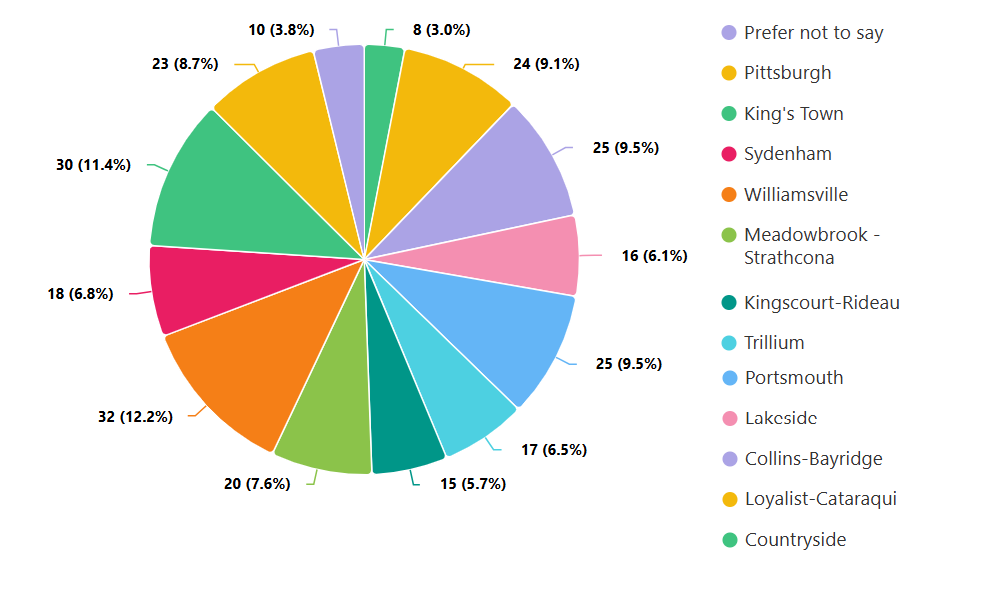
Which City of Kingston electoral district (ward) do you live in?
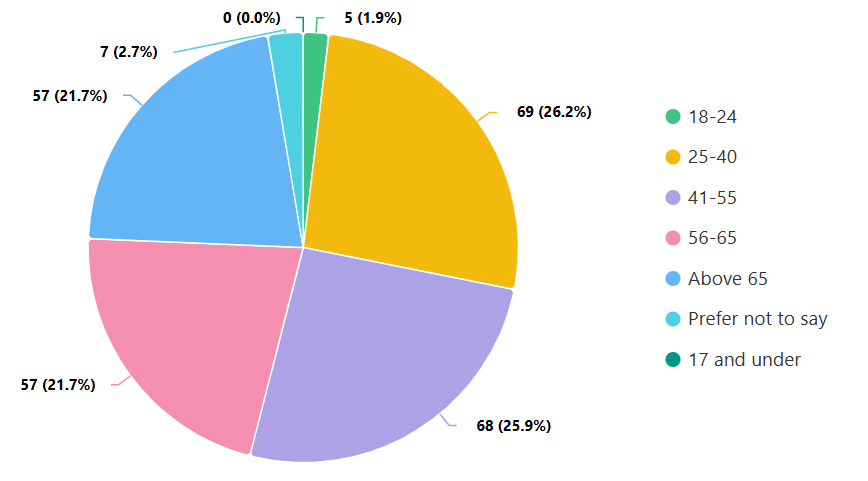
 Please select your age range.
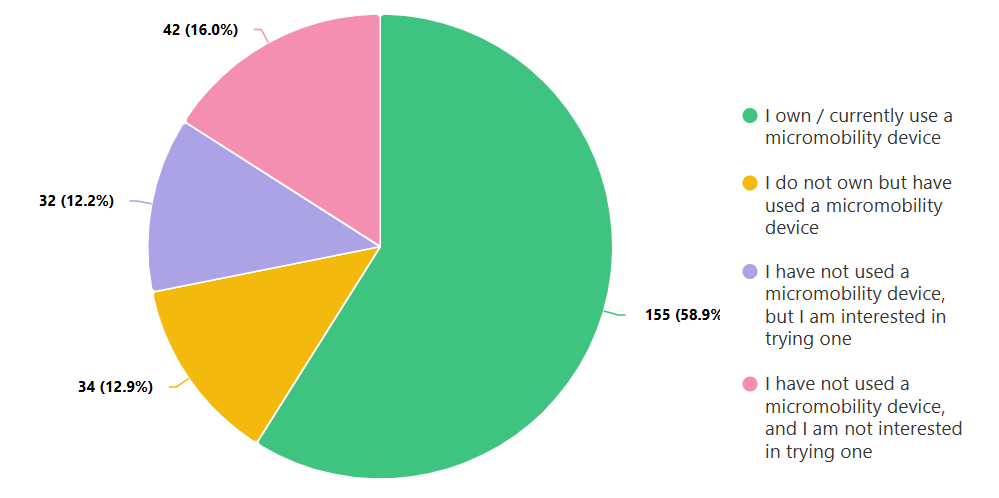
Select what option best describes your experience with micromobility to date?
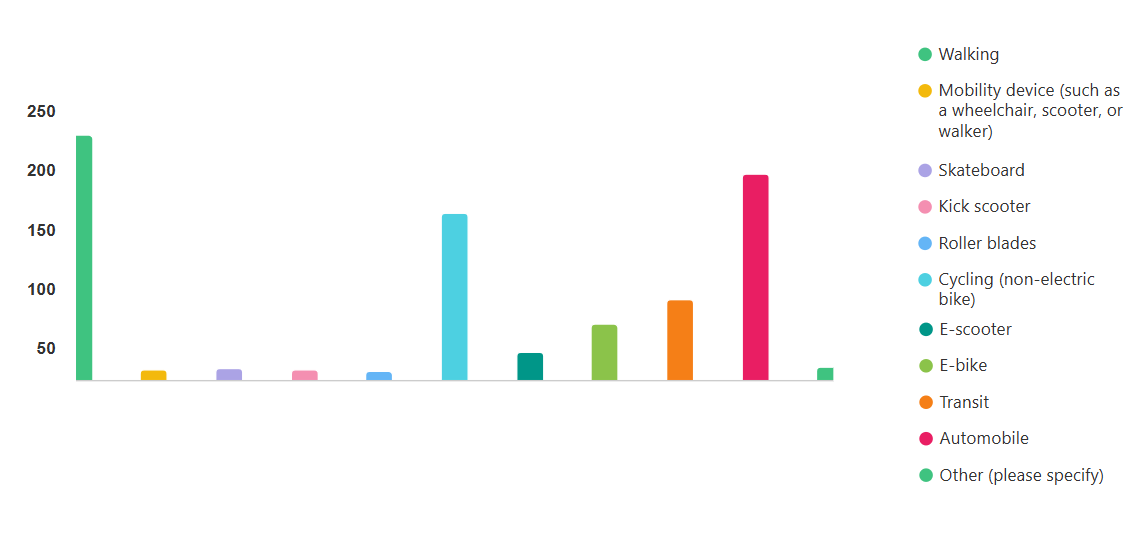
Which of the following travel options do you typically use for short trips in Kingston (under 5 km)? (Select all that apply.)
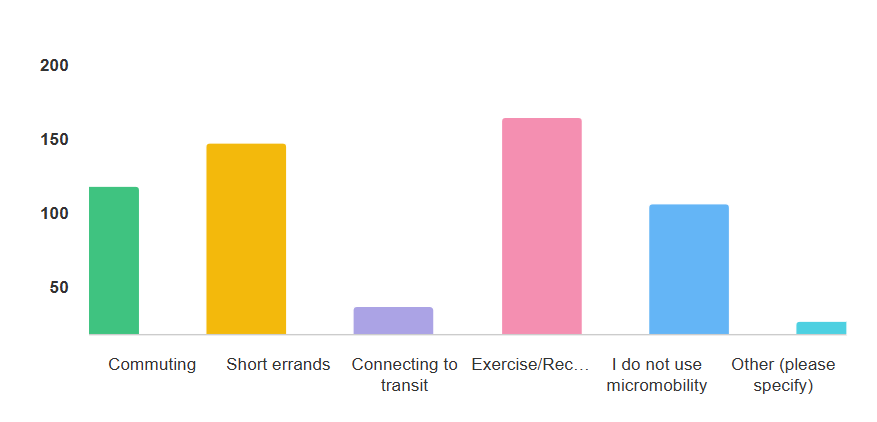
 For what purposes do you currently use micromobility devices to travel? (Select all that apply.)
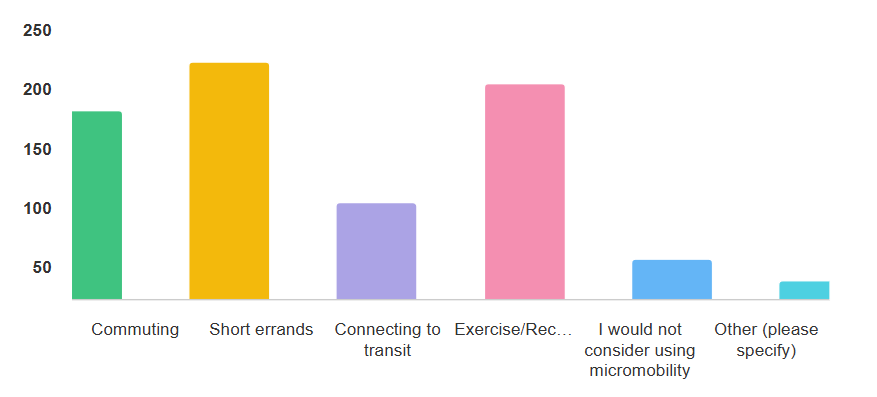
Looking ahead, how would you consider using micromobility in the future, if the conditions were right? (Select all that apply.)
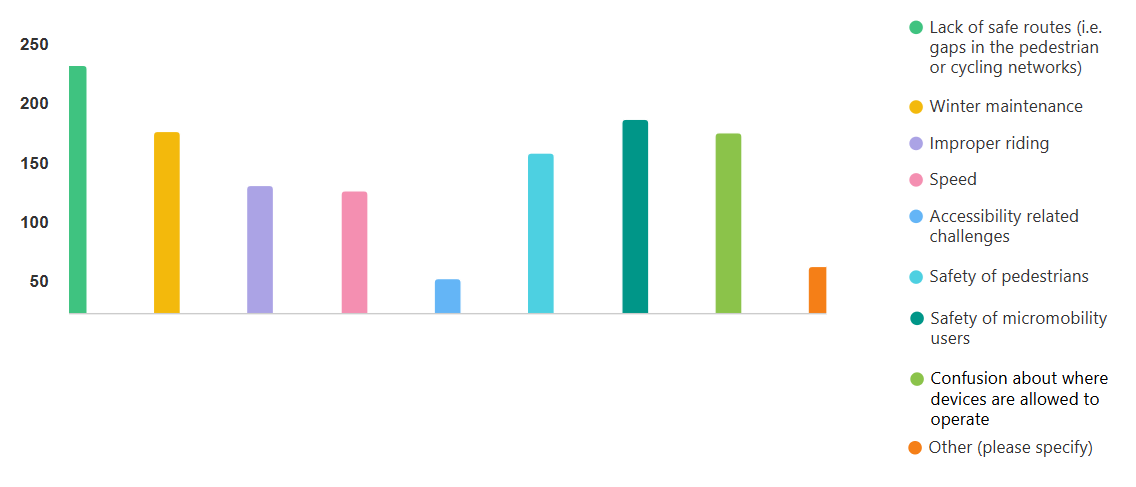
 What potential issues/barriers do you think are most important to consider when regulating micromobility in Kingston? (Select all that apply).
Let us know where you think e-bikes that resemble a traditional bicycle can operate safely and comfortably for both riders and other users by selecting yes, no, or unsure for each option.
| Question Options | Yes | No | Unsure |
On-road
| 202 | 43 | 17 |
| Bike lanes | 238 | 17 | 7 |
| Cycle tracks | 218 | 27 | 16 |
| In-boulevard multi-use paths (located next to the road) | 205 | 36 | 21 |
| Off-road trails and within parks (ex K&P Trail) | 179 | 56 | 27 |
For the municipal regulations and e-bike permissions section, respondents generally supported allowing e-bikes that resemble traditional bicycles on most cycling facilities, with the strongest support for bike lanes, cycle tracks, and on-road use.
Let us know where you think moped-style e-bikes (up to 120 kg) can operate safely and comfortably for both riders and other users by selecting yes, no, or unsure for each option.
| Question Options | Yes | No | Unsure |
On-road
| 226 | 24 | 13 |
| Bike lanes | 105 | 133 | 24 |
| Cycle tracks | 64 | 163 | 31 |
| In-boulevard multi-use paths (located next to the road) | 66 | 160 | 33 |
| Off-road trails and within parks (ex K&P Trail) | 39 | 195 | 24 |
For moped-style (or motor-scooter style) e-bikes, respondents generally supported allowing them to operate on roads, but expressed concerns about their use in bike lanes, cycle tracks, multi-use pathways, and off-road trails, where most respondents had concerns that these heavier devices could not operate safely and comfortably alongside other users.
Bike share programs allow the public to rent bikes or e-bikes for use at various locations across the City. Looking ahead, would you use a public bike share or e-bike share program if it were available in Kingston?
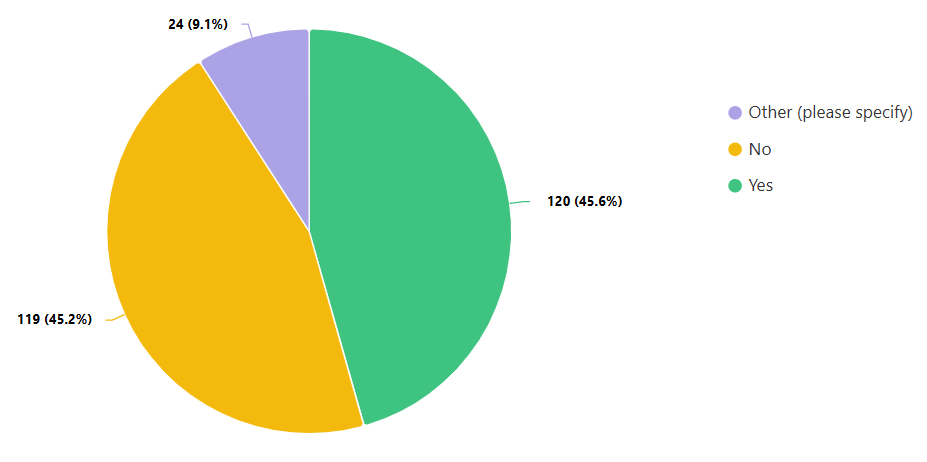
When respondents were asked if they would use a public bike share or e-bike share program if it were available in Kingston in the future, 45.6% answered yes and 45.2% answered no. The remaining 9.1% answered other, mainly noting that it would depend on cost, location, and connectivity with transit.
How much do you support or oppose the City of Kingston opting-in to the E‑Scooter Pilot Program for personally owned e‑scooters?
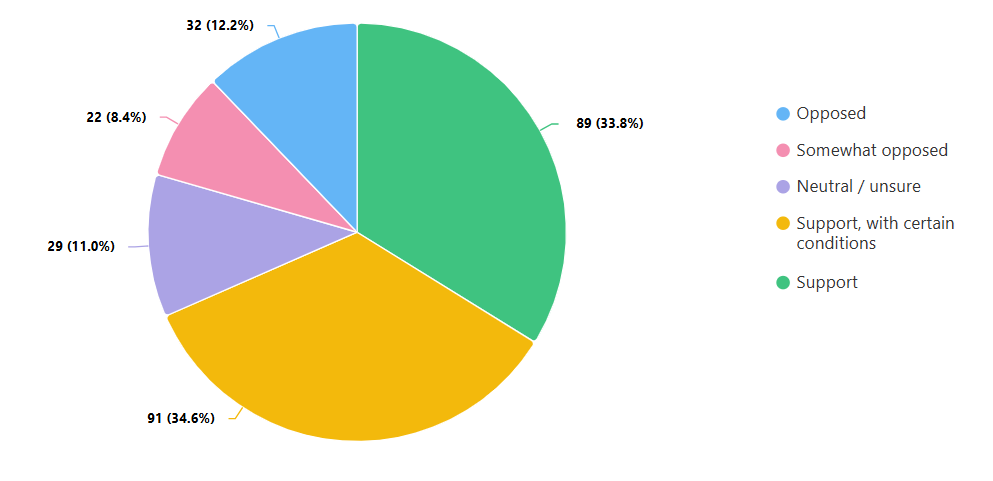
Regarding the provincial pilot program section, respondents were asked about e-scooters and cargo e-bikes. For the e-scooter pilot program, 68% of respondents supported the City opting-in to Ontario’s E-Scooter Pilot Program for personally owned e-scooters, half of whom expressed support only with certain conditions in place, while 21% were opposed and 11% were neutral or unsure.
Please explain why you selected the option you did in the previous question.
Key themes included:
- Overall support was strong (approximately 68%), with respondents generally viewing e-scooters as a valuable mobility option, while also expressing concerns about safety, rider behaviour, underage riding, and enforcement.
- Supporters highlighted e-scooters as an affordable, practical, and low-emission transportation option to get around.
- Supporters with conditions emphasized the importance of clear rules, enforcement, and safety measures, including mandatory helmets, requirements on speed, riding permissions, and education.
- Neutral/unsure respondents most often cited unfamiliarity with the pilot program's details rather than a specific concern about e-scooters.
- Somewhat opposed respondents generally based their view on firsthand observations of unsafe riding while noting that stronger regulation and enforcement could address many of their concerns.
- Those opposed highlighted safety concerns including sidewalk riding, lack of helmet use, underage riders, excessive speeds, and lack of enforcement.
If the City of Kingston opts-in to the E-scooter Pilot Program for personally owned scooters, where do you think e‑scooters can operate safely and comfortably for both riders and other users? Let us know by selecting yes, no, or unsure for each option.
| Question Options | Yes | No | Unsure |
| Bike lanes | 202 | 30 | 29 |
| Cycle tracks | 176 | 53 | 32 |
| In-boulevard multi-use paths (located next to the road) | 185 | 46 | 32 |
| Off-road trails and within parks (ex K&P Trail) | 114 | 106 | 40 |
| On roads with speed limit of 5 km/h or lower | 147 | 78 | 37 |
For e-scooter operating permissions, respondents generally supported permitting personally owned e-scooters in bike lanes, in-boulevard multi-use paths, and cycle tracks, while support was more mixed for roads with posted speed limits of 50 km/h or lower and off-road trails and parks.
E-scooter share programs allow the public to rent e-scooters at various locations across the City. Looking ahead, would you use an e-scooter share program if it were available in Kingston?
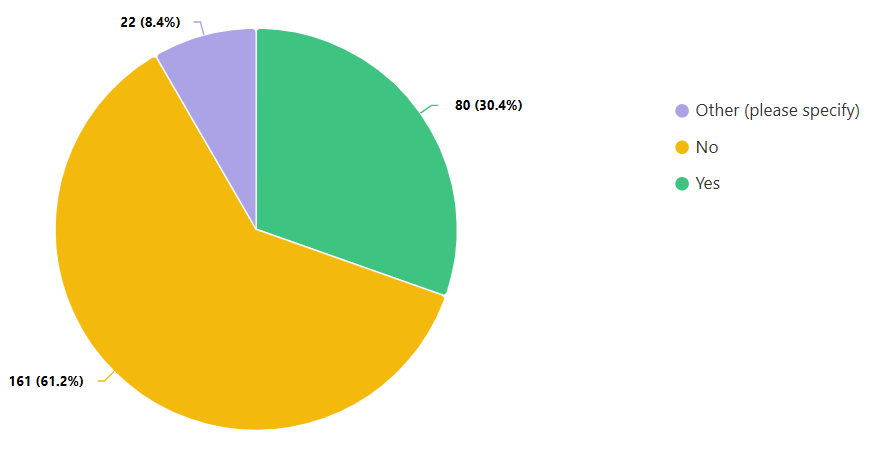
When respondents were asked if they would use an e-scooter share program if it were available in Kingston in the future, 61.4% responded no and 30.4% responded yes. The remaining 8.4% of respondents responded other, noting factors such as cost, convenience, the need for clear rules as determining factors.
How much do you support or oppose the City of Kingston opting-in to the Cargo E‑Bike Pilot Program?
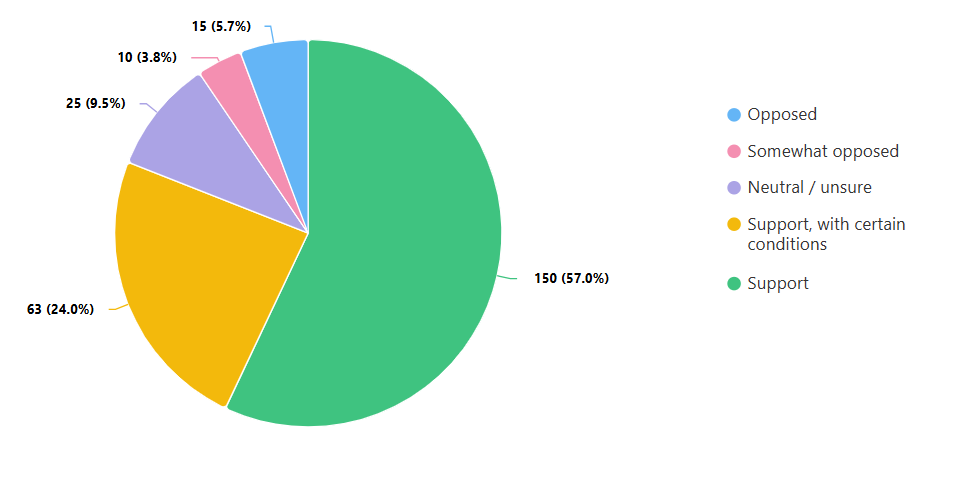
Support for the City opting into the Cargo E‑Bike Pilot Program was strong, with 81% of respondents expressing support overall, 24% of whom expressing support only with certain conditions in place, while approximately 10% were opposed and 10% were neutral or unsure.
Please explain why you selected the option you did in the previous question.
Key themes included:
- Strong overall support, driven by the potential to reduce car dependence, congestion, and emissions while expanding transportation options.
- Supporters stated cargo e-bikes are an environmentally friendly, practical alternative to cars and delivery trucks for errands, family transportation, and last-mile deliveries.
- Supporters with conditions stated support depends on clear rules, safe operating practices, licensing/training requirements, and enforcement.
- Neutral/unsure respondents stated they need more information and expressed uncertainty about where cargo e-bikes fit within Kingston's transportation network.
- Somewhat opposed respondents stated concerns about road space, congestion, infrastructure limitations, and the ability of cargo e-bikes to safely operate alongside other road users.
- Opposed respondents stated cargo e-bikes could create safety risks, traffic conflicts, and enforcement challenges, particularly if not properly regulated.
If the City of Kingston opts-in to the Cargo E-Bike Pilot Program, where do you think Cargo E-Bikes can operate safely and comfortably for both riders and other users? Let us know by selecting yes, no, or unsure for each option.
| Question Options | Yes | No | Unsure |
On-road
| 189 | 36 | 35 |
| Bike lanes | 163 | 73 | 27 |
| Cycle tracks | 114 | 106 | 41 |
| In-boulevard multi-use paths (located next to the road) | 134 | 94 | 32 |
| Off-road trails and within parks (ex K&P Trail) | 71 | 150 | 40 |
For cargo e-bike operating permissions, respondents generally supported cargo e-bikes operating on roads, bike lanes and in-boulevard multi-use paths, while responses were more divided for cycle tracks. Respondents expressed the greatest concern about cargo e-bikes operating on off-road trails and within parks, where most respondents did not feel they could operate safely and comfortably alongside other users.
Do you have any additional feedback or comments that you would like to share about micromobility?
Key themes included:
- Overall, the most common theme was the desire for a more connected, fully separated cycling and micromobility network, particularly along major transportation corridors.
- Safety and enforcement were recurring concerns, particularly around speeding, sidewalk riding, underage users, helmet use, and compliance with existing rules.
- Many respondents emphasized the need for education and clear rules for what devices are allowed and where they can operate.
- Respondents frequently noted that micromobility is already widely used and growing, with many viewing it as an important transportation option due to affordability, sustainability, and changing travel needs.
- Several respondents highlighted potential conflicts that can exist between micromobility users, pedestrians, and vehicles.
- While many supported expanding mobility options, some expressed concerns over existing road conditions, winter maintenance, and the impact on vehicle traffic.